
AdvanSix’s Ammonia Ambitions: Grant-Fueled Expansion Meets Regulatory and Financial Headwinds
A $47.4 million USDA grant positions AdvanSix to expand ammonia production, but recent losses and regulatory risks test the durability of its business model as environmental and trade pressures reshape the chemical manufacturing landscape.
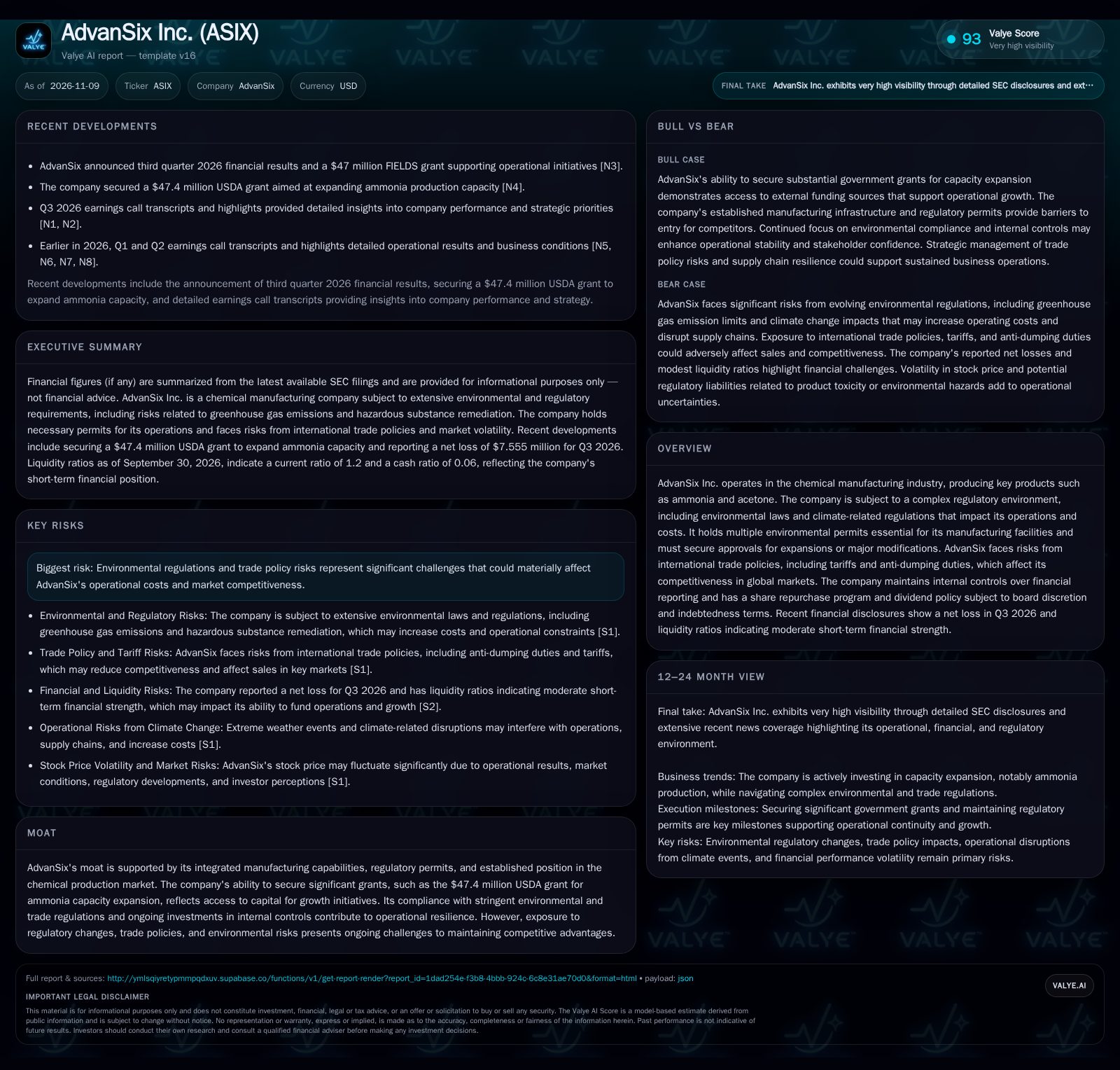
AdvanSix secured a $47.4 million USDA grant to expand ammonia production, signaling public-sector support for capacity growth. However, a Q3 2026 net loss and reported liquidity position highlight financial vulnerability amid a landscape of tightening environmental and trade regulations. The company’s ability to convert new capacity into profitable, resilient operations will depend on cost discipline, regulatory navigation, and end-market demand.[N3] [N4] [S2]
AdvanSix’s latest quarter crystallizes both opportunity and challenge for the U.S. chemical manufacturer. The company’s $47.4 million USDA grant to expand ammonia production underscores its strategic relevance to domestic supply chains and the energy transition. As environmental and trade policies become more complex and volatile, AdvanSix’s ability to translate new capacity into durable margins will ultimately determine whether recent investments yield sustainable value or amplify existing vulnerabilities.
Grant-Driven Expansion Amid Financial Strain and Regulatory Complexity
AdvanSix’s receipt of a $47.4 million USDA grant to boost ammonia production capacity marks a pivotal moment, providing non-dilutive capital for strategic growth and signaling government endorsement of its role in the U.S. chemical value chain.[N4] Simultaneously, the company reported a net loss of $7.555 million in Q3 2026, with basic and diluted EPS at -$0.28, highlighting ongoing profitability challenges. [S2] [S2] The company remains subject to stringent environmental regulations, ongoing permit requirements, and trade policy risks, all of which could materially impact its cost structure and competitive position.[S1]
The interplay between the USDA grant and the company’s financial strain introduces complex dynamics for capital allocation and operational priorities. While the grant reduces immediate capital expenditure burdens, it may also impose specific usage and reporting requirements that constrain flexibility. Additionally, the timing mismatch between grant disbursement and ramp-up of production capacity could create interim liquidity challenges. The company must therefore balance near-term cash flow management with long-term strategic investments, all while navigating regulatory complexities that could alter cost assumptions or delay project milestones. This tension underscores the importance of integrated financial and operational planning amid an evolving policy environment.
How Ammonia and Acetone Economics Shape Profitability
AdvanSix’s core business revolves around manufacturing ammonia and acetone—commodities with cyclical pricing and high sensitivity to feedstock costs, energy inputs, and regional supply-demand balances. The grant-funded expansion could enable higher volumes, but the economics will depend on the spread between input costs (notably natural gas for ammonia) and realized selling prices. Fixed costs are substantial due to capital-intensive assets and regulatory compliance, so incremental volume can drive operating leverage if end-market demand and pricing remain robust. However, if market prices for ammonia or acetone soften or regulatory costs rise, new capacity could exacerbate losses rather than dilute them.
The capital intensity of chemical manufacturing means that funding growth through external grants is favorable, but sustaining profitability requires efficient conversion of capacity into sales at attractive margins. Environmental compliance—such as emissions abatement and hazardous material handling—adds to the fixed cost base, while trade policies (tariffs, anti-dumping duties) can introduce volatility in export economics. In this context, AdvanSix’s ability to manage variable costs, pass through regulatory and energy cost increases, and optimize plant utilization will determine whether scale generates value or simply magnifies financial exposure.
The sensitivity of ammonia and acetone margins to input costs and regulatory expenses implies that even modest fluctuations can disproportionately impact profitability. A useful metric would be the company’s ability to hedge or pass through natural gas price volatility to customers, which could mitigate margin compression. Moreover, the elasticity of demand in key end markets—such as agriculture or industrial solvents—will influence pricing power. If demand proves inelastic, the company may better sustain margins despite cost pressures; conversely, elastic demand would amplify margin vulnerability. Given the capital intensity, the pace at which fixed costs are absorbed by incremental production is critical; underutilization risks fixed cost overruns, while overexpansion without demand growth could exacerbate losses.
Barriers to Entry, Regulatory Moats, and the Threat of Substitution
AdvanSix benefits from established manufacturing infrastructure and a suite of environmental permits, both of which create meaningful barriers to entry for would-be competitors. The ability to secure a large USDA grant also suggests a degree of strategic relevance and access to public-sector capital unavailable to smaller players.[N4] However, the company’s moat is not insurmountable: chemical manufacturing is exposed to global competition, with international producers often enjoying lower feedstock or labor costs.
Regulatory compliance can both insulate and threaten incumbents. While long-standing permits and environmental investments deter new entrants, evolving climate regulation could impose new costs or force capital outlays that erode returns. Substitution risk—such as alternative feedstocks, green ammonia, or bio-based acetone—remains a medium-term consideration, especially as end users face their own decarbonization mandates. The company’s position is strongest where regulatory and capital barriers are high and weakest where commodity pricing or policy shocks can rapidly erode margins.
The regulatory moats that protect incumbents like AdvanSix are double-edged, as compliance costs may rise unpredictably with evolving environmental standards. This creates a strategic imperative to invest in process efficiencies and emissions reduction technologies that can both ensure permit renewals and lower long-term operating expenses. Additionally, the threat of substitution by green ammonia or bio-based acetone is contingent on technological maturity, cost competitiveness, and policy incentives favoring low-carbon alternatives. Should these alternatives gain traction, AdvanSix’s existing asset base could face accelerated obsolescence risk, particularly if retrofit costs are prohibitive. Thus, the company’s competitive resilience depends not only on current barriers but also on proactive adaptation to emerging industry paradigms.
If Capacity Expansion Aligns with Strong Market Demand and Regulatory Stability
The most favorable outcome for AdvanSix is a scenario where expanded ammonia capacity comes online into a robust demand environment—driven by agriculture, energy transition, or industrial growth—and where regulatory and trade headwinds remain manageable. In this case, the company could achieve higher plant utilization, improved operating leverage, and margin expansion. The $47.4 million grant would lower effective capital costs, enhancing return on investment.[N4]
Confirmation would come from sustained volume growth, positive operating income, and evidence that incremental production is absorbed at attractive prices. Regulatory clarity—such as stable emissions frameworks and manageable permitting—would further support the thesis. Falsification would occur if new capacity led to persistent oversupply, weak pricing, or if rising compliance costs outpaced volume-driven gains.
Navigating Volatility: Execution in an Unforgiving Operating Environment
The most plausible near-term trajectory features a mix of incremental capacity growth and ongoing margin pressure. AdvanSix may modestly increase ammonia output as grant-funded projects reach completion, but faces continued volatility in input costs, product pricing, and regulatory requirements.
Confirmation would be a pattern of break-even to slightly positive net income, stable or improving current ratios, and incremental improvements in plant utilization or cost efficiency. Falsification would be signaled by recurring losses, rising debt or working-capital stress, or inability to commercialize new capacity profitably.
Adverse Shifts: Cost Inflation, Regulatory Shocks, and Demand Disruption
A negative chain of events would see AdvanSix’s new ammonia capacity met with weak demand or falling market prices, while regulatory costs or environmental compliance requirements rise sharply. Trade policy changes—such as new tariffs or anti-dumping actions—could further erode export margins.
Falsification would require evidence of pricing resilience or regulatory relief that offsets cost headwinds.
What Will Determine Whether AdvanSix’s Expansion Delivers or Disappoints?
Quarterly trends in ammonia and acetone sales volumes and realized prices—if disclosed—will be critical for assessing demand absorption and pricing power.
Progress on deploying the $47.4 million USDA grant, including timelines, capital allocation, and actual capacity increases, will reveal execution effectiveness.[N4]
Operating and net income trends in subsequent quarters will help determine whether scale is improving profitability or amplifying losses.
Updates on regulatory costs, compliance investments, and any new permitting hurdles will show whether environmental headwinds are accelerating.
Changes in working capital, debt levels, or credit facility usage would indicate stress or flexibility in funding ongoing operations.
Disclosures around trade policy impacts—including tariffs, anti-dumping duties, or new export restrictions—will test the resilience of the company’s market access.
Any evidence of customer or end-market shifts toward green alternatives or substitutes would signal longer-term demand risks.
Disclaimer: This is research-only, informational analysis and not investment advice. It may include AI-generated interpretation and general industry context. Always verify important details using primary sources.

Comments