
Compass Diversified Holdings 2026: Portfolio Agility, Governance Overhaul, and the Stakes of Subsidiary Turbulence
Amid recent governance amendments, CEO transition, and ongoing legal issues tied to a bankrupt subsidiary, Compass Diversified Holdings faces a test of its diversified model’s resilience. The interplay of active portfolio management, capital allocation, and legal risk now shapes both the upside and downside for shareholders.
Recent governance amendments and a CEO transition underscore a period of strategic and operational flux. The ability to navigate legal risk while driving performance across a broad portfolio will determine the company’s trajectory over the next 12-24 months. [S2] [N1] [N2]
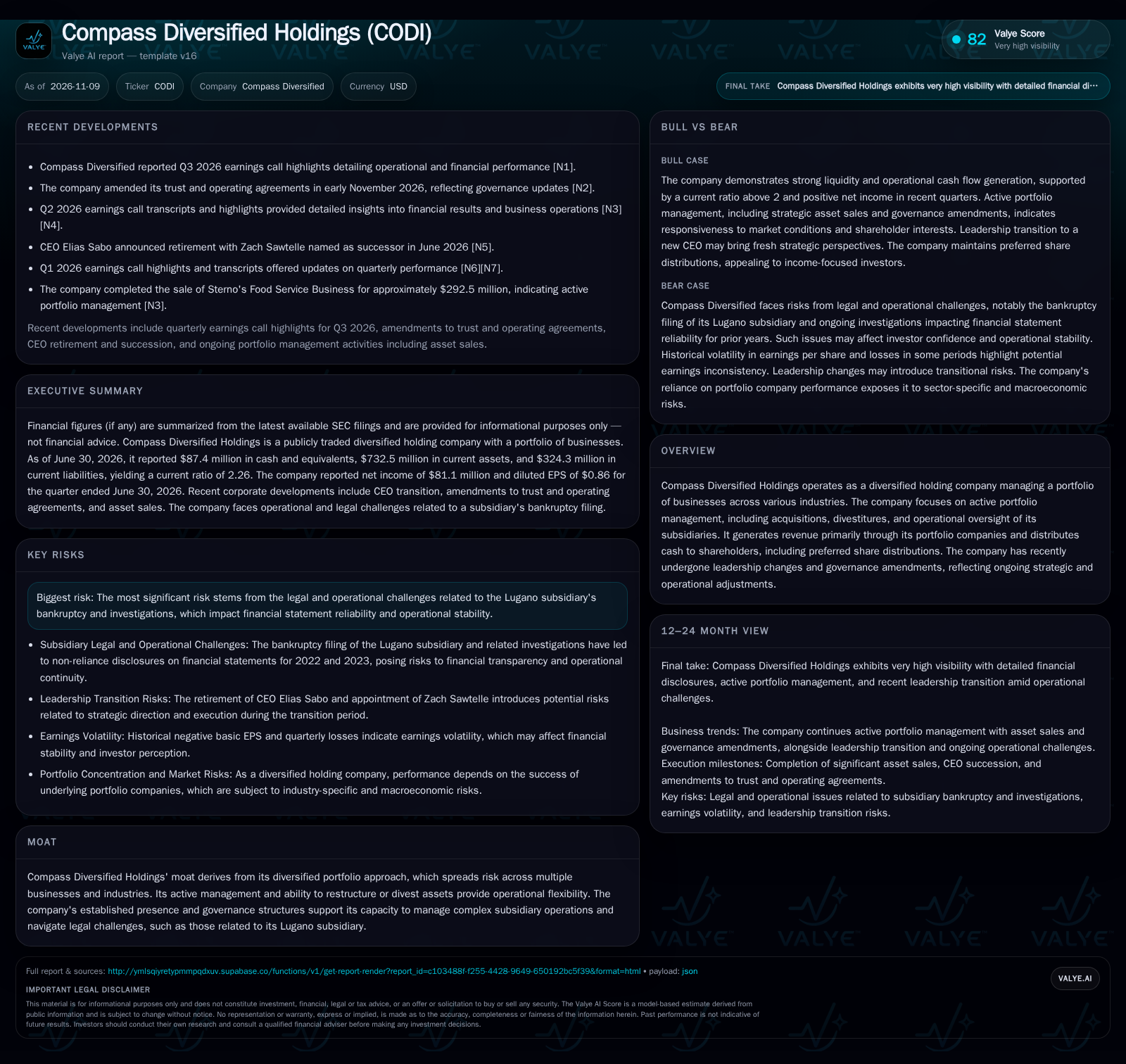
Compass Diversified Holdings enters late 2026 at a crossroads: operationally profitable in the near term but facing structural uncertainty from a subsidiary bankruptcy, governance changes, and a CEO transition. The company’s diversified business model, typically a source of resilience, is being tested by legal and operational disruptions that threaten financial transparency and stability. Investors must weigh the company’s demonstrated ability to generate income and actively manage its portfolio against unresolved legal risks and the unknowns of new leadership.
Recent Financials and Governance Moves Define Near-Term Compass
As of June 30, 2026, Compass Diversified Holdings reported $81.1 million in quarterly net income and a diluted EPS of $0.86, indicating near-term profitability after a period of historical volatility. [S2]
Operationally, the most disruptive current event is the bankruptcy of the Lugano subsidiary, which has triggered ongoing legal investigations and led the company to issue non-reliance disclosures for 2022 and 2023 financials. [N1] This directly threatens financial transparency and could have broader implications for portfolio stability and investor trust.
On the governance front, Compass Diversified amended its trust and operating agreements in early November 2026, and is undergoing a CEO transition from Elias Sabo to Zach Sawtelle. [N2] [N5] These changes signal a willingness to adapt the corporate structure and leadership approach, potentially in response to both external pressures and internal strategic review.
Portfolio Structure, Cash Generation, and the Mechanics of Value Creation
Compass Diversified’s core economic engine is its diversified portfolio of businesses, with the holding company actively managing acquisitions, divestitures, and operational oversight. Income is generated primarily through subsidiary cash flows and, when available, realized gains on asset sales. This model can create a mix of recurring operating cash flow and episodic capital gains, but also exposes the parent to sector-specific and idiosyncratic risks from its underlying businesses.
The reported net income for Q2 2026 affirms the potential for robust operating leverage when portfolio companies perform well. [S1] [S2]
Capital allocation is central: management must decide when to reinvest in existing businesses, acquire new platforms, or divest non-core assets. The amended trust and operating agreements may enable greater flexibility in these decisions, but also introduce uncertainty as new governance norms are tested.
Diversification as Defense: Advantages and Frictions in the Multi-Industry Arena
Compass Diversified’s principal advantage lies in its broad portfolio, which theoretically dampens earnings volatility by spreading risk across industries. This structure can attract investors seeking exposure to private-equity-like returns with the liquidity of a public vehicle. The company’s active management approach—frequent portfolio rebalancing, operational improvements, and strategic divestitures—can generate value above passive holding models.
However, this diversification is not absolute protection. The bankruptcy of a single subsidiary (Lugano) has created outsized legal and reputational risk, demonstrating that concentrated problems can still impact the parent materially. The company competes with other diversified holding companies, private equity firms, and strategic buyers for acquisitions, and must contend with a competitive M&A environment for quality assets.
Switching costs for portfolio companies are generally low, given the holding company model, but Compass’s ability to add value through operational expertise and governance may differentiate it from less involved owners. The recent governance amendments suggest an attempt to enhance this operational edge, but the effectiveness of such changes will depend on execution and market perception.
If Governance Reform and Portfolio Shifts Drive Renewed Growth
The most favorable scenario emerges if the company’s governance amendments and new leadership catalyze improved capital allocation and operational oversight. Successful resolution of the Lugano legal issues—either through settlement, asset recovery, or ring-fencing of liabilities—would restore confidence in reported financials and free management focus for growth initiatives.
If preferred dividends are maintained alongside resumed growth in common share dividends or buybacks, Compass could attract a wider investor base seeking both yield and capital appreciation.
Confirmation would come from restored reliability of financial statements, new acquisitions or asset sales at attractive multiples, and sustained growth in consolidated net income. Falsification would be rapid if legal costs escalate, governance reforms prove cosmetic, or if new leadership fails to stem operational disruptions.
Stable Portfolio Management Amid Ongoing Legal and Market Headwinds
The most plausible near-term trajectory is one of operational stability but continued legal and reputational drag from the Lugano bankruptcy. Portfolio companies are likely to generate sufficient cash flow to support ongoing preferred distributions and meet near-term liabilities, but incremental growth will be muted until legal uncertainties are resolved.
Governance amendments and a new CEO may yield incremental improvements in capital allocation or risk management, but transformational results are unlikely until legacy issues are behind the company. Asset sales or selective acquisitions may occur, but with heightened scrutiny on risk and return profiles.
Evidence for this scenario would be continued positive net income, maintenance of liquidity ratios above 2, and no further material adverse developments from the Lugano situation. A deviation from this path would be signaled by renewed volatility in reported earnings, erosion of liquidity ratios, or escalation of legal proceedings.
Legal Escalation or Portfolio Underperformance Erodes Investor Confidence
The downside looms if legal costs and uncertainties from the Lugano bankruptcy expand, forcing further restatements, asset write-downs, or even cross-default risk across the portfolio. In this scenario, management’s attention is diverted from value creation to damage control, and liquidity could tighten if working capital is consumed by legal settlements or operational disruptions.
If the new CEO’s transition is rocky, with delays in strategic execution or missteps in capital allocation, investor confidence could erode quickly. Underperformance or losses at other portfolio companies—potentially triggered by macroeconomic shocks—would compound the problem, exposing the limits of diversification when multiple sectors stumble simultaneously.
Downside confirmation would come from additional non-reliance disclosures, a drop in the current ratio below 1.5, suspension of preferred dividends, or forced asset sales at distressed prices. Mitigating factors would include rapid legal resolution, successful divestitures, or outside capital infusions.
Milestones That Will Reveal Compass Diversified’s Resilience and Trajectory
Resolution status and financial impact of the Lugano subsidiary bankruptcy and related investigations, including any restatements or settlements.
Trends in consolidated net income and earnings per share across the next two quarters, to test for sustained profitability or renewed volatility.
Liquidity ratios (current and cash) in subsequent filings—particularly if the current ratio remains above 2 and the cash ratio improves.
Execution and strategic clarity from new CEO Zach Sawtelle—updates on capital allocation, acquisition/disposition activity, and operational priorities.
Any new amendments to governance or trust structures, and the market’s reaction to these changes.
Announcement of material acquisitions or divestitures, especially if disclosed multiples suggest attractive capital deployment.
If disclosed, the performance of specific portfolio companies, especially in industries facing macro headwinds, as a barometer of diversification benefits.
Disclaimer: This is research-only, informational analysis and not investment advice. It may include AI-generated interpretation and general industry context. Always verify important details using primary sources.

Comments