
Western Midstream 2026: Fee-Based Stability Tested by Liquidity Frictions and Industry Headwinds
Western Midstream continues to demonstrate profitability and fee-based revenue resilience, reporting $1.19 billion in Q3 2026 revenue and $332 million in net income.
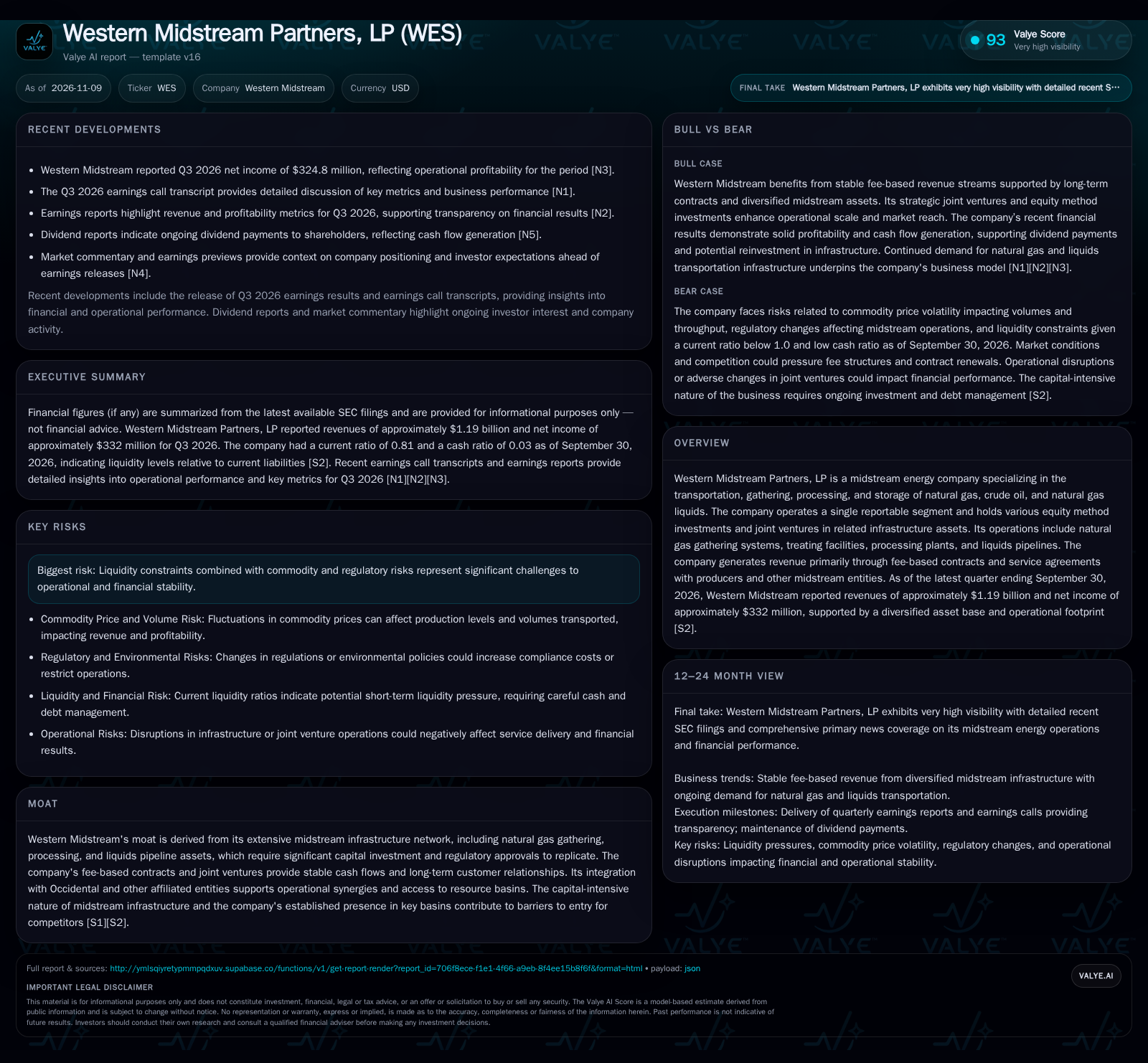
Western Midstream continues to demonstrate profitability and fee-based revenue resilience, reporting $1.19 billion in Q3 2026 revenue and $332 million in net income. However, a current ratio of 0.81 and a cash ratio of 0.03 highlight ongoing short-term liquidity pressures. The company's network of natural gas and liquids infrastructure, underpinned by joint ventures and equity investments, supports operational scale but requires vigilant capital and risk management as energy market and regulatory dynamics evolve [S2] [N1] [N3].
Western Midstream Partners, LP enters late 2026 as a textbook midstream operator: highly profitable on a quarterly basis, with $1.19 billion in revenue and $332 million in net income for Q3, and underpinned by a sprawling network of gathering, processing, and pipeline assets. Yet the company’s financial structure reveals a persistent tension—fee-based contract stability and visible dividend flows on one hand, and a sub-1.0 current ratio and razor-reported cash balance on the other. As the energy value chain evolves under regulatory, volume, and capital cost pressures, Western Midstream’s ability to balance its payout commitments, reinvestment needs, and risk exposures will define its medium-term trajectory [S2] [N1] [N3] [N5].
Profitability Holds, but Liquidity Remains Tight
Western Midstream reported $1,194,217,000 in revenue and $331,906,000 in net income for Q3 2026, confirming ongoing operational profitability [S2] [N3]. The company's asset base spans natural gas gathering, processing, and liquids pipelines, with joint ventures and equity method investments reinforcing operational scale [S1] [S2]. However, as of September 30, 2026, Western Midstream's current ratio was 0.81 and its cash ratio stood at just 0.03, indicating that liquid assets cover only a fraction of near-term liabilities [S2]. [N5] The tension between cash commitments and short-term balance-sheet flexibility is a central factor shaping Western Midstream's current risk-reward profile.
Fee-Based Revenue Model: Stability and Strain
Western Midstream’s business model centers on fee-based contracts for transporting, gathering, processing, and storing natural gas, crude oil, and NGLs. This structure is designed to insulate revenue from direct commodity price swings, with fixed or volume-based fees providing predictability. However, actual volumes remain sensitive to upstream production levels and broader energy demand, so downturns in drilling or production can still pressure throughput and, by extension, revenues.
Most midstream contracts are long-term and feature minimum volume commitments or take-or-pay provisions, but contract renewal risk and renegotiation pressure can rise during industry downturns. Operating leverage is high: fixed infrastructure costs dominate, so incremental volume growth can drive substantial margin expansion, but volume declines quickly erode profitability.
The capital intensity of midstream assets means ongoing investment is necessary both to maintain existing infrastructure and to pursue growth. Funding needs are typically met through a combination of operating cash flow, debt, and retained earnings.
The fee-based revenue model, while providing a degree of insulation from commodity price volatility, remains inherently linked to volume throughput, which is influenced by upstream production activity and broader market demand. This exposure means that prolonged downturns in drilling or production can erode fee revenues despite contractual protections. Moreover, the presence of minimum volume commitments or take-or-pay clauses does not fully eliminate volume risk, as renegotiations or contract terminations during industry stress periods can alter revenue profiles. The capital intensity of midstream assets also creates a tension between maintaining existing infrastructure and funding growth, requiring careful prioritization of capital expenditures to sustain service levels and competitive positioning while preserving potential financial flexibility.
Defensible Infrastructure and the Limits of Scale
Western Midstream’s competitive position is anchored by extensive, hard-to-replicate midstream infrastructure networks and a strong presence in key resource basins. Significant barriers to entry—high capital requirements, regulatory approvals, and long development timelines—protect incumbents and favor established players. The company’s joint ventures and equity method investments provide access to additional assets and market reach, potentially supporting economies of scale and operational synergies [S1] [S2].
However, the midstream sector is structurally competitive, with alternative providers, pipeline interconnects, and evolving producer preferences limiting pricing power. Fee structures can come under pressure during periods of overcapacity or when producers consolidate and seek better contract terms. Furthermore, environmental regulations and policy shifts could introduce new compliance costs or restrict asset utilization, eroding the moat over time. Western Midstream’s integration with Occidental and other affiliates may offer stable anchor volumes, but also exposes the company to concentration risk if major counterparties change drilling or production priorities.
While Western Midstream benefits from significant barriers to entry and an entrenched asset base, competitive dynamics within the midstream sector can exert pressure on pricing and contract terms. Producers’ evolving preferences, including shifts toward integrated service providers or alternative transportation options, may reduce the bargaining power of midstream operators. Additionally, regulatory developments, such as emissions standards or pipeline safety requirements, can impose incremental costs and operational constraints, potentially diminishing asset utilization rates or necessitating capital outlays for compliance. The company’s joint ventures and equity investments may provide diversification benefits but also introduce complexity in governance and risk-sharing, which can affect operational agility and financial outcomes in changing market conditions.
Volume Recovery and Contract Renewal Drive Cash Flow Upside
A favorable scenario for Western Midstream would be driven by sustained or growing volumes across its gathering and processing networks, supported by stable upstream production and continued demand for natural gas and NGLs. If industry fundamentals remain robust, contract renewals could occur at favorable terms, and incremental throughput would flow directly to the bottom line due to high operating leverage.
Confirmation of this scenario would come from sequential volume growth, higher utilization rates, and evidence of contract extensions or new long-term agreements at attractive rates. Conversely, signs of declining volumes, margin compression on contract renewals, or reduced producer activity would challenge this thesis.
Navigating Steady-State Operations Amid Capital Constraints
In this scenario, the company focuses on maximizing utilization of existing assets, optimizing costs, and preserving cash flow for dividends and essential reinvestment.
Deterioration in liquidity metrics, debt covenant breaches, or cuts to the dividend would suggest a break from this base case.
Liquidity Tightens as Volumes and Margins Compress
A negative scenario would see Western Midstream’s liquidity situation worsen if upstream production declines, leading to lower throughput and reduced fee revenue. Contract renegotiations could result in lower rates or volumes, while regulatory or environmental events could increase operating costs or restrict asset utilization.
What Will Determine Western Midstream’s Next Phase of Stability or Stress?
Quarterly throughput and utilization rates for gas gathering, processing, and liquids pipelines—if disclosed—would clarify volume trends and asset productivity.
Contract renewal rates, average contract duration, and changes in fee structures would help assess revenue visibility and pricing power.
Free cash flow generation after dividends and maintenance capital spending, as reported, would test the balance of payout capacity and reinvestment ability.
Updates on joint venture performance, including earnings contributions, asset reliability, and potential disruptions, would highlight partnership stability.
Disclosures regarding regulatory, environmental, or legal developments affecting core assets would help gauge external risk exposure.
Capital project announcements, asset sales, or major new investments would reveal shifts in growth appetite or liquidity management.
Disclaimer: This is research-only, informational analysis and not investment advice. It may include AI-generated interpretation and general industry context. Always verify important details using primary sources.

Comments