
Walker & Dunlop 2026: Navigating Multifamily Leadership, Revenue Mix Shifts, and Affordable Housing Uncertainty
Walker & Dunlop’s scale in U.S. multifamily finance anchors its recurring revenue base, but exposure to interest-rate volatility, regulatory risk in affordable housing, and technology investment cycles create both opportunity and uncertainty for the next phase of growth.
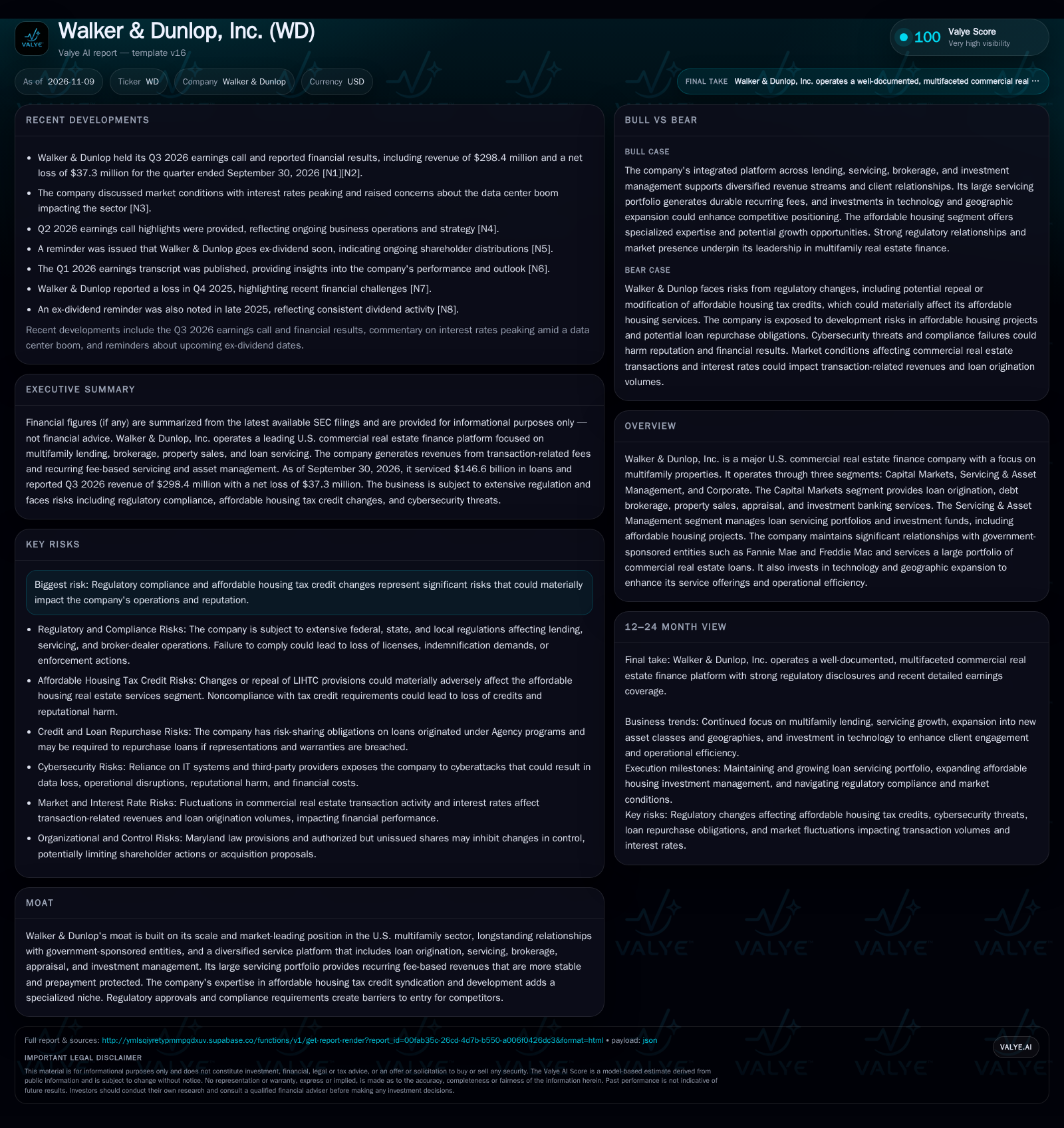
Walker & Dunlop remains a leader in U.S. multifamily real estate finance, with $146.6 billion in serviced loans and a business model balancing transaction-driven fees and recurring servicing revenues. While its market position is supported by agency relationships and regulatory expertise, the company faces headwinds from interest-rate-driven market slowdowns and the threat of changes to affordable housing tax credits. Strategic investments in technology and international expansion could widen its competitive moat, but execution and regulatory changes remain pivotal to the thesis. [S2] [N3]
Walker & Dunlop’s position as a top-tier originator and servicer of U.S. multifamily real estate loans gives it a robust platform of recurring revenues and strong industry relationships. However, the company’s exposure to cyclical transaction activity, evolving regulatory frameworks, and the shifting economics of affordable housing creates a complex risk-reward profile. As management invests in technology and international expansion while contending with interest-rate and policy headwinds, the next phase of value creation will depend on execution, regulatory stability, and the ability to adapt its revenue mix.
Loan Servicing Scale, Market Conditions, and Affordable Housing Exposure Shape the 2026 Outlook
As of September 30, 2026, Walker & Dunlop serviced $146.6 billion in commercial real estate loans, predominantly multifamily, providing a substantial base of recurring, largely prepayment-protected servicing fees [S2]. This servicing scale underpins the company’s recurring revenue and cash flow profile, partially insulating it from short-term volatility in loan origination. However, recent commentary has highlighted that interest rates have peaked and that the ongoing data center construction boom may distort sector dynamics, raising concerns about the near-term outlook for new transactions and origination volumes [N3].
The company’s affordable housing real estate services remain exposed to regulatory risk, particularly the potential modification or repeal of low-income housing tax credits (LIHTCs), which could materially impact this business line [S2]. Meanwhile, Walker & Dunlop continues to invest in technology and international growth, with some new business segments operating near break-even, reflecting ongoing commitment to expansion but also underlining the challenge of scaling profitability alongside innovation [S2].
How Walker & Dunlop’s Revenue Mix and Fee Structures Drive Economic Outcomes
Walker & Dunlop’s core business model blends transaction-driven revenues—such as loan origination, debt brokerage, and property sales fees—with recurring fee-based streams from servicing and asset management. Transaction fees are recognized upon origination and sale of loans, while servicing revenues are contractually paid, typically monthly, and are tied to the outstanding balance of serviced loans [S2]. This structure creates a mix of volatile, market-sensitive income and more stable, recurring cash flows.
The company funds originations through warehouse lines, selling loans to investors—often agencies like Fannie Mae and Freddie Mac—usually within 60 days. The ability to retain servicing rights on these loans is crucial, as it converts episodic origination into a persistent revenue stream, with the added benefit of some prepayment protection. However, the economics of this model are sensitive to origination volumes, which can swing sharply with interest rate cycles and real estate market sentiment.
Operating leverage is achieved by growing the servicing portfolio—fixed costs of the servicing platform can be spread over a larger asset base. However, technology investments and expansion into new geographies, such as Europe, require upfront spending and can suppress margins if new businesses take time to reach scale. The affordable housing vertical, reliant on tax credit stability and development partnerships, introduces additional complexity, as revenues here may be more lumpy and exposed to regulatory shifts.
Market Leadership in Multifamily Finance—But Competitive Dynamics and Regulatory Barriers Remain in Flux
Walker & Dunlop’s competitive position is anchored by its scale in U.S. multifamily lending and servicing, longstanding agency relationships (notably with Fannie Mae and Freddie Mac), and a broad platform spanning origination, brokerage, servicing, and investment management [S2]. These attributes create switching frictions for clients and counterparty confidence for investors, while regulatory expertise and approvals represent real barriers to entry for new competitors.
However, the market for commercial real estate finance is highly competitive, with large banks, independent mortgage banks, and specialized agency lenders all vying for origination and servicing mandates. The company’s ability to innovate through technology, expand geographically, and deepen its affordable housing niche could provide incremental advantages, but these moves also invite execution risk and potential margin dilution if scale is slow to materialize.
Potential substitutes include direct real estate investment platforms, private debt funds, and fintech-enabled lenders, all of which could pressure fee structures or capture segments of the value chain if Walker & Dunlop cannot maintain its integration and service differentiation. Regulatory changes, especially around affordable housing credits, could also shift the competitive landscape abruptly.
If Technology and Geographic Expansion Pay Off, Recurring Revenue Durability and Market Share Could Rise
The most favorable scenario for Walker & Dunlop is one in which investments in technology and international expansion drive both client acquisition and operational efficiency, enabling the company to capture a larger share of origination and servicing flows while reducing marginal costs. If the affordable housing segment benefits from continued LIHTC stability and regulatory support, the company could further entrench itself as a specialized provider in this growing market.
Confirmation of this scenario would come from sustained growth in the servicing portfolio, rising servicing and asset management fees as a proportion of total revenue, and improved profitability in new business lines. Evidence would also include successful entry or scale-up in European markets, increased technology-driven productivity metrics, and continued leadership in agency lending volumes.
Falsification would occur if technology investments fail to yield cost savings or client growth, if European expansion stalls or becomes a sustained drag on margins, or if regulatory changes undermine the affordable housing business before it scales.
Maintaining Servicing Scale While Navigating Cyclical Headwinds and Policy Uncertainty
The most plausible trajectory is that Walker & Dunlop sustains its core servicing portfolio and associated fee revenues, while origination and transaction-driven income remains sensitive to broader commercial real estate cycles and interest rate trends. Technology and new market investments may contribute incrementally, but are unlikely to transform the business mix in the near term.
Affordable housing operations are likely to remain viable as long as LIHTC policy is stable, but the segment will continue to face periodic uncertainty and development risk. The company’s competitive moat should hold in the multifamily sector, but pricing pressure from peers and potential new entrants will remain an ongoing challenge.
Evidence confirming this scenario would include stable or modestly growing servicing balances, recurring revenue maintaining or increasing its share of the revenue mix, and profitability in line with historical ranges. Falsification would be signaled by sustained declines in origination or servicing volumes, unexpected regulatory shocks, or failure to scale new initiatives.
Regulatory Shocks or Transactional Drought Could Erode Both Revenue Streams and Market Position
The adverse case centers on a combination of regulatory risk and market contraction. If LIHTC provisions are repealed or materially curtailed, Walker & Dunlop’s affordable housing segment could see a sharp drop in syndication and co-development revenues, as well as reputational harm among investors and partners. Simultaneously, a prolonged downturn in commercial real estate transactions—driven by high interest rates, sector-specific shocks (such as overbuilding in the data center space), or loss of agency mandates—could significantly reduce origination and brokerage revenues.
Should these factors coincide with operational missteps in technology or international expansion, the company could face margin compression and underutilized fixed costs. Loan repurchase obligations or credit losses under risk-sharing programs could further pressure results in a stressed macro environment.
This scenario would be confirmed by a sharp reduction in affordable housing activity, a material drop in total revenues, negative operating leverage, and evidence of regulatory or compliance failures. Falsification would require resilience in both recurring and transactional revenues despite adverse headlines.
Ways to Test the Walker & Dunlop Thesis as Market, Policy, and Technology Shifts Unfold
Growth or contraction in the total servicing portfolio, especially multifamily balances, as a leading indicator of recurring revenue durability.
Origination and debt brokerage volumes by quarter, to gauge the sensitivity of transaction-driven revenues to interest rates and market sentiment, if disclosed.
Revenue mix evolution—specifically, the proportion of recurring servicing and asset management fees versus transaction-based income.
Profitability trends and margin contribution from new technology and international business lines, if disclosed, to assess the payback on current investments.
Changes in affordable housing revenue and deal activity in response to LIHTC policy developments or regulatory news.
Incidence and financial impact of loan repurchase obligations or credit losses under risk-sharing programs, if disclosed.
Evidence of successful client acquisition or expanded mandates from agency partners, particularly in new asset classes or geographies.
Disclaimer: This is research-only, informational analysis and not investment advice. It may include AI-generated interpretation and general industry context. Always verify important details using primary sources.

Comments