
Sera Prognostics 2026: The Stakes of Commercial Adoption in Prenatal Diagnostics
The company’s outlook now hinges on whether it can convert technological differentiation into meaningful adoption and revenue growth before financial pressures mount further.
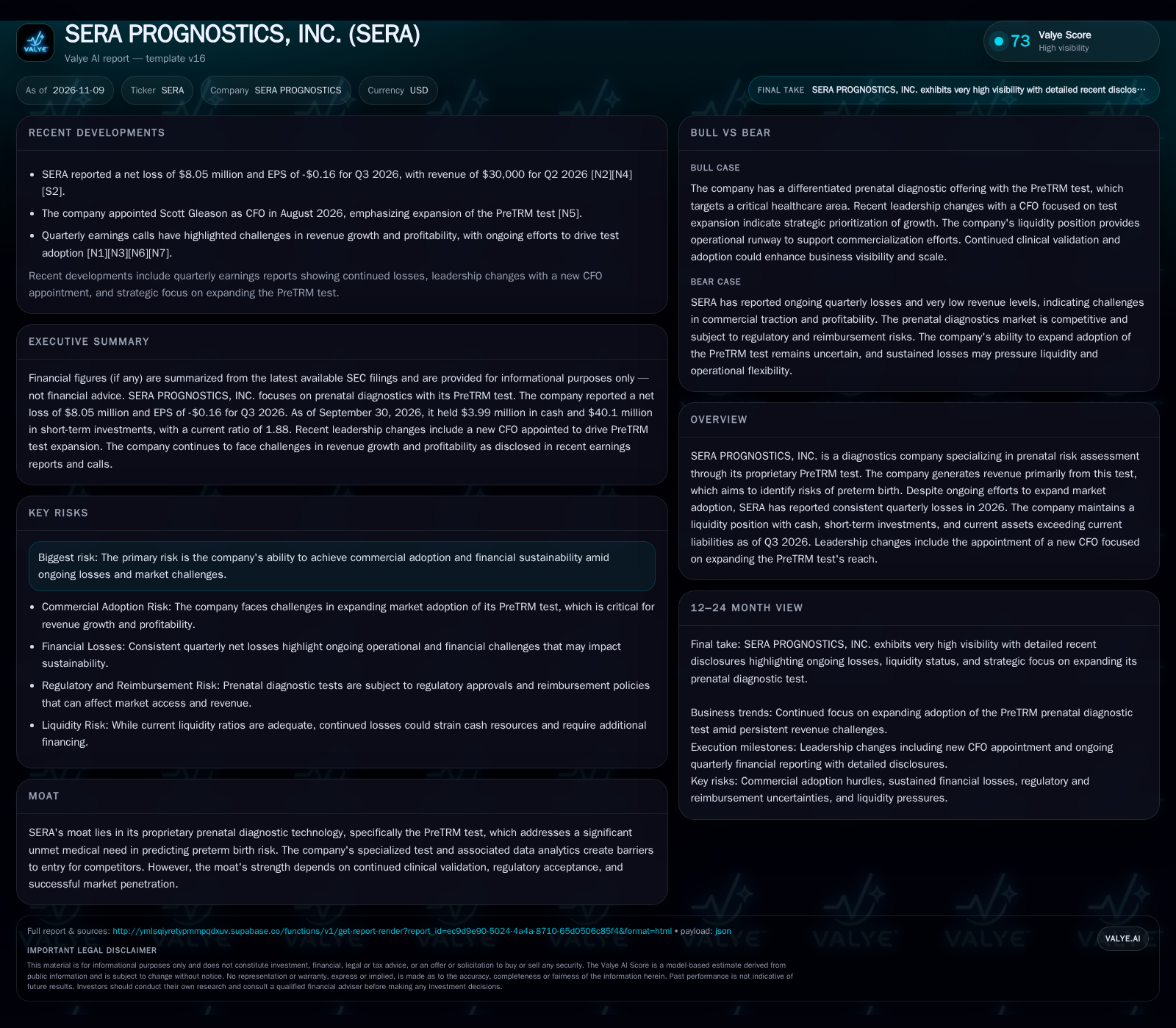
Sera Prognostics, specializing in prenatal diagnostics with its proprietary PreTRM test, posted another quarterly net loss and continues to struggle with revenue generation. Despite holding over $44 million in liquid assets as of Q3 2026, the company’s path to sustainability depends on overcoming adoption barriers in a competitive and regulated market. A recent CFO appointment signals strategic intent, but persistent losses and low sales underscore the urgency of proving commercial viability before liquidity erodes further. [S2] [N4] [N5]
Sera Prognostics, Inc. faces a pivotal phase as it seeks to commercialize its PreTRM prenatal risk assessment test amid continuing financial losses and tepid revenue growth. The recent appointment of a new CFO underscores strategic urgency, but meaningful market traction is yet to materialize—a situation that will define Sera’s fate over the coming quarters. [S2] [N5]
Recent Results: Persistent Losses and Limited Revenue Traction
Sera Prognostics reported a net loss of $8.05 million for Q3 2026, with revenue for the prior quarter at just $30,000. This continues a multi-quarter trend of losses and minimal commercial uptake, despite ongoing efforts to drive adoption of its PreTRM prenatal risk assessment test. As of September 30, 2026, the company’s liquidity position included $3.99 million in cash and $40.1 million in short-term investments, with current assets of $46.2 million against current liabilities of $24.5 million—yielding a current ratio of 1.88 and a cash ratio of 1.8. August 2026 saw the appointment of Scott Gleason as CFO, with an explicit strategic focus on expanding PreTRM’s reach. These facts frame the immediate challenge: Sera’s differentiated technology has yet to achieve meaningful revenue, and the clock is ticking on its reported cash balance. [S2] [N4] [N5]
Prenatal Diagnostics Economics: Where Value Creation Meets Friction
Sera’s business model is predicated on commercializing the PreTRM test, a proprietary diagnostic aimed at early identification of preterm birth risk. In theory, the economics of such a test could be attractive: high clinical value may command premium pricing, and the prenatal care market is large and recurrent. However, early-stage adoption in diagnostics is typically hampered by slow physician uptake, payer reimbursement hurdles, and the need for extensive clinical validation. The company’s negligible quarterly revenue suggests that either pricing, volume, or both are currently constrained—likely reflecting limited market penetration and reimbursement bottlenecks.
On the cost side, fixed expenses for R&D, regulatory compliance, and commercial infrastructure remain high relative to revenue. This creates negative operating leverage: every dollar of incremental sales could improve margins rapidly, but until critical mass is reached, fixed costs dominate. Sera’s quarterly loss of $8.05 million on $30,000 revenue exemplifies this mismatch. Capital needs remain significant, as further investment is required to drive clinical adoption, expand payer coverage, and potentially fund additional studies or marketing initiatives. If Sera cannot materially increase test volumes or secure better reimbursement, its economics will remain subscale and unsustainable.
The interplay between clinical utility and payer economics is crucial in prenatal diagnostics. For Sera, demonstrating cost-effectiveness relative to existing prenatal screening methods would be a pivotal factor in securing reimbursement. Payers typically require evidence that a new diagnostic not only improves patient outcomes but also reduces overall healthcare expenditures, such as by preventing costly preterm births or reducing neonatal intensive care utilization. If Sera can generate robust health economic data showing downstream savings, it may alleviate payer concerns and justify premium pricing. Conversely, without clear cost-offsets, payers may resist coverage or impose restrictive reimbursement policies, constraining revenue growth potential.
Defensibility and the Obstacles to Market Penetration
Sera’s moat is anchored in its proprietary PreTRM diagnostic platform, which addresses a critical and underserved clinical need. In diagnostics, such differentiation can create barriers to entry if the technology is clinically validated, widely adopted, and reimbursed. However, the competitive landscape for prenatal screening is crowded, with established diagnostics companies, academic labs, and emerging startups all vying for provider mindshare and payer contracts. Substitutes range from traditional risk scoring and ultrasound to emerging molecular and genetic screening approaches.
The company’s defensibility may be further tested by the inertia of clinical practice—obstetricians and maternal-fetal medicine specialists are often slow to adopt new diagnostics, especially absent clear reimbursement and guideline endorsement. The strength of Sera’s position will ultimately depend on its ability to generate compelling clinical evidence, secure broad payer coverage, and embed the PreTRM test within standard prenatal protocols. Until these hurdles are overcome, the moat is more potential than proven.
Market penetration in prenatal diagnostics is often influenced by the dynamics of clinical guideline development and professional society endorsements. These endorsements can accelerate adoption by codifying the test’s role in standard prenatal care pathways. However, the pathway to guideline inclusion is typically iterative and dependent on accumulating high-quality evidence from diverse patient populations and clinical settings. Sera’s ability to engage key opinion leaders and participate in multicenter studies could be critical in shaping clinical consensus. Additionally, competitive responses from incumbents—such as bundling tests or leveraging established payer relationships—may raise barriers to entry, requiring Sera to differentiate not only on clinical merits but also on pricing, service, and integration with existing workflows.
If Clinical and Commercial Catalysts Align: Pathway to Scaling
A favorable trajectory for Sera would see the PreTRM test gain clinical guideline endorsements, secure positive reimbursement decisions from major payers, and achieve momentum in provider adoption. This could be triggered by publication of robust clinical outcomes data demonstrating clear utility in reducing preterm births and associated healthcare costs, followed by successful payer negotiations and integration into obstetric care pathways.
If adoption accelerates, Sera’s high fixed-cost structure could quickly yield operating leverage, converting incremental sales into improved margins and narrowing losses. Confirmation of this scenario would be visible in sequential revenue growth, announcements of new or expanded payer contracts, and increasing test order volumes. Additionally, positive commentary from large provider networks or inclusion in standard-of-care recommendations would strongly support the upside case.
Stalled Commercialization: Slow Uptake and Persistent Losses
The most plausible near-term outcome is continued slow adoption of the PreTRM test, with revenue remaining minimal and losses persisting. This scenario would be characterized by incremental progress in clinical studies and payer engagement, but without a decisive breakthrough in reimbursement or provider uptake. Sera may continue to report quarterly losses, drawing down its cash and investment reserves while seeking to build the evidence base for broader adoption.
Evidence supporting this base case would include flat or only modestly rising test revenues, continued management commentary about commercial headwinds, and the absence of major new payer contracts or clinical guideline endorsements. If Sera fails to materially improve revenue by the time its liquidity cushion narrows, it may be forced to seek additional financing, restructure operations, or pursue strategic alternatives.
Erosion of Resources Before Commercial Breakthrough
In an adverse scenario, Sera is unable to materially increase PreTRM test adoption or secure significant new reimbursement, leading to ongoing quarterly losses that rapidly consume its cash and short-term investments. The company’s fixed cost base would become unsustainable, forcing management to consider layoffs, project deferrals, or a search for strategic buyers under distressed conditions.
Warning signs for this scenario would include sequential declines in cash and current assets, little to no revenue growth despite increased commercial spending, and public disclosure of liquidity concerns or going-concern warnings. If Sera is unable to raise additional capital on reasonable terms, the risk of insolvency or an unfavorable acquisition increases.
Milestones That Will Determine Sera Prognostics’ Future
Quarterly revenue progression: Sustained sequential increases in PreTRM test sales would indicate improving adoption and commercial traction.
Test order volume (if disclosed): Tracking the number of tests ordered per quarter would provide direct insight into provider uptake.
Payer contract announcements: Evidence of new or expanded reimbursement agreements with major insurers would support the case for scaling.
Gross margin trends: Improvement in gross margins would signal both better pricing and scale economics.
Cash and short-term investment burn rate: Monitoring the rate of liquidity decline will clarify operational runway and risk of capital shortfall.
Clinical guideline endorsements: Inclusion of PreTRM in national or specialty guidelines would be a major inflection point for adoption.
Management commentary on commercial pipeline: Updates on provider network engagement and pilot program outcomes would help test the thesis.
Regulatory or reimbursement policy changes: Any shifts affecting prenatal test coverage or clinical practice could materially impact Sera’s outlook.
Disclaimer: This is research-only, informational analysis and not investment advice. It may include AI-generated interpretation and general industry context. Always verify important details using primary sources.

Comments