
Ethos Technologies 2026: Digital Leverage, Channel Dynamics, and the Stakes of Insurance Platform Scale
Ethos Technologies’ rapid policy activation growth and high-margin digital model underscore its disruptive potential in life insurance—but future scale, channel mix, and network effects will determine whether early profitability proves durable.
Ethos Technologies activated nearly 200,000 new life insurance policies in 2025, driving revenue to $388 million and achieving a striking 98% gross margin. While direct-to-consumer distribution remains the largest contributor, channel and product mix shifts are reducing average revenue per unit. The company’s vertically integrated, digital-first platform enables rapid scaling and dynamic pricing but leaves Ethos reliant on third-party agents and carrier relationships. The key question is whether network effects and platform differentiation can sustain margin advantages and offset competitive and macroeconomic headwinds as the business matures. [S2] [N3] [N6]
Ethos Technologies has emerged as a high-velocity disruptor in digital life insurance, combining a fully integrated platform with rapid policy activation and robust financial metrics. The company’s 2025 results highlight both the promise and tension of platform scale: strong revenue growth and exceptional gross margins, but a modest decline in average revenue per unit as channel and product mix evolve. Whether its network effects, digital efficiencies, and agent/carrier relationships can deliver durable margin leadership in a competitive, regulated market is the core strategic question. [S2] [N3] [N6]
Ethos’ 2025 Performance: Rapid Policy Growth Meets High Margins
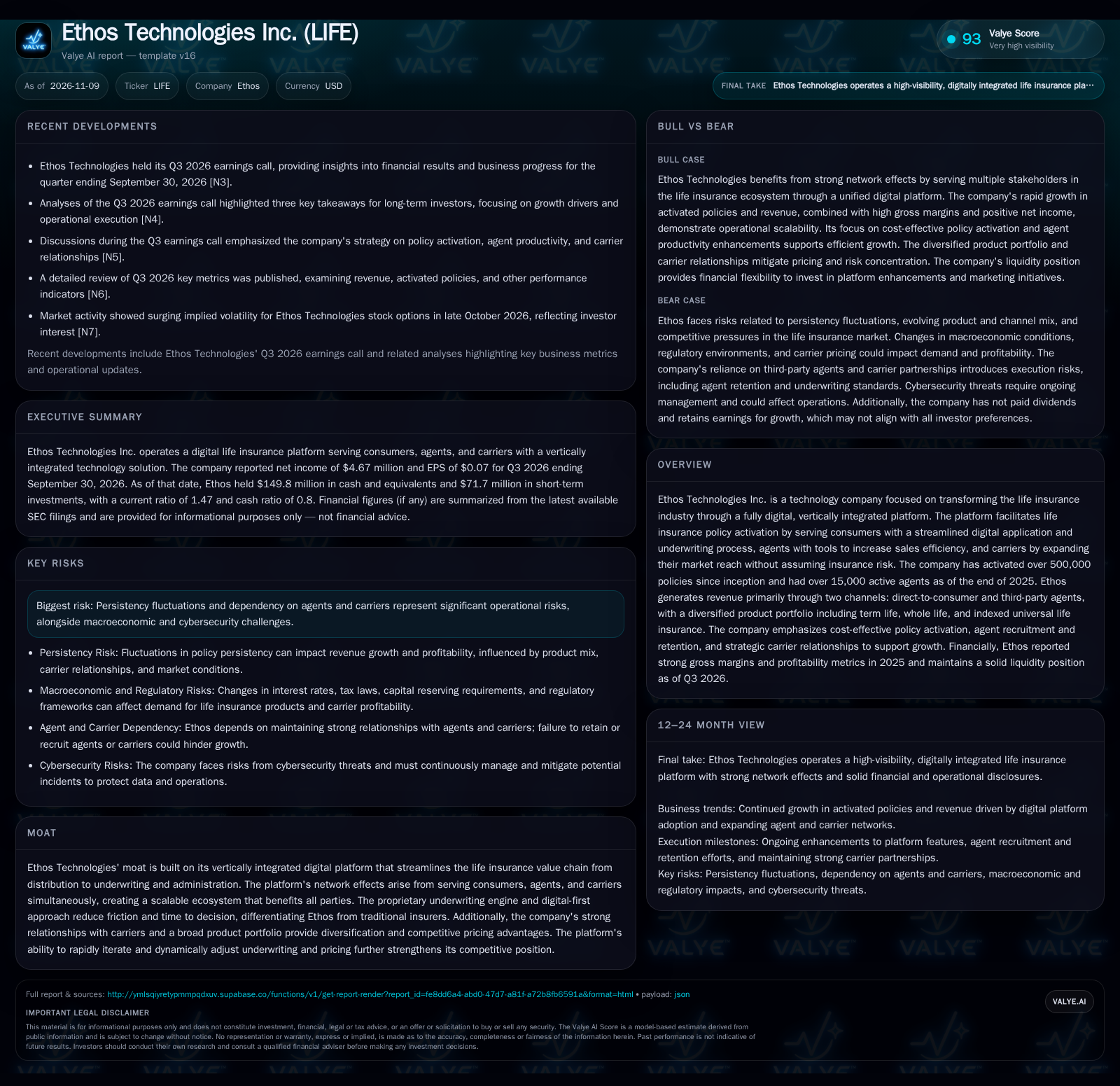
Ethos Technologies activated 198,338 life insurance policies in 2025, a 55% increase from 127,619 in 2024, reflecting significant momentum in both direct-to-consumer and agent-driven channels. Revenue for 2025 reached $388 million, with $243 million (63%) from DTC and $145 million (37%) from third-party channels. Despite the surge in volume, average revenue per unit (ARPU) edged down to $1,954 from $1,997 in 2024, indicating a shift in product or channel mix. The company reported a gross margin of 98% and contribution margin of 42%, supporting net income of $71.2 million (18% net income margin). As of September 30, 2026, Ethos held $149.8 million in cash and $71.7 million in short-term investments, with a current ratio of 1.47. The company does not assume insurance risk, instead monetizing platform services for carrier partners. [S2] [N3] [N6]
How Ethos’ Platform Model Drives Profitability and Scale
Ethos’ vertically integrated digital platform is engineered for capital-light, high-margin economics. By focusing on distribution, underwriting, payments, and administration for carrier partners, Ethos avoids insurance risk and capital requirements tied to underwriting liabilities. Its revenue model is primarily based on per-policy fees or commissions from carriers, with possible upside from additional platform or data services. The platform’s digital onboarding, automated underwriting, and agent tools enable rapid policy activation and short payback periods (about two months on average marketing spend as of 2025), supporting efficient customer acquisition.
Variable costs are relatively low, as evidenced by the 98% gross margin, with the main expenses tied to marketing, technology development, and agent recruitment/retention. Fixed costs—platform development, compliance, and core personnel—are leveraged across a growing policy base, which should enhance operating leverage as scale increases. However, declining ARPU signals that as Ethos expands into lower-premium segments or through third-party channels, the revenue yield per policy may decrease, testing the limits of its contribution margin. The company’s profitability is sensitive to channel mix, persistency rates, and the ongoing ability to optimize marketing and agent incentives.
Network Effects, Platform Differentiation, and the Threat from Traditional and Digital Insurers
Ethos’ competitive positioning is built around network effects—serving consumers, agents, and carriers in a unified platform that aims to reduce friction, lower costs, and increase transparency. For consumers, the promise is instant digital underwriting and decisioning; for agents, a productivity-boosting Agent OS; for carriers, access to a wider pool of applicants without the burden of direct distribution. This multi-sided approach can increase switching costs if agents and carriers increasingly rely on Ethos’ workflow tools and data.
However, the life insurance market is intensely competitive, with both established insurers and newer insurtechs investing in digital distribution and underwriting. Traditional carriers could accelerate their own digital transformation or acquire competing platforms, while newer entrants may undercut Ethos on fees or offer differentiated products. Ethos’ lack of direct insurance risk is a double-edged sword: it limits capital exposure but also means the company’s fortunes are tied to carrier willingness to partner and cede margin. Regulatory changes, persistent agent churn, or a failure to maintain technological differentiation could erode Ethos’ moat over time.
If Network Effects Deepen and Channel Mix Stabilizes, Margin Expansion Could Accelerate
The most favorable scenario for Ethos is one where its platform becomes the default infrastructure for a growing share of U.S. life insurance distribution. If agent and carrier adoption continue to rise, network effects could drive down per-policy activation costs, increase persistency, and enable Ethos to capture a larger share of value in the ecosystem. A stable or improving ARPU—potentially through higher-value products, cross-sell, or premium DTC growth—would reinforce margin expansion.
Confirmation would come from sustained double-digit policy activation growth, a rebound or stabilization in ARPU, expanding contribution margin, and evidence of increasing agent/carrier dependency on Ethos’ tools. Additional signals would be new carrier relationships, higher policy persistency rates, and platform feature launches that drive material agent productivity gains. Conversely, if ARPU erosion accelerates or agent churn rises, the upside scenario would be undermined.
Digital Platform Maturity Brings Growth, but Mix Shifts Pressure Margins
The most plausible trajectory is continued growth in policy activations and revenue, but at a moderating pace as Ethos penetrates more price-sensitive segments. Channel and product mix shifts—such as increased reliance on third-party agents or lower-premium policies—may keep ARPU under pressure, offsetting some scale-driven margin gains. Ethos’ gross and contribution margins remain strong relative to traditional insurers, but incremental improvements are harder to achieve without new product innovation or more favorable persistency trends.
This scenario would be confirmed by steady policy activation numbers, stable or slightly declining ARPU, and net income margins in the mid-to-high teens. Management’s ability to dynamically optimize marketing spend, maintain agent and carrier relationships, and launch incremental platform enhancements would keep the business on a profitable growth path. Should policy persistency or agent retention worsen, or if regulatory/capital changes impact carrier partnerships, the base scenario could tilt toward margin compression.
Persistency, Agent Churn, and Regulatory Shocks Could Erode Platform Economics
A negative outcome could emerge if policy persistency drops, agent churn accelerates, or carriers become less willing to pay for Ethos’ distribution due to margin pressures or regulatory changes. If macroeconomic headwinds or higher interest rates dampen consumer demand for life insurance, or if regulatory shifts increase capital requirements for carriers, Ethos could see a contraction in policy activations and revenue per policy. Increased customer acquisition costs or the need for higher agent incentives would further compress contribution margins.
Downside confirmation would include a sharp decline in policy activation growth, sustained declines in ARPU, deterioration in net income margin, or loss of key carrier relationships. Signs of increased agent turnover, higher marketing spend without commensurate activation growth, or regulatory disclosures indicating platform constraints would also tilt the risk profile to the downside.
What Will Determine Whether Ethos’ Platform Model Sustains Its Edge?
Quarterly policy activation growth by channel (DTC vs. agent) and its impact on ARPU and margin—if disclosed.
Agent retention and recruitment rates, including productivity metrics per agent—would help test the network effect thesis.
Carrier partner concentration and any new carrier signings or departures, as these impact revenue resilience.
Policy persistency rates and duration, which directly affect lifetime value and platform economics—if disclosed.
Average customer acquisition cost (CAC) and payback period trends, as signals of sustainable marketing efficiency.
Contribution margin and incremental gross margin on new policies activated, to monitor scalability and operating leverage.
Regulatory or macroeconomic disclosures that could alter carrier economics or consumer demand for life insurance.
Disclaimer: This is research-only, informational analysis and not investment advice. It may include AI-generated interpretation and general industry context. Always verify important details using primary sources.

Comments