
Fortune Brands Innovations 2026: Portfolio Streamlining and the Stakes of Home-Category Evolution
A $160M divestiture, executive shake-up, and Q3 underperformance signal a strategic inflection for Fortune Brands Innovations, as it seeks to sharpen focus and unlock value in a shifting home and security landscape.
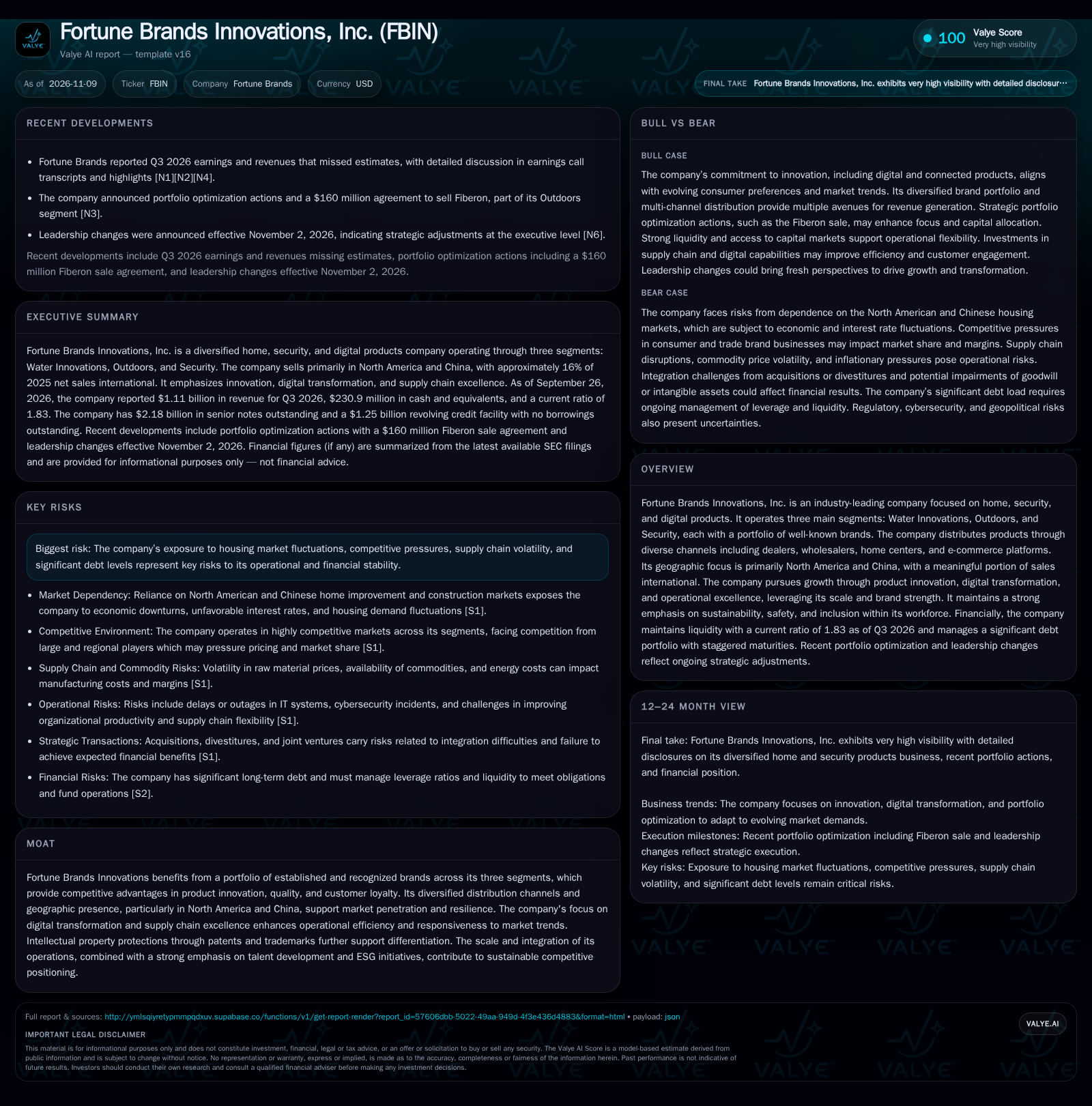
Fortune Brands Innovations is actively reshaping its portfolio, notably with a $160 million Fiberon sale agreement, amid leadership changes and recent earnings misses. These moves highlight a push toward greater operational focus and efficiency, but also underscore the company’s sensitivity to housing market cycles, competitive intensity, and execution risks.
Fortune Brands Innovations, Inc. is at a strategic crossroads, catalyzed by underwhelming Q3 2026 results, the announced $160 million sale of its Fiberon business, and a leadership transition set for November. These moves reflect a clear intent to streamline its portfolio and sharpen the company’s focus on its most competitive businesses in home, security, and digital products. With significant exposure to cyclical housing markets and large retail partners, Fortune Brands faces both the opportunity to unlock value through operational discipline and the challenge of navigating demand headwinds and competitive shifts. The next phase will test whether portfolio discipline and fresh executive leadership can translate into sustainable growth and margin resilience.
Strategic Actions and Financial Markers Define a Pivotal Year
The company reported a current ratio of 1.83 for the period. [N1] [N2] [N4] [N3] [N6] [S2]
How Fortune Brands Makes—and Could Lose—Money
Fortune Brands generates revenue through the design, manufacture, and distribution of branded home, security, and digital products, with sales flowing through diverse channels: kitchen and bath dealers, wholesalers, large home centers, showrooms, e-commerce, and direct-to-consumer platforms.[S1] The company's three segments—Water Innovations, Outdoors, and Security—feature varying economics: Water Innovations (e.g., Moen, ROHL) benefits from brand premium, replacement cycle demand, and some pricing power; Outdoors (e.g., Therma-Tru, Fiberon) is more exposed to new construction and renovation cycles; Security (e.g., Master Lock, Yale) faces commodity and branded competition in both residential and commercial end markets.
Gross margins are shaped by input costs (brass, steel, resin, etc.), product mix, and the ability to pass through inflation or capture value from innovation. The company's scale supports some operating leverage, but fixed costs in manufacturing and SG&A mean that volume declines—such as those implied by Q3's miss—can quickly pressure profitability. Portfolio optimization, like the Fiberon sale, is likely aimed at refocusing capital on higher-return categories and potentially reducing exposure to lower-margin or more volatile product lines. Fortune Brands’ access to a $1.25 billion revolver and manageable debt maturities offer funding flexibility, but the company remains sensitive to macro housing cycles and consumer discretionary trends.
Brand Power, Channel Reach, and the Pressures of Scale
Fortune Brands’ competitive position rests on a portfolio of recognized brands, broad channel access, and operational scale—particularly in North America and China.[S1] Its brands (Moen, Therma-Tru, Master Lock, etc.) command consumer and trade loyalty, but the company faces intense competition from both global multinationals and regional players in each segment. In Water and Security, innovation and brand reputation can support premium pricing and retention, while in Outdoors, differentiation is more challenging and price-based competition is fiercer—potentially explaining the Fiberon divestiture.
Channel concentration is a double-edged sword: Lowe’s and The Home Depot each represent 11% of sales, providing massive volume but exposing the company to contract renegotiation leverage and the risk of changing channel strategies.[S1] E-commerce and direct-to-consumer initiatives may help diversify, but the transition requires investment and carries execution risk. Digital transformation and connected-product innovation could create new moats, but these are not yet proven as major revenue or margin drivers. Intellectual property protections exist but are not cited as individually material, suggesting that competitive advantage is more about execution and brand than patents.[S1]
Sharper Focus Yields Margin Expansion and Innovation-Led Growth
If Fortune Brands executes well on portfolio optimization—deploying Fiberon sale proceeds into higher-margin, faster-growing categories or returning capital to shareholders—the company could achieve a leaner, more profitable profile. Success would be confirmed by sustained margin improvement, even in a tepid demand environment, and evidence of market share gains in Water and Security, driven by digital and connected-product innovation. Improved working capital efficiency, as seen in the recent operating cash flow boost, could become structural rather than episodic if supply chain and category management initiatives take hold.[S2]
The upside scenario would be further validated by the new executive team articulating and delivering on a focused strategy, with positive channel feedback and renewed partnerships with major home centers. A recovery in housing activity or a shift toward premium renovation could accelerate top-line growth, especially if Fortune Brands leverages its brand and distribution breadth to capture higher-value projects.
Portfolio Streamlining Offsets Market Headwinds but Growth Remains Muted
The most plausible near-term outcome is that Fortune Brands stabilizes core operations through its portfolio actions, offsetting some housing-market and input-cost headwinds but not fully escaping the gravitational pull of a sluggish macro environment. Revenues may remain flat or grow modestly, with margin recovery dependent on the ability to execute cost savings and avoid further volume erosion. The successful completion of the Fiberon sale would demonstrate discipline, but redeployment of capital—whether to debt reduction, buybacks, or reinvestment—will be scrutinized for effectiveness.
Confirmation of the base scenario would come from steady operating cash flow, stable or improving gross margins, and no significant loss of shelf space or share at major retail partners. If disclosed, retention rates for trade customers and progress on digital product sales would help test whether the company’s innovation investments are translating into durable advantages.
Execution Missteps and Prolonged Housing Weakness Expose Vulnerabilities
The adverse scenario unfolds if the Fiberon sale fails to close or delivers less than expected value, while leadership transitions disrupt execution and focus. In this case, Fortune Brands could experience further margin compression as fixed costs remain high amid continued volume declines, particularly if housing demand remains soft or deteriorates. A loss of major retail channel support, or aggressive price competition from rivals, could exacerbate top-line and margin pressures.
Negative signals would include declining operating cash flow, inventory build-ups, or the need to draw on revolver capacity to meet obligations. Unexpected write-downs related to divestitures or restructuring, or impairment of goodwill/intangibles from past acquisitions, would further stress the balance sheet and investor confidence. If disclosed, a drop in customer retention, digital adoption, or innovation pipeline health would validate downside risks.
Testing the Fortune Brands Reset: What Could Confirm or Challenge the Thesis
Monitor the final closing, cash proceeds, and capital redeployment strategy following the Fiberon divestiture.
Track gross and operating margin trends for signs of structural improvement or further erosion, especially post-portfolio actions.
Watch for updates on the contribution and growth of digital and connected products—if disclosed—as a signal of innovation effectiveness.
Assess changes in shelf space, contract renewals, and sales concentration with Lowe’s, The Home Depot, and other major retail partners.
Evaluate new executive leadership’s strategic communications, execution milestones, and ability to retain or attract top talent.
Monitor working capital turns and inventory levels for indications of supply chain discipline or emerging operational stress.
Follow any updates on international sales momentum, particularly in China, to gauge exposure and opportunity outside North America.
A useful metric would be customer retention and churn rates in core Water and Security categories, if disclosed.
Disclaimer: This is research-only, informational analysis and not investment advice. It may include AI-generated interpretation and general industry context. Always verify important details using primary sources.

Comments