
Merck 2026: Pipeline Partnerships, Product Momentum, and the Pressures of Scale
Merck’s 2026 trajectory hinges on the continued strength of its flagship products, the execution of a robust collaborative pipeline, and its ability to navigate intensifying industry headwinds. With solid Q3 financials and high-profile partnerships, the company faces a complex mix of opportunity and execution risk as it seeks to sustain growth and defend its competitive position.
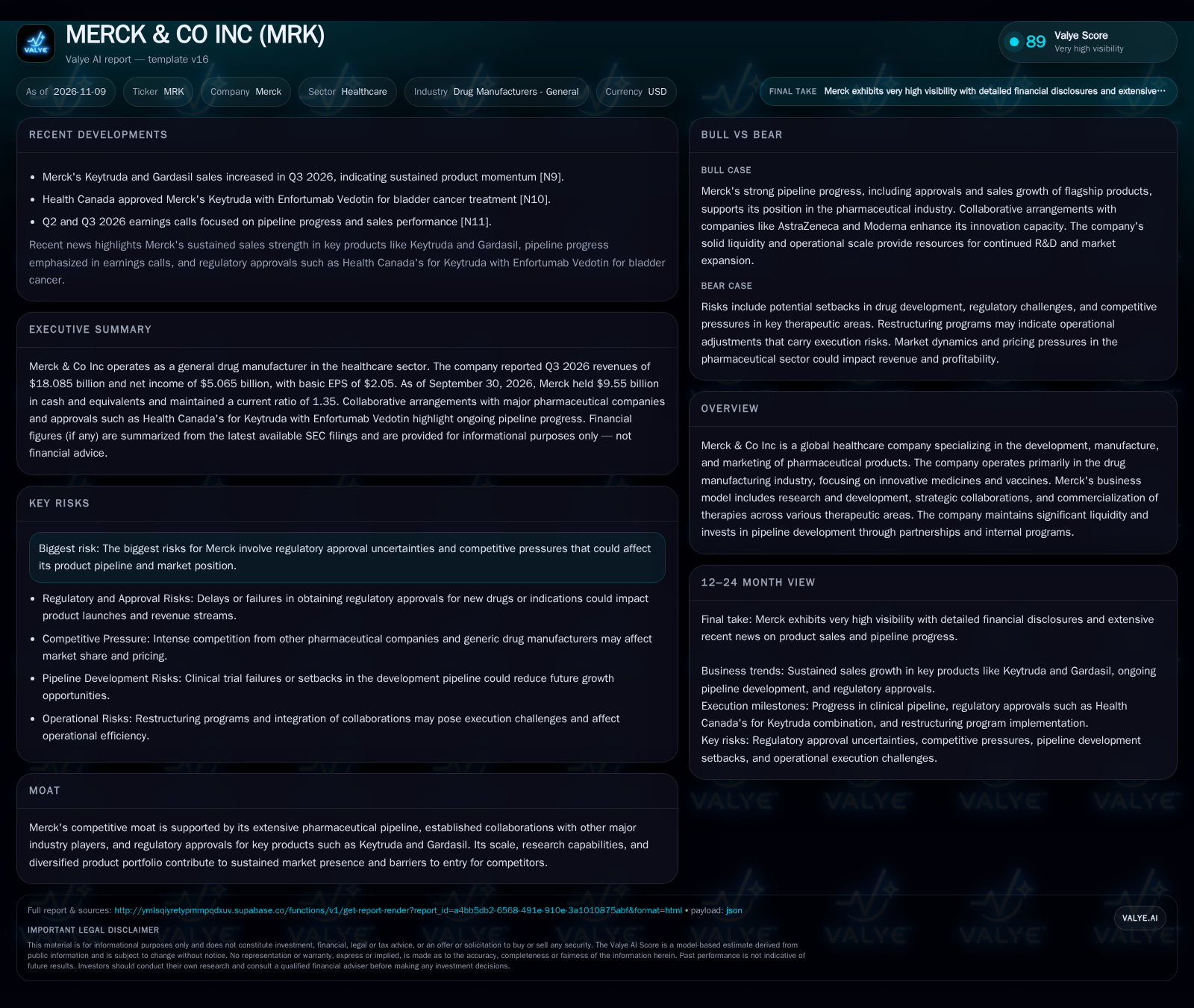
Merck enters late 2026 with strong Q3 revenues, a reported liquidity position, and a collaborative pipeline spanning partners such as AstraZeneca and Moderna. These relationships offer future growth potential, but regulatory, competitive, and operational risks remain central to the thesis. The next phase will test whether Merck can translate scale and partnerships into sustained innovation and margin resilience.
The company’s web of high-profile partnerships offers innovation leverage but also adds complexity to execution. As Merck moves through the next product and regulatory cycle, its ability to convert collaborative R&D into durable revenue streams—and to defend margins in the face of industry-wide pressures—will define its competitive standing.
Current Momentum and Strategic Relationships Define Merck’s 2026 Position
Merck reported $18.085 billion in revenue and $5.065 billion in net income for Q3 2026, reflecting ongoing commercial strength in its core franchises [S1]. The company reported cash and liquidity metrics for the period; these figures do not by themselves establish operating runway, investment capacity, financial flexibility, or financing capacity.
Collaborative arrangements with major pharmaceutical companies—including AstraZeneca, Eisai, Bayer AG, and Moderna—remain central to Merck’s pipeline strategy, giving the company access to external innovation and diversified risk-sharing in development programs [S1]. At the same time, Merck continues to implement restructuring programs, suggesting ongoing operational recalibration and the need to adjust cost structures or integrate new initiatives [S1].
How Merck’s Product Mix and Partnership Structures Shape Profitability
Merck’s business model is built on the interplay of high-margin innovative drugs, vaccine franchises, and the economics of large-scale R&D. The company’s flagship products, such as Keytruda (immuno-oncology) and Gardasil (HPV vaccine), generate substantial revenue and likely contribute outsized operating leverage due to scale and pricing power in protected markets. However, as these products mature, the sustainability of margins depends on the ability to extend indications, defend patents, and successfully launch next-generation therapies.
Collaborative arrangements with peers—such as those with AstraZeneca and Moderna—offer both risk mitigation and new revenue opportunities, but also introduce profit-sharing, milestone, and royalty structures that may dilute Merck’s share of future upside. The economics of these partnerships typically hinge on the stage of asset development: early-stage deals often involve higher risk and lower upfront cost, while later-stage or commercial-stage collaborations involve higher payments and revenue splits.
Merck’s ongoing restructuring programs point to efforts to optimize cost structures, integrate acquired or partnered assets, and streamline operations. While this can enhance long-term efficiency, it also introduces near-term restructuring charges and potential disruption.
Defending Franchise Strength in a Crowded and Evolving Market
Merck’s competitive position is anchored by the scale and clinical differentiation of its leading products, but faces persistent threats from rival pharmaceutical companies, generics, and emerging biotechs. In immuno-oncology, Keytruda’s broad label and first-mover advantage have established it as a market leader, but the field is increasingly competitive, with new checkpoint inhibitors and combination therapies from large-cap peers and smaller innovators.
The vaccine segment, led by Gardasil, benefits from high barriers to entry due to manufacturing complexity and regulatory requirements, but remains exposed to public health policy shifts and new entrants over time.
Partnerships with companies like AstraZeneca and Moderna provide Merck with access to external R&D pipelines, helping to offset internal development risk and potentially accelerate time-to-market for new therapies. However, these collaborations also mean Merck must share economics and may not have full control over asset development, regulatory strategy, or commercialization pace.
Generic competition—especially as patents expire on key products—poses an ongoing risk to the durability of Merck’s revenue base. The company’s scale and breadth create a moat, but they also require continuous innovation and successful pipeline execution to sustain long-term leadership.
Sustained Innovation and Partnership Success Drive Outperformance
If Merck can continue to deliver new indications and market expansions for its flagship products, while successfully advancing late-stage pipeline assets (both internal and partnered), the company could sustain high single-digit revenue growth and maintain operating leverage even as legacy products mature. Successful execution on collaborative R&D—especially with partners like AstraZeneca and Moderna—could yield new blockbuster therapies or vaccines, extending the company’s innovation cycle.
Upside would be further supported if restructuring programs deliver meaningful cost savings without disrupting core operations, and if regulatory approvals are achieved ahead of expectations. Evidence confirming this scenario would include consistent regulatory wins, robust data from late-stage trials, new product launches, and clear cost-efficiency gains in quarterly results.
Falsification would come from pipeline setbacks, regulatory delays, or underwhelming performance of new launches, which would indicate that Merck’s scale and partnerships are not translating into sustained growth.
Pipeline Progress Offsets Mature Franchise Erosion, but Margin Pressures Persist
The most plausible near-term outcome is that Merck’s flagship products continue to anchor revenue, but face gradual deceleration as competitive intensity rises and patent cliffs approach. Incremental pipeline progress, both internally and through collaborations, provides new growth vectors, but is partly offset by restructuring-related costs and the need to share upside with partners.
Margins may compress modestly as the mix shifts toward partnered products and as the company invests in late-stage trials, launches, and integration of new assets.
Confirming evidence would include steady but slowing sales growth in core franchises, ongoing pipeline investments, and regular updates on restructuring progress. Falsification would be signaled by sharp declines in flagship product sales, major pipeline failures, or operational disruptions resulting from restructuring.
Pipeline Failures and Regulatory Setbacks Erode Franchise Value
Adverse outcomes could materialize if Merck experiences significant clinical trial failures, regulatory rejections, or delays in key pipeline assets, particularly those developed through partnerships. In this scenario, the anticipated revenue replacement for maturing franchises fails to materialize, leading to contraction in both top-line growth and operating margins.
Operational risks from restructuring could compound the challenge, causing inefficiencies or delays in integrating new assets. Heightened competition—either from new branded entrants or accelerated generic/biosimilar launches—could further erode market share and pricing power.
Evidence supporting this scenario would include negative regulatory news, missed clinical endpoints, delayed product launches, or higher-than-expected restructuring charges. Falsification would require clear signs of pipeline resilience, robust regulatory progress, and margin stabilization despite competitive and operational headwinds.
Milestones and Frictions That Will Shape Merck’s Next Chapter
Progress in late-stage clinical trials and regulatory filings for both internal and partnered pipeline assets—particularly in oncology and vaccines—would help confirm Merck’s ability to drive future growth.
Quarterly revenue and margin trends for flagship products remain critical to gauging the durability of Merck’s core franchises.
Updates on the financial and operational impact of ongoing restructuring programs would clarify whether cost savings and operational efficiencies are being realized.
Disclosures (if provided) on the economics and terms of major collaborative arrangements—including revenue sharing, milestones, and commercialization rights—would illuminate future profit potential.
Any announced changes in patent protection timelines or new competitive entrants in key therapeutic areas would directly affect long-term revenue visibility.
Pipeline attrition rates and the conversion of clinical candidates into commercial products will test the effectiveness of Merck’s R&D and partnership strategy.
Material regulatory or reimbursement changes in the U.S. or other major markets could impact both pricing and access for Merck’s portfolio.
Disclaimer: This is research-only, informational analysis and not investment advice. It may include AI-generated interpretation and general industry context. Always verify important details using primary sources.

Comments