
Trimble 2026: AI-Driven Platform Ambitions, Workflow Integration, and the Stakes of Tight Liquidity
Trimble’s third-quarter 2026 performance underscores the company’s push to scale cloud and AI-enabled platforms across construction, geospatial, and transportation.
Trimble’s 2026 results highlight robust revenue growth in the AECO segment and aggressive investment in AI-powered, cloud-centric platforms. Yet, profit pressures and a sub-1 current ratio raise questions about the pace at which digital transformation can translate into operational leverage and sustainable cash flow.
Trimble stands at a pivotal juncture in 2026, as its core strategy to connect digital and physical workflows with AI-enabled cloud platforms gains traction across construction and transportation. The central question is whether Trimble’s platform-centric, subscription-driven model can achieve sufficient scale and stickiness to overcome near-term financial pressures and intensifying competition from both entrenched software giants and specialized vertical challengers.
2026 Operating Landscape: Revenue Growth, Profit Decline, and Liquidity Constraints
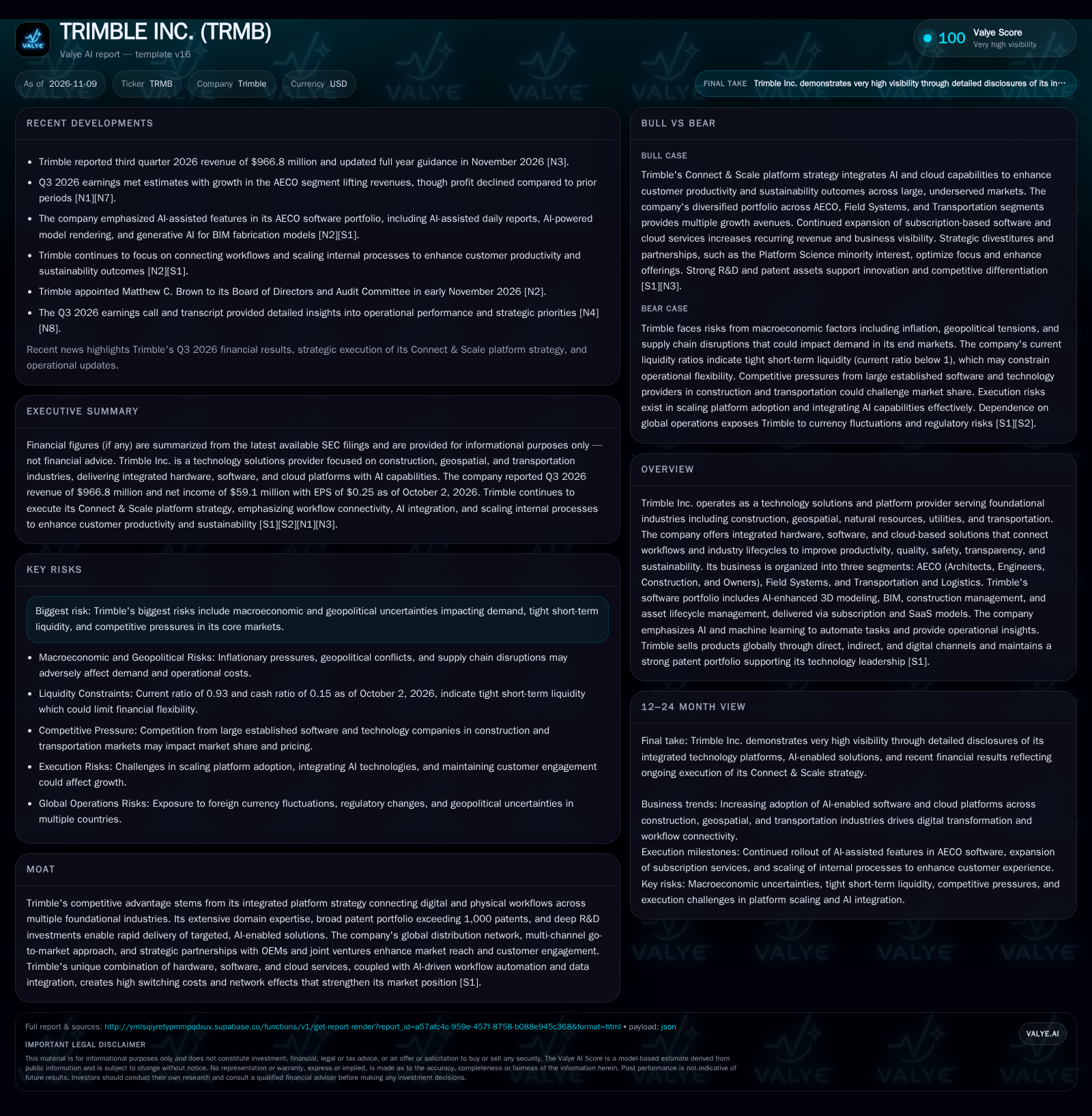
Trimble reported third-quarter 2026 revenue of $966.8 million, with AECO segment growth cited as a key driver, while net income for the period was $59.1 million and EPS stood at $0.25 [N3] [S2]. Despite meeting revenue expectations, the company’s profit declined year-over-year, reflecting ongoing investment in software, cloud infrastructure, and AI capabilities [N1] [N7]. As of October 2, 2026, Trimble’s cash and equivalents totaled $214.5 million, with a current ratio of 0.93 and a cash ratio of 0.15, signaling tight short-term liquidity [S2]. The company reported cash and liquidity metrics for the period; these figures do not by themselves establish operating runway, investment capacity, financial flexibility, or financing capacity.
For instance, if accounts receivable days are elongating due to slower customer payments or extended credit terms, this could exacerbate liquidity pressures despite revenue growth. Conversely, efficient inventory management and payables deferral might temporarily bolster cash flow but could strain supplier relationships.
How Platform Migration and SaaS Adoption Could Reshape Trimble’s Economics
Trimble’s business model is transitioning from a historical reliance on hardware and perpetual software licenses toward cloud platforms, SaaS subscriptions, and integrated workflow solutions. The company’s Connect & Scale strategy aims to create open cloud environments that integrate AI, machine learning, and computer vision across foundational industries. In principle, this shift could enhance revenue visibility, recurring cash flows, and customer stickiness—if subscription pricing and customer adoption scale as planned.
The economics of this transition are nuanced. SaaS and cloud solutions generally carry higher gross margins once at scale, but require sustained R&D and cloud infrastructure investment upfront. The cost structure is likely to see a shift from variable product costs (hardware, implementation) toward higher fixed costs (R&D, software development, cloud hosting). Operating leverage may emerge if platform adoption accelerates and customer churn remains low, but margin pressure is likely during the transition as legacy revenues mix with lower-maturity SaaS lines.
The company’s ability to convert platform adoption into durable free cash flow is therefore a central economic test.
The transition to a platform and SaaS-heavy model also introduces new revenue recognition and billing complexities that can affect reported financial metrics and cash flow timing. Subscription revenues are typically recognized ratably over the contract term, potentially delaying revenue recognition compared to upfront hardware sales, which can compress near-term earnings despite improving long-term predictability. Additionally, customer onboarding and integration services may require upfront costs without immediate revenue offset, impacting short-term margins. The balance between accelerating platform adoption and managing these transitional financial effects will be pivotal in determining the trajectory of Trimble’s profitability and free cash flow generation.
Where Trimble’s Platform Ambitions Meet Industry Friction and Rivalry
Trimble’s aspiration is to be the connective tissue for digital workflows in construction, geospatial, and transportation—domains characterized by entrenched legacy systems, fragmented value chains, and increasing competition from both horizontal software giants and specialist vertical players. The company’s patent portfolio and deep domain expertise are assets, supporting integration of hardware, software, and AI in ways that may be hard for generic cloud or ERP providers to replicate [S1].
However, competitive risks abound. Large enterprise software vendors and cloud hyperscalers have intensified their focus on construction and logistics, bringing scale, pricing power, and robust ecosystems. Meanwhile, vertical SaaS entrants and digital twins platforms are targeting the same customer pain points of workflow fragmentation and data silos. Switching costs in these industries can be high due to integration complexity and user training, but price sensitivity and procurement cycles in construction and logistics remain long and unpredictable.
Trimble’s multi-channel go-to-market approach (direct, dealer, OEM, digital) is a strength for reach, but can dilute control over pricing and customer experience. The test for competitive advantage will be whether Trimble’s platform delivers enough differentiated value—via AI-driven automation, data integration, and open ecosystem flexibility—to justify premium pricing and retain customers through industry cycles.
Another layer of complexity arises from the heterogeneity of Trimble’s end markets, where digital maturity and technology adoption rates vary widely. In segments where customers have deeply entrenched legacy systems, the cost and complexity of switching to new platforms may be prohibitive, limiting Trimble’s addressable market and slowing adoption curves. Conversely, in more digitally progressive pockets, rapid uptake of AI-enabled workflows could create pockets of competitive advantage. The company’s ability to tailor its platform offerings to these diverse customer needs—balancing standardization with customization—will influence its success in building a scalable, defensible ecosystem amid stiff competition.
A Virtuous Cycle: Platform Scale Unlocks Margin Expansion and Customer Lock-In
If Trimble’s Connect & Scale strategy succeeds, the company could achieve a flywheel effect: Growing adoption of its cloud platforms and AI-driven applications across AECO, Field Systems, and T&L segments would drive recurring subscription revenue, reduce dependence on lumpy hardware sales, and expand gross margins as software mix increases. AI-powered features—such as generative model rendering and real-time workflow automation—could further boost productivity gains for customers, creating switching frictions and reinforcing platform lock-in.
Confirmation of this upside would include sustained double-digit growth in SaaS and subscription ARR, rising gross margins as software outpaces hardware, and evidence of declining customer churn or expanding wallet share per account. Pipeline growth in large enterprise or government contracts, expansion of ecosystem partners, and visible cross-sell/upsell momentum across segments would also support the bull case. Ultimately, a positive scenario would see margin expansion and free cash flow acceleration, enabling reinvestment or debt reduction despite current liquidity constraints.
Platform Transition Delivers Growth, But Margin Recovery Lags: The Most Likely Trajectory
The most plausible scenario for Trimble in the next 12–24 months is steady platform adoption—especially in the AECO segment—driving moderate top-line growth, but with margin improvement lagging as the company juggles R&D, cloud infrastructure, and go-to-market investments. Hardware and perpetual license sales may remain a sizable revenue contributor, muting the expansion of software margins in aggregate.
Confirmation of this path would be ongoing revenue growth in core segments, gradual increase in recurring revenue mix, and stabilization of net income even if margins remain below historical peaks. Falsification would be a reversal in software or platform adoption rates, a spike in customer churn, or a need for dilutive capital raises to fund operations.
When Platform Ambitions Outrun potential Financial Flexibility: The Risk of Margin Compression and Funding Strain
The adverse scenario for Trimble is one where the costs of platform migration and AI integration outpace the company’s ability to grow subscription revenues and shrink legacy cost structures. Prolonged margin compression, driven by R&D, cloud costs, and slow customer migration, could erode profitability.
Early customer attrition or competitive share loss in core verticals would further stress the model. A scenario where macroeconomic or industry-specific slowdowns hit Trimble’s end markets—especially construction and logistics—could accelerate downside risks, particularly if working capital needs spike or credit markets tighten.
What Will Prove Out Trimble’s Platform Model—And Where the Thesis Could Falter
SaaS and subscription annual recurring revenue (ARR) growth rates, if disclosed, to gauge the pace and scale of platform migration.
Gross margin trends by segment—especially the software/cloud mix versus hardware—to test operating leverage assumptions.
Customer churn and net retention rates for cloud/SaaS offerings, if disclosed, as proxies for platform stickiness.
New enterprise or government contract wins and size, testing the platform’s appeal for large-scale workflow integration.
R&D and cloud infrastructure spend as a percentage of revenue, to monitor investment intensity and margin headwinds.
Competitive win/loss data or market share shifts in AECO, Field Systems, and T&L, if available, to assess the impact of rival platforms.
AI feature rollout velocity—such as adoption of generative BIM tools—would help validate Trimble’s innovation edge.
Disclaimer: This is research-only, informational analysis and not investment advice. It may include AI-generated interpretation and general industry context. Always verify important details using primary sources.

Comments