
Relay Therapeutics 2026: Clinical-Stage Ambition, AI Discovery, and the Realities of Oncology Drug Development
Relay Therapeutics remains a clinical-stage biotech with no approved products as of late 2026.
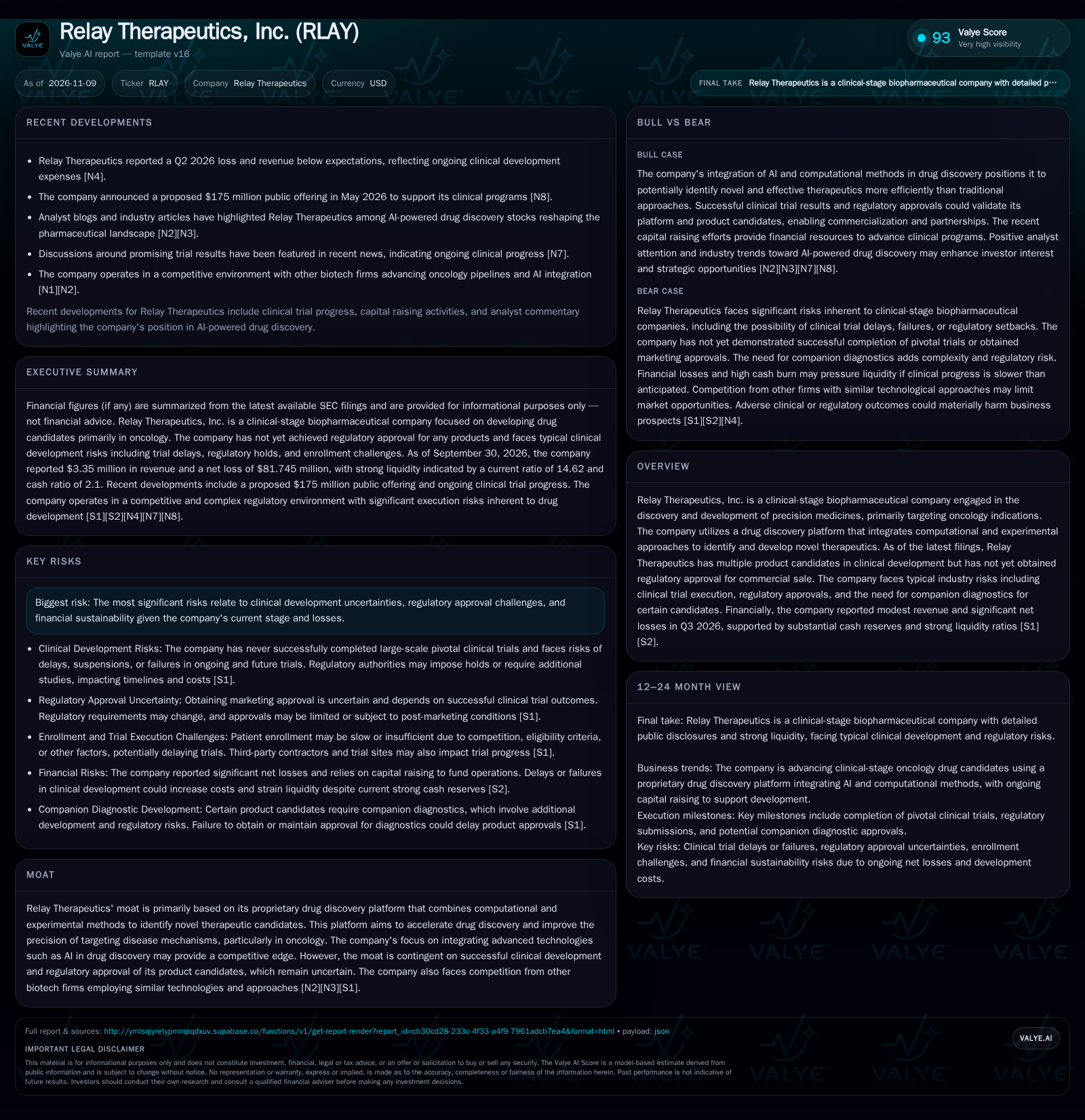
Relay Therapeutics remains a clinical-stage biotech with no approved products as of late 2026. A $175M proposed public offering in 2026 aims to further bolster resources for its high-cost, high-risk development programs. [S2] [N8]
Relay Therapeutics sits at the intersection of cutting-edge computational drug discovery and the unforgiving realities of clinical-stage biopharma. As of Q3 2026, the company is defined by its ambitious oncology pipeline, integration of AI in drug candidate identification, and a balance sheet that, while strong by sector standards, is tested by ongoing net losses and the need for continued capital raises. With no approved therapies and revenue still negligible relative to expenses, Relay’s future will be determined by clinical milestones, regulatory outcomes, and the ability to convert technology-driven promise into real-world patient impact and commercial value.
Relay’s 2026 Financials and Funding Moves Set the Stage for Clinical Execution
Relay Therapeutics reported Q3 2026 revenue of $3.35 million and a net loss of $81.745 million, emphasizing the company’s ongoing dependence on investment rather than product sales [S2]. [S2] Yet, the company moved to further strengthen its balance sheet with a proposed $175 million public offering in May 2026, reflecting persistent capital requirements typical for clinical-stage biopharma [N8]. Despite ongoing clinical trial activity and analyst attention, Relay has not completed pivotal trials or secured regulatory approval for any product, keeping future commercial traction uncertain [S2] [N7].
Beyond headline financials, a nuanced understanding of Relay’s capital structure and funding cadence is essential to gauge sustainability. Clinical-stage biotechs often face a funding paradox: the need to demonstrate clinical progress to attract capital, while simultaneously requiring capital to generate that progress. The timing and terms of capital raises can materially affect shareholder dilution and strategic flexibility.
Economic Model: High Fixed Costs, Platform Leverage, and the Path to Monetization
Relay’s business economics reflect the classic profile of a pre-commercial biotech: minimal revenue, heavy R&D investment, and a cost structure dominated by fixed expenses tied to scientific personnel, clinical trials, and platform development. The company’s AI-powered discovery platform is designed to increase the speed and precision of identifying novel oncology therapeutics, potentially reducing time-to-clinic and attrition rates compared to traditional drug discovery. If successful, this could drive a step-change in R&D efficiency and create opportunities for out-licensing, partnerships, or premium pricing upon commercialization.
However, until a candidate achieves regulatory approval, Relay’s revenue will be limited to milestone payments, research collaborations, or grants—none of which are currently material relative to expenses [S2]. The economics could shift dramatically if a lead asset achieves approval, moving the company from cash burn to a royalty or product-sales model, but this transition is inherently high risk. [N8]
The platform leverage inherent in Relay’s AI-driven approach also introduces a unique cost dynamic. While traditional drug discovery entails iterative, resource-intensive cycles, computational methods can theoretically reduce redundancy and focus experimental validation on higher-probability candidates. However, this efficiency gain depends critically on the platform’s predictive accuracy and integration with downstream clinical development. If the AI platform fails to consistently generate viable candidates, the company risks sunk costs in platform maintenance without commensurate pipeline advancement. Conversely, a validated platform could open alternative revenue streams such as technology licensing or collaborative discovery partnerships, diversifying income beyond product sales.
AI-Powered Discovery: Differentiation or Commodity in Oncology?
Relay’s core pitch is its proprietary integration of computational and experimental methods to discover precision oncology drugs. In a sector increasingly crowded with AI-enabled platforms, the question is whether Relay’s approach yields meaningfully better clinical candidates or faster development cycles compared to peers. Competitors include both legacy pharmaceutical companies adopting AI and pure-play biotechs focused on computational drug discovery, such as Recursion Pharmaceuticals and Schrodinger [N2].
Sustained competitive advantage may depend on the demonstrable clinical success of pipeline assets, the ability to form lucrative partnerships, or the development of a platform that becomes a preferred industry standard. However, if AI-driven discovery becomes commoditized or if larger players achieve faster clinical wins, Relay could face pressure on both pipeline differentiation and partnership value. The need for companion diagnostics for certain candidates adds complexity and potential regulatory drag, possibly diluting any speed advantages conferred by the platform.
The competitive landscape for AI-powered oncology discovery is also shaped by the evolving regulatory environment and industry adoption curves. Regulatory agencies are increasingly scrutinizing AI-derived data and companion diagnostics for transparency, reproducibility, and clinical relevance. Relay’s ability to navigate these regulatory nuances will influence not only the speed of approval but also the market acceptance of its products. Moreover, as larger pharmaceutical companies integrate AI internally, Relay’s differentiation may hinge on proprietary datasets, algorithmic superiority, or unique experimental validation capabilities. Failure to maintain these advantages could result in commoditization, reducing bargaining power in partnerships and licensing negotiations.
If Pivotal Trials Succeed: Platform Validation and Commercial Inflection
The most favorable scenario for Relay involves one or more lead candidates demonstrating compelling efficacy and safety in pivotal clinical trials, leading to regulatory approval. Such an outcome would not only unlock product revenue but also validate the company’s AI-driven discovery model, potentially attracting partnerships, licensing deals, or acquisition interest from larger pharmaceutical players. In this scenario, Relay could rapidly scale commercialization efforts or leverage its platform for additional pipeline expansion.
Confirmation of this scenario would come from positive late-stage clinical data (e.g., statistically significant trial outcomes), successful regulatory submissions, and announcements of major partnership or licensing agreements. Milestone payments or upfront licensing revenue would also signal traction. Conversely, if pivotal data fail to deliver, or regulatory agencies request additional studies, this thesis would be quickly undermined.
Clinical Progress Continues, but Commercialization Remains on the Horizon
The most plausible middle path for Relay assumes steady clinical progress but no near-term regulatory approvals. The company continues to advance its pipeline, reporting incremental clinical data and perhaps expanding its platform capabilities, but remains pre-commercial through 2026 and into 2027.
Evidence supporting this scenario includes stable or increasing R&D spend, ongoing clinical trial enrollment, and updates on pipeline progress that fall short of pivotal data or regulatory filings. The absence of major licensing deals or product revenue would confirm that commercialization is not imminent. Falsification would require either a major clinical setback (moving to the downside case) or an unexpected regulatory win (moving to the upside).
Setbacks in the Clinic or Funding: When Platform Promise Hits Biotech Reality
The adverse scenario involves significant clinical trial setbacks—such as safety signals, lack of efficacy, or regulatory holds—that delay or derail Relay’s lead programs. In this case, the company could see investor confidence erode, making it more difficult and expensive to raise additional capital. High fixed costs and continued cash burn could eventually lead to restructuring, pipeline reprioritization, or forced partnership terms unfavorable to shareholders.
This scenario would be confirmed by public announcements of trial discontinuations, regulatory setbacks, or sharply reduced liquidity despite capital raises. Rising R&D costs without corresponding clinical progress, or news of layoffs and halted programs, would also point to downside risk. Conversely, successful navigation of late-stage clinical hurdles or a strategic partnership could mitigate the worst-case outcome.
Milestones That Will Determine Whether Relay’s Platform Can Deliver Value
Completion and top-line results of pivotal clinical trials for lead oncology candidates—positive or negative readouts will directly affect the company’s trajectory.
Regulatory interactions and feedback, including acceptance of filings and requirements for additional studies or companion diagnostics.
Updates on the $175 million public offering: pricing, investor appetite, and net proceeds, which will shape the near-term funding runway [N8].
Announcements of new or expanded partnerships, collaborations, or licensing deals, which could validate platform value or offset funding needs.
Patient enrollment rates and clinical trial timelines—delays or acceleration would impact both funding needs and strategic flexibility.
Any material change in the competitive landscape, such as a peer achieving regulatory approval for a directly competing asset or platform.
Disclaimer: This is research-only, informational analysis and not investment advice. It may include AI-generated interpretation and general industry context. Always verify important details using primary sources.

Comments