
Prudential Financial 2026: Diversification Strengths, Capital Return, and the Pressures of Industry Disruption
The company’s diversified model in insurance and investment management faces mounting challenges from fintech disruption, climate volatility, and evolving ESG demands.
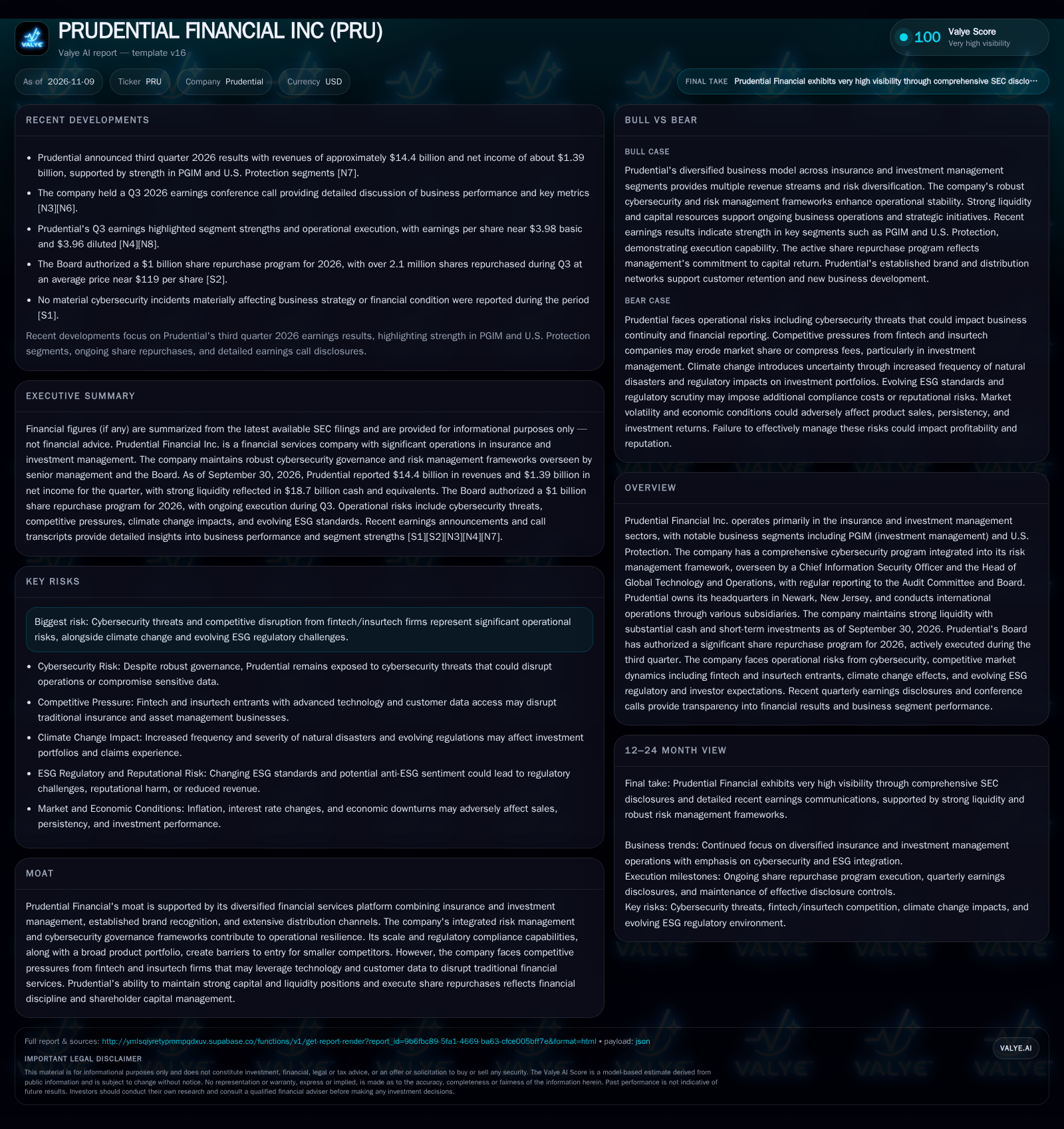
Prudential Financial reported $14.4 billion in Q3 2026 revenue and $1.39 billion in net income, supported by strength in both insurance and investment management segments. Its future performance will hinge on balancing operational resilience and adapting to industry transformation. [S2] [N3] [N7]
Prudential Financial’s latest quarter underscores the resilience and complexity of a diversified financial services giant navigating a rapidly evolving competitive and regulatory landscape. However, the company’s long-term trajectory will be defined by its response to mounting challenges: digital disruption from fintech and insurtech, climate change’s unpredictable effects on risk and investment portfolios, and the rising cost and scrutiny of ESG compliance. The next phase will test Prudential’s ability to innovate, adapt, and defend its franchise.
Q3 2026 Highlights: Earnings, Liquidity, and Shareholder Returns
Prudential Financial reported revenues of approximately $14.4 billion and net income of $1.39 billion for the quarter ended September 30, 2026, with basic earnings per share of $3.98 and diluted EPS of $3.96. The company’s balance sheet included $18.7 billion in cash and cash equivalents and $5.4 billion in short-term investments at quarter-end [S2].
The Board authorized a $1 billion share repurchase program for 2026, of which about $250 million remained as of September 30; over 2.1 million shares were repurchased during Q3 at an average price of roughly $119 [S2].
No material cybersecurity incidents were reported during the period, and management concluded that disclosure controls and procedures remained effective [S1] [S2].
These facts matter because they signal ongoing operational execution, capital return discipline, and risk management—while also demonstrating the company’s potential financial flexibility amid industry headwinds.
How Prudential Makes Money: Insurance Float, Asset Management Fees, and Scale
Prudential generates revenue primarily from insurance premiums, investment income (including the ‘float’ from insurance liabilities), and asset management fees through its PGIM segment. In insurance, profitability depends on underwriting discipline, mortality/morbidity trends, and investment returns on reserves. The investment management business is driven by assets under management (AUM), fee rates, and investment performance—subject to market cycles and client flows.
Fixed costs are substantial in both segments, including regulatory compliance, technology, and distribution. This creates operating leverage: incremental revenue, especially from asset management or higher premium volumes, can drive margin expansion once fixed expenses are covered. However, variable expenses (claims, commissions, performance-based compensation) can quickly erode margins in adverse scenarios.
Capital requirements are high in insurance, as regulatory regimes mandate significant reserves and risk-based capital to support policyholder liabilities. The company reported cash and liquidity metrics for the period; these figures do not by themselves establish operating runway, investment capacity, financial flexibility, or financing capacity. Asset management, while less capital-intensive, faces margin pressure from fee compression and passive product competition.
The interplay between underwriting outcomes and investment income is particularly critical for Prudential’s insurance operations. Underwriting profitability can fluctuate due to changes in mortality rates, health trends, and claims experience, which are themselves influenced by demographic shifts and emerging health risks. Simultaneously, the investment portfolio backing policyholder liabilities must generate returns that meet or exceed assumptions embedded in pricing models. If market volatility or low interest rates persist, the company may face pressure to recalibrate assumptions or strengthen reserves, impacting earnings. This dynamic underscores the importance of integrated risk management and scenario analysis to maintain solvency and optimize capital deployment.
Defending the Franchise: Diversification, Brand, and the Threat of Digital Disruption
Prudential’s competitive position rests on its scale, diversified revenue streams, brand recognition, and regulatory expertise. Its broad product suite and distribution networks (including advisors, institutional channels, and digital touchpoints) help attract and retain customers. The integration of risk management and cybersecurity governance enhances operational resilience and client trust [S1] [S2].
However, the competitive environment is intensifying. Fintech and insurtech entrants are targeting both insurance and asset management value chains, leveraging advanced analytics, automation, and direct-to-consumer models to undercut traditional providers. These disruptors may offer more personalized products, faster onboarding, and lower fees, challenging Prudential’s pricing power and customer retention.
Traditional peers in insurance and asset management—large incumbents with global reach—remain formidable but are also under pressure to innovate. Competitive advantage for Prudential will increasingly depend on its ability to enhance digital capabilities, adapt product offerings, and manage costs while maintaining regulatory compliance.
If Prudential Leverages Scale and Technology: A Path to Margin Resilience
A favorable trajectory for Prudential would see the company successfully harness its scale to invest in digital transformation—streamlining operations, improving customer engagement, and launching new products that blend insurance and investment management. This could enable higher retention, cross-selling, and improved efficiency, offsetting fee compression and underwriting headwinds.
Confirmation would come from sustained or growing AUM in PGIM, stable or rising insurance premium volumes, and margin expansion despite competitive and regulatory pressures. Evidence of successful digital initiatives—such as increased digital sales, improved customer satisfaction, or reduced acquisition costs—would further validate this scenario.
Falsification would be indicated by persistent outflows from asset management, declining insurance persistency, or rising expense ratios despite technology investments.
Navigating Industry Pressures: Incremental Innovation and Defending Share
The most plausible outcome is that Prudential maintains steady performance through incremental product innovation, cost management, and disciplined risk control, but faces ongoing margin and growth pressures.
Confirmation would include stable or modestly growing earnings, continued execution of share repurchases, and absence of major cybersecurity or regulatory lapses. Margins may remain stable but not expand meaningfully, as efficiency gains are offset by competitive fee pressures and compliance costs.
This scenario could be falsified by a material deterioration in net flows, claims experience, or regulatory capital ratios—especially if coupled with unexpected operational or cybersecurity incidents.
When Digital Disruption or External Shocks Erode Core Economics
A negative scenario unfolds if fintech/insurtech entrants accelerate share gains, compressing fees and disintermediating Prudential’s distribution channels faster than it can adapt. Simultaneously, adverse climate events or regulatory changes could trigger elevated claims, investment losses, or capital requirements, straining profitability and limiting capital return.
Confirmation would be visible in declining revenues or net income, significant outflows from PGIM, material increases in claims or loss ratios, or a halt to share repurchases or dividends. A high-profile cybersecurity incident or regulatory sanction would further exacerbate downside risk.
Falsification would require Prudential to demonstrate resilience: retaining clients in the face of digital competition, managing risk events without outsized financial impact, and maintaining access to capital markets on favorable terms.
What Will Test Prudential’s Resilience and Adaptation?
Quarterly net flows in PGIM (investment management)—significant net inflows or persistent outflows would reveal competitive positioning and pricing power, if disclosed.
Trends in insurance premium volumes and persistency rates—a useful metric would be new business growth versus lapse rates across core product lines.
Expense ratio and operating margin—movement here would help test whether technology investments are yielding meaningful efficiency gains.
Share repurchase execution—whether the company completes its remaining $250 million authorization and signals future capital return intentions.
Any material cybersecurity incidents or regulatory findings—disclosures would provide early warning for operational or reputational risk.
Claims/loss ratio trends, especially in segments exposed to climate risk—rising ratios could indicate structural risk or pricing inadequacy.
AUM growth and fee rate trends in PGIM—declining fee rates or AUM could confirm intensifying competitive pressure.
Disclaimer: This is research-only, informational analysis and not investment advice. It may include AI-generated interpretation and general industry context. Always verify important details using primary sources.

Comments