
Champion Homes 2026: Scale, Integration, and the Stakes of Affordable Housing Cycles
Champion Homes’ vertically integrated platform and acquisition-driven expansion have delivered growth despite signs of moderating demand and industry headwinds. The company’s next phase will be shaped by its ability to convert scale into margin leverage, manage order volatility, and defend share in a market facing affordability constraints and shifting macro conditions.
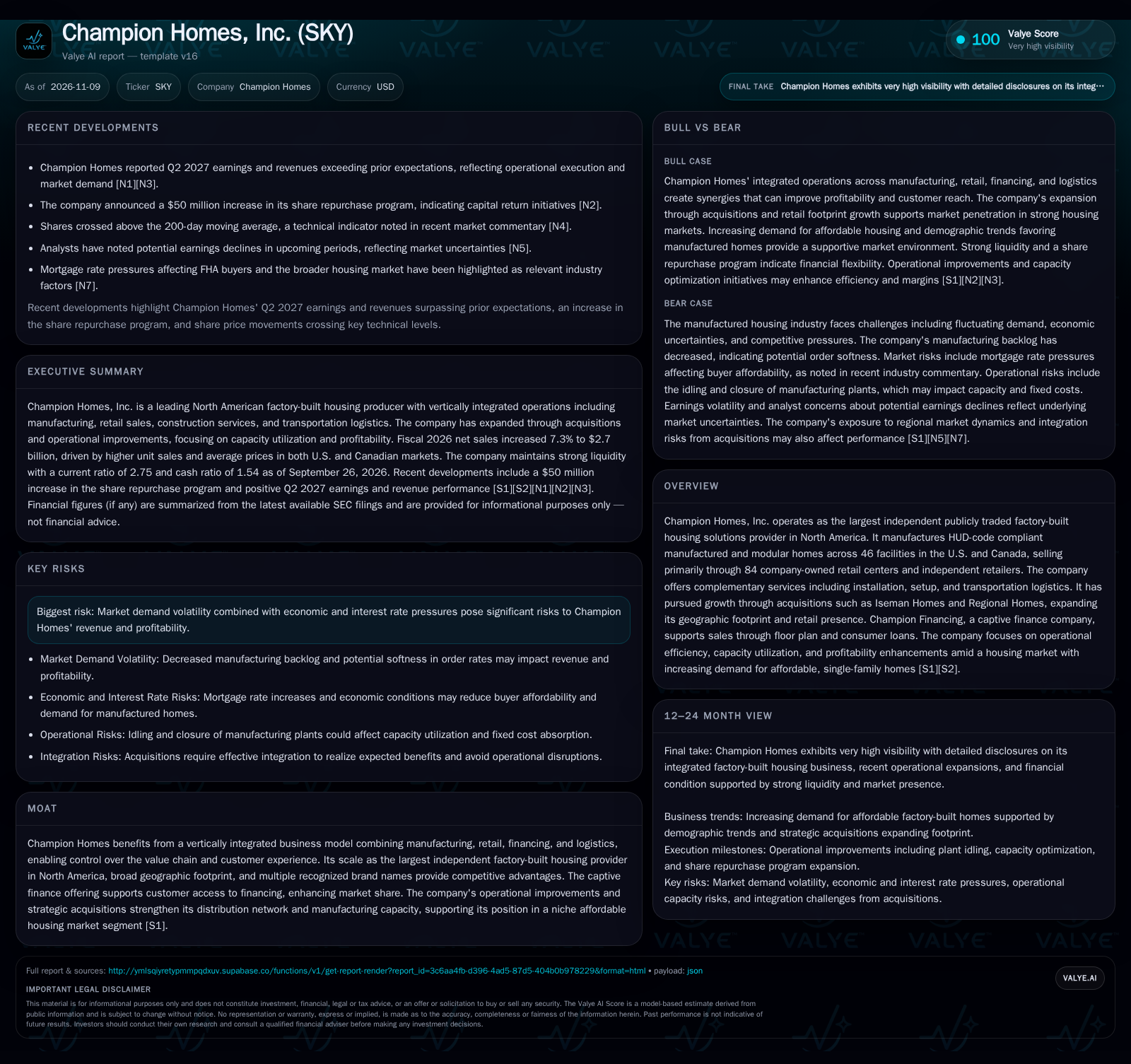
Champion Homes increased net sales 7.3% in fiscal 2026 to $2.7B, driven by higher unit sales and average selling prices in both the U.S. and Canada. Recent acquisitions have expanded its retail and manufacturing presence, but a declining manufacturing backlog signals potential softening demand. The company is emphasizing operational efficiency, capacity utilization, and shareholder returns, but faces risks from mortgage rate pressures and cyclical housing market dynamics. Its ability to sustain market share and margin improvement will be tested as industry conditions evolve. [S1] [S2] [N1] [N2] [N3]
Champion Homes, Inc. stands at a pivotal juncture in North America’s factory-built housing market. After several years of acquisition-fueled expansion and vertical integration, the company delivered robust sales growth in fiscal 2026, but a declining backlog and analyst caution signal intensifying industry crosscurrents. As mortgage rates and affordability pressures weigh on buyers, the company’s ability to convert scale into durable margin leverage, efficiently integrate new assets, and defend its share in a cyclical market will determine whether its recent gains can be sustained or if a period of normalization looms.
Recent Expansion, Sales Momentum, and Backlog Dynamics
Champion Homes reported fiscal 2026 net sales of $2.7 billion, a 7.3% increase over the prior year, with both unit sales and average selling prices contributing to growth across its U.S. and Canadian segments [S1]. The U.S. segment saw a 6.7% rise in net sales, driven by a 1.8% increase in homes sold and a 4.8% increase in average selling price. Canadian operations posted even stronger gains, with net sales up 17.9% on a 15.2% volume increase [S1].
The company expanded its footprint through the acquisitions of Iseman Homes and Regional Homes, adding 54 retail centers and 3 manufacturing facilities, consolidating its position as the largest independent factory-built housing provider in North America [S1].
Despite these positives, the manufacturing backlog declined to $316 million as of March 2026, as production rates outpaced new order rates [S1]. This signals a potential shift in demand momentum and raises questions about near-term revenue visibility.
Champion Homes ended the September quarter with $702.8 million in cash and a current ratio of 2.75, and announced a $50 million increase to its share repurchase program in November 2026 [S2] [N2].
How Integration and Scale Shape Earnings Power
Champion Homes’ vertically integrated model—spanning manufacturing, company-owned retail, installation, logistics, and captive finance—offers multiple revenue streams and the potential for margin capture at several points in the value chain. The company’s ability to internalize installation and logistics may reduce customer friction and improve gross margins versus competitors who outsource these functions.
Revenue drivers hinge on a blend of unit volumes, average selling price (ASP), product mix (HUD-code versus modular), and geographic exposure. The 2026 results show both volume and ASP expansion, with acquisitions likely contributing to both—through increased retail penetration and broader product offerings [S1].
Fixed-cost leverage is a central dynamic: plant utilization rates and retail throughput directly impact operating margins. When demand is strong, incremental units sold can drive outsized profit gains, but underutilization (as signaled by plant idling and a shrinking backlog) can quickly pressure margins by spreading fixed costs over fewer units.
Capital allocation is another lever. The company reported cash and liquidity metrics for the period; these figures do not by themselves establish operating runway, investment capacity, financial flexibility, or financing capacity. However, the capital intensity of manufacturing and the working capital needs of inventory and receivables can rise quickly in a downturn or if acquisition integration falters.
Defending Share in a Fragmented, Cyclical Market
Champion Homes competes with both large factory-built housing manufacturers and regional players, as well as traditional site-built homebuilders for budget-conscious buyers. Its 22.5% U.S. wholesale market share in HUD-code homes reflects significant scale, but the industry remains fragmented and sensitive to local economic and regulatory factors [S1].
The company’s integrated distribution—owning both manufacturing and 84 retail centers—offers a potential advantage in controlling the customer experience and capturing margin, though it does require effective management of a sprawling footprint.
Brand diversity (multiple recognized brands in the U.S. and Canada) may help target different buyer segments, but also adds complexity to operations and marketing. The captive finance offering can be a differentiator if credit standards and servicing remain disciplined.
Key counterforces include rising mortgage rates (which especially impact FHA and subprime buyers), competition from other forms of affordable housing (such as apartments and single-family rentals), and supply chain volatility for key materials. Barriers to entry are moderate: while manufacturing scale and distribution networks matter, new entrants can still emerge, and regional fragmentation limits the defensibility of any one player’s share.
Margin Expansion and Share Gains If Demand Holds
If U.S. manufactured housing shipments continue their modest upward trend and affordability concerns drive more buyers to factory-built options, Champion Homes could leverage its expanded manufacturing and retail network for outsized earnings growth. Successful integration of recent acquisitions may enable further procurement and operational efficiencies, while plant utilization could drive improved fixed-cost absorption and margin expansion.
The captive finance business could facilitate sales growth if credit conditions remain stable, enabling more buyers to qualify for manufactured homes despite higher interest rates.
Evidence that would confirm this scenario includes a reversal or stabilization in the manufacturing backlog, further increases in unit sales and ASP, and margin improvement on both gross and operating lines. Sustained or accelerating buybacks and continued strong cash generation would also support the upside case.
Falsification would come from continued backlog declines, margin erosion, or evidence that acquisition integration is failing to deliver expected synergies.
Normalized Growth Amid Softening Order Trends
The most plausible near-term outcome is a moderation in growth as the industry digests recent demand surges and faces higher-for-longer mortgage rates. Champion Homes’ sales volumes may plateau or grow modestly, with pricing power constrained by affordability limits and competition.
Margin performance will likely hinge on the company’s ability to adjust production to match order rates, manage plant utilization, and extract operational efficiencies from its larger scale. Acquisitions may continue to contribute, but integration costs and regional market variations could dilute some gains.
Confirming evidence would include relatively stable unit sales and ASPs, with manageable declines in backlog and no sharp drops in gross or operating margins. Ongoing capital returns (buybacks/dividends) and steady cash flow would be consistent with this scenario.
Falsification would involve a sharper-than-expected drop in orders, more pronounced plant idling, or significant margin compression.
Order Deterioration and Margin Compression in a Weakening Market
In a more adverse scenario, further increases in mortgage rates or a broader economic slowdown could sharply curtail demand for manufactured homes, especially among price-sensitive buyers. This would likely drive further declines in the manufacturing backlog, underutilization of factory capacity, and more plant idling or closures.
Margin compression would follow as fixed costs are spread over fewer units and competitive pricing pressure limits ASP growth. Inventory write-downs and increased promotional activity could further erode profitability.
Acquisition integration risks could be magnified in a downturn, with underperforming retail centers or manufacturing plants dragging on consolidated results.
Evidence confirming this scenario would include a rapid or sustained drop in backlog and unit sales, rising inventory levels, negative operating leverage, and reductions to capital return programs. Reports of further plant closures or asset sales would also be consistent with this outcome.
Testing the Thesis: Operational, Financial, and Market Triggers to Monitor
Sustained trends in the manufacturing backlog: Persistent declines would indicate softening demand, while stabilization or growth would support a stronger outlook [S1].
Quarterly unit sales and average selling price (ASP) by segment: These metrics are critical for understanding volume/mix effects and pricing power; a useful metric would be segment-level ASP if disclosed.
Gross and operating margin progression: Margin trends will reveal the effectiveness of cost controls, integration, and pricing discipline; tracking margin by segment (if disclosed) would sharpen this analysis.
Plant utilization rates and announcements of idling/closures: Further plant reductions would signal demand softness and risk to fixed-cost leverage; if disclosed, utilization rates would help gauge operating efficiency.
Integration progress and performance of acquired retail/manufacturing assets: Watch for disclosures on synergy capture, cost savings, and any operational disruptions related to Iseman and Regional Homes.
Credit performance in the captive finance joint venture: Rising delinquencies or tightening credit standards could constrain sales.
External indicators: U.S. manufactured housing shipment data and mortgage rate movements remain vital context for near-term demand.
Disclaimer: This is research-only, informational analysis and not investment advice. It may include AI-generated interpretation and general industry context. Always verify important details using primary sources.

Comments