
FIS 2026: Reshaped Portfolio, Recurring Revenue, and the Stakes of Integration and Debt Leverage
Fidelity National Information Services (FIS) enters late 2026 with a refocused business mix after major portfolio moves and ongoing investments in digital platforms and AI. Recurring multi-year contracts in banking and capital markets anchor revenue stability, but integration of the Issuer Solutions acquisition and elevated debt levels shape both opportunity and risk.
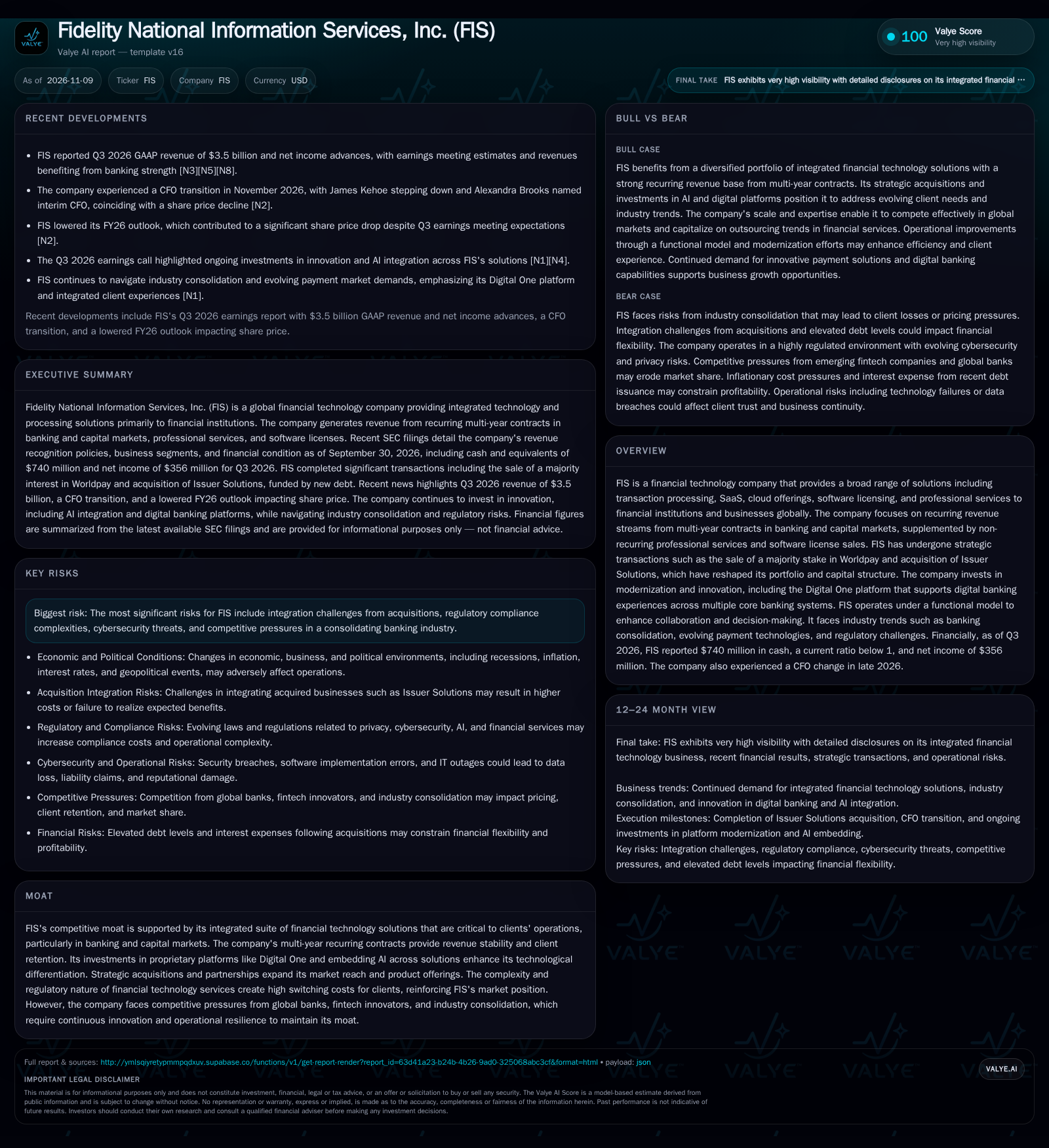
FIS's post-Worldpay-sale portfolio now leans more heavily on its core banking and capital markets technology, with multi-year contracts providing revenue visibility. The $7.7 billion Issuer Solutions deal increases scale but also adds debt and integration complexity. Innovation in digital banking and AI is a strategic focus, while industry consolidation and regulatory pressures pose ongoing challenges. [S2] [N3] [N5] [N8]
Fidelity National Information Services (FIS) has undergone a strategic transformation in 2026, selling a majority stake in its Worldpay Merchant Solutions business and acquiring Issuer Solutions with significant new debt. This reshuffling leaves FIS more focused on its core banking and capital markets technology, supported by recurring multi-year contracts. While Q3 2026 revenue and income showed stability, the company's future now hinges on successful integration of new assets, disciplined debt management, and continued investment in digital and AI-driven solutions to maintain competitive relevance in a consolidating, rapidly evolving financial technology sector. [S2] [N3] [N5] [N8]
Strategic Transactions and Recurring Revenue Define FIS’s 2026 Landscape
FIS’s business profile in late 2026 is shaped by two transformative moves: the sale of a 55% equity stake in Worldpay Merchant Solutions in early 2024 and the acquisition of Issuer Solutions in January 2026, which was financed by approximately $7.7 billion of new debt. These actions have shifted FIS’s portfolio further toward its core banking and capital markets solutions, focusing on technology and transaction processing. Most of FIS’s revenue is now derived from recurring multi-year contracts in these segments, providing a stable and visible revenue base even as the company’s capital structure takes on greater leverage. For Q3 2026, FIS reported GAAP revenue of $3.5 billion and a cash balance of $740 million, with a current ratio of 0.55. [S2] [N3] [N5] [N8]
How FIS Makes Money: Recurring Contracts, Transaction Fees, and the Cost Structure Challenge
FIS’s primary revenue streams come from technology and processing solutions, transaction fees, and professional services for financial institutions. The core economics rely heavily on multi-year contracts with banks and capital markets clients, structured to provide predictable, recurring revenues. These contracts are typically long-term due to the mission-critical nature of the underlying software and services, which support customers’ daily operations. Additional revenue is generated through non-recurring professional services and licensing, though these are less predictable and more cyclical. The specific renewal rates and contract terms are not disclosed, but industry experience suggests that such contracts can contribute to revenue stability.
The company’s cost structure is a blend of fixed and variable components. Software development, infrastructure, and regulatory compliance are largely fixed, providing operating leverage as volumes and contract values grow. Transaction processing costs and third-party data expenses are more variable, scaling with client activity. Following the Issuer Solutions acquisition, FIS’s interest expense has risen, intensifying the need for efficient integration and margin discipline. The ability to pass through vendor cost increases to clients is limited by market conditions, so margin expansion may depend more on operational efficiencies and technology-driven automation than on pricing power in the near term. [S2]
Capital needs are pronounced in periods of acquisition or large-scale platform investment. The $7.7 billion in new debt for Issuer Solutions reflects a significant increase in leverage, which, combined with ongoing investments in digital and AI capabilities, puts pressure on free cash flow generation and return on invested capital. The company’s relatively low current and cash ratios are not unusual for the sector, but sustained deleveraging will likely require both successful integration and continued growth in high-margin recurring revenues.
FIS’s Moat: Switching Costs, Integration, and the Threat of Disruption
FIS’s competitive position is anchored by the breadth and integration of its technology suite, which serves as the operational backbone for many banks and capital markets clients. Multi-year contracts and the complexity of core system migrations can increase switching costs, often resulting in high client retention. The company’s investments in platforms like Digital One and embedding AI across its offerings aim to enhance differentiation, drive stickiness, and respond to evolving client demands for digital and data-driven solutions.
However, the competitive landscape is dynamic. Large global banks may pursue internal development or partner with emerging fintechs, while specialist software providers and cloud-native entrants target high-growth segments. The trend toward industry consolidation among banks could reduce the total addressable client base or shift bargaining power. At the same time, regulatory complexity and the mission-critical nature of FIS’s offerings provide a barrier to entry for less established competitors, especially in the U.S. and major international markets.
The successful integration of Issuer Solutions is a double-edged sword: if executed well, it could expand FIS’s value proposition and cross-sell potential, but missteps could erode client trust and open the door to competitors. Ongoing innovation and operational reliability are essential for defending the moat against both traditional and disruptive rivals.
Integration Success and Digital Modernization Drive Margin Expansion
A favorable outcome for FIS would see smooth integration of Issuer Solutions, leading to cost and revenue synergies that exceed initial expectations. If FIS leverages its expanded client base to cross-sell digital banking, AI-enabled analytics, and payment solutions, it could accelerate top-line growth. Successful modernization of legacy platforms, particularly with Digital One and embedded AI, could increase switching costs and client reliance, enhancing pricing power and retention.
Evidence supporting this upside would include above-trend organic revenue growth in core banking and capital markets, margin expansion despite cost inflation, and clear disclosure of realized integration synergies. Accelerated deleveraging—such as rapid debt paydown from free cash flow—would reinforce potential financial flexibility and provide capacity for further innovation or bolt-on acquisitions. If disclosed, metrics such as client adoption rates of new digital modules, cross-sell penetration, or net retention rates would help confirm this scenario.
Stable Recurring Revenue, Measured Integration Progress, and Margin Pressure
The most plausible scenario is for FIS to maintain stable recurring revenues from its core client base, with moderate growth driven by incremental adoption of digital and AI-enabled solutions. Integration of Issuer Solutions proceeds as planned, but synergy realization is gradual, offsetting only part of the increased interest expense from the new debt. Pricing remains competitive, limiting the ability to fully pass on vendor or wage inflation, so operating margins are steady or under modest pressure.
The company’s competitive position remains intact, but market share gains are incremental rather than transformative. Confirmation of this scenario would come from consistent quarterly revenue in the banking segment, stable or modestly improving margins, and steady progress on integration milestones as disclosed in management commentary and filings.
Integration Missteps and Debt Drag Undermine Profitability
A negative outcome would be triggered by material integration challenges with Issuer Solutions—such as client attrition, platform disruptions, or higher-than-expected costs—that erode anticipated synergies. If FIS is unable to realize efficiencies or cross-sell new offerings, revenue growth may stall while expenses and interest costs rise, compressing margins and delaying deleveraging.
This scenario could be exacerbated by accelerated industry consolidation, regulatory changes impacting core products, or successful competitive incursions by agile fintechs and cloud-native platforms. Under such conditions, FIS might face increased client churn, pricing concessions, or the need for additional restructuring spending.
Evidence for this downside would include negative surprises in integration updates, client loss disclosures, margin contraction beyond management guidance, or warnings about covenant headroom or refinancing risks. Disclosures of lost contracts, delayed platform rollouts, or cost overruns would further validate this risk.
What Will Prove FIS’s Ability to Deliver on Integration, Leverage, and Digital Growth?
Integration milestones for Issuer Solutions, including cost synergy realization, revenue cross-sell metrics, and client retention levels, would help test the success of the acquisition.
Organic revenue growth rates in the core banking and capital markets segments, if disclosed, will indicate underlying demand and the effectiveness of modernization initiatives.
Operating margin trends and management commentary on cost discipline or inflation pass-through will clarify the company’s ability to defend profitability.
Net debt/EBITDA ratios and debt service coverage, as reported in future filings, will show progress on deleveraging and potential financial flexibility.
Adoption and penetration rates for Digital One and new AI-driven modules—such as percentage of clients migrated or annual recurring revenue from new solutions—would help gauge technology leadership.
Client renewal and net retention rates, if disclosed, would provide insight into switching costs and competitive pressure.
Any disclosures of large client wins, contract losses, or market share shifts in banking and capital markets would test the strength of FIS’s moat.
Management updates on regulatory, cybersecurity, or operational incidents could signal emerging risks or resilience.
Disclaimer: This is research-only, informational analysis and not investment advice. It may include AI-generated interpretation and general industry context. Always verify important details using primary sources.

Comments