
Millrose Properties 2026: Option-Driven Land Banking, Capital Recycling, and the Stakes of Homebuilder Demand
Millrose Properties, spun off from Lennar in 2025, operates a capital-recycling platform for residential land, supplying finished homesites to homebuilders via option contracts. As the company expands its financing toolkit and geographic reach, its fortunes hinge on homebuilder demand, disciplined development risk management, and the resilience of its asset-light, recurring-revenue model.
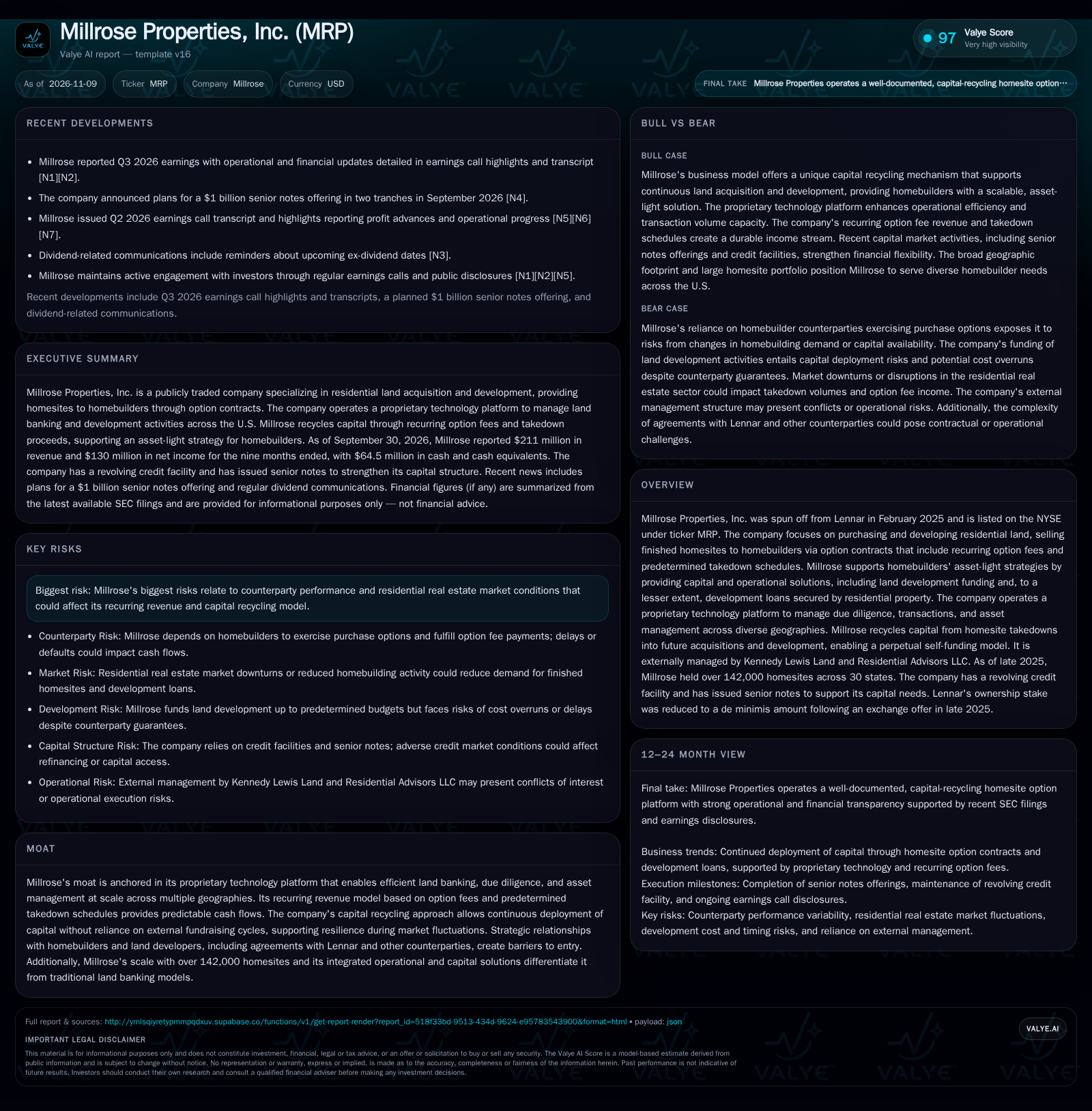
Millrose Properties monetizes a large, geographically diversified portfolio of residential land by selling homesites to homebuilders through option contracts with recurring fees and scheduled takedowns. The company’s asset-light, capital-recycling model—backed by a proprietary technology platform—enables ongoing land acquisition and development. Recent financial strength is evidenced by nine-month 2026 net income of $130 million, a $1 billion senior notes offering plan, and continued expansion of its land banking activities. The durability of its model will be tested by the health of U.S. homebuilding demand, counterparty follow-through, and disciplined management of capital deployment and development risk. [S1] [S2] [N4]
Millrose Properties, Inc. has emerged as a specialized residential land bank, operating at the intersection of real estate capital markets and homebuilder supply chains. Since its 2025 spin-off from Lennar, Millrose has rapidly scaled a nationwide portfolio of over 140,000 homesites, leveraging option contracts to deliver finished lots to homebuilders while generating recurring option fees and takedown proceeds. Its asset-light, perpetual capital recycling model promises efficiency and resilience, but the business remains exposed to homebuilder demand cycles, counterparty execution, and the discipline of its capital deployment. The company’s latest financials and capital market moves signal both opportunity and the need for ongoing vigilance as it navigates a dynamic real estate environment. [S1] [S2] [N4]
Recent Financial Results and Strategic Moves Shape Millrose’s Outlook
Millrose Properties reported $211.0 million in revenue and $130.0 million in net income for the nine months ended September 30, 2026, translating to basic and diluted EPS of $0.78. Its cash and cash equivalents stood at $64.5 million as of quarter-end. The company announced plans for a $1 billion senior notes offering in two tranches in September 2026, building on its prior $2.0 billion in senior notes and a $1.335 billion revolving credit facility. These moves reinforce Millrose’s access to capital and its intent to scale its land banking activities. The company’s active communication of dividend information and regular earnings call disclosures further reflect operational and financial transparency. [S2] [N4] [N3]
How Millrose’s Option Contract Model Drives Recurring Revenue and Capital Efficiency
Millrose’s core business is the acquisition and development of residential land, monetized through homesite option contracts with homebuilders. These contracts grant homebuilders the right, but not the obligation, to purchase finished homesites at predetermined prices and on set takedown schedules. Millrose collects recurring, non-refundable option fees—providing a steady income stream independent of actual lot purchases—and earns additional proceeds when homesites are taken down. This structure allows Millrose to recycle capital efficiently: proceeds from takedowns and option fees fund new land acquisitions and development, supporting a self-sustaining growth loop.
The asset-light nature of the model means Millrose is not directly exposed to the vertical risk of home construction and sales, but it does bear the capital intensity of land acquisition and horizontal infrastructure development. Counterparties (homebuilders) are responsible for development execution and cost guarantees, partially mitigating Millrose’s exposure to cost overruns, though ultimate performance risk is not eliminated. The company supplements its main business with development loans secured by residential property, providing another revenue stream but adding some credit risk.
Operating leverage is inherent in the platform: as Millrose increases the volume and scale of optioned homesites, incremental costs (excluding new land and development spend) rise more slowly than revenue. This can support margin expansion in favorable environments, but also amplifies the impact of volume or fee declines during downturns. The need for ongoing capital—managed through revolvers and senior notes—remains significant, especially as Millrose pursues new land banking commitments and large-scale acquisitions.
Competitive Dynamics: Scale, Platform Integration, and Market Entry Barriers
Millrose’s competitive positioning is anchored in its proprietary technology platform, which enables scalable due diligence, transaction management, and asset oversight across diverse geographies. This digital infrastructure supports efficient handling of a vast homesite portfolio—over 142,000 lots in 30 states as of late 2025—creating operational scale that few direct competitors can match. The company’s recurring-revenue model, capital recycling engine, and deep relationships with national and regional homebuilders provide further differentiation.
Barriers to entry in this niche include the need for substantial initial capital, expertise in land acquisition and entitlement, and the ability to structure complex option agreements that balance builder flexibility with predictable returns. While traditional land developers and bank lenders compete for similar opportunities, Millrose’s model is distinct in its focus on option-based lot delivery and its ability to serve homebuilders seeking off-balance-sheet land strategies. However, the company is not immune to substitution: homebuilders may pursue direct land purchases in frothy markets or shift to alternative financing sources if Millrose’s terms become less attractive. External management by Kennedy Lewis Land and Residential Advisors LLC adds a layer of complexity that could affect competitive agility.
If Homebuilder Demand Remains Robust and Capital Recycling Accelerates
The most favorable outcome for Millrose would see U.S. homebuilder demand remain strong, driving high takedown volumes and sustained appetite for option-based lot acquisition. In this scenario, recurring option fee revenue and takedown proceeds rise, supporting rapid capital recycling and enabling Millrose to scale its homesite portfolio further. The successful execution and closing of its $1 billion senior notes offering would provide ample dry powder for new land banking commitments and opportunistic acquisitions.
Operational leverage could drive margin expansion as fixed platform costs are spread over a larger revenue base. The proprietary technology platform would enable Millrose to win incremental share from less technologically advanced land banks or lenders. Confirmation of this scenario would include sustained or rising option fee income, a growing homesite portfolio, and continued expansion of builder relationships—potentially reflected in new large-scale contracts or partnerships with national builders.
A falsification of this scenario would be visible if takedown volumes stagnate or option fee growth slows, indicating builder caution or market softening. Missed execution milestones on new financings or a shrinking pipeline of new land deals would also challenge the upside thesis.
What a Normalized Land Banking Cycle Could Look Like for Millrose
The most plausible trajectory for Millrose is a moderately expanding homesite portfolio, with recurring revenue from option fees and takedown activity tracking the broader health of the U.S. residential construction market. The company continues to recycle capital from completed takedowns into new land banking opportunities, maintaining a steady cadence of acquisitions and development funding.
Millrose’s platform and scale allow it to support both national and regional homebuilders, but growth rates may moderate as the market digests prior expansion and as interest rates, housing affordability, or regulatory changes influence new home construction activity. The company’s financial health remains robust, supported by ongoing access to credit and capital markets, but is periodically tested by the timing of takedowns and builder cash flows.
Evidence confirming this scenario would include stable or gradually increasing homesite counts, consistent option fee and takedown revenue, and continued renewal or expansion of builder relationships. Any significant deviation in these metrics—especially a drop in option contract renewals or a spike in contract terminations—would suggest a departure from the base case.
How a Homebuilder Slowdown or Counterparty Stress Could Pressure Millrose’s Model
A materially adverse outcome for Millrose would be triggered by a cyclical downturn in U.S. homebuilding activity, whether due to higher interest rates, declining affordability, or macroeconomic shocks. In this scenario, homebuilders may slow or defer lot takedowns, leading to reduced takedown proceeds and potentially lower recurring option fee income if contracts are terminated or renegotiated. Builder defaults or delays could directly impact Millrose’s cash flows and expose the company to stranded land development costs.
Although option deposits are non-refundable and cost guarantees mitigate some risk, Millrose remains exposed to the risk that builder counterparties do not perform as expected during periods of stress. If capital markets tighten, Millrose’s ability to refinance or roll over credit facilities and senior notes could be impaired, raising funding costs or constraining new investment activity.
A sharp increase in development cost overruns or material disputes with counterparties would further validate the downside case.
Milestones and Metrics That Will Shape Millrose’s Next Chapter
The pace and volume of homesite takedowns by builder counterparties—reported quarterly—will directly influence revenue momentum and capital recycling velocity.
Recurring monthly option fee income, if disclosed, would provide insight into contract retention, builder demand, and the resilience of the income base.
The size and geographic diversity of the homesite portfolio, including new land banking commitments and acquisitions, will signal growth trajectory and risk dispersion.
Execution and closing of the planned $1 billion senior notes offering, including terms and investor demand, will test capital market confidence in Millrose’s model.
Incidence and financial impact of contract terminations, renegotiations, or builder defaults—especially in a cyclical downturn—will be critical to monitor.
Development cost overruns or disputes, if disclosed, would highlight operational discipline and the effectiveness of counterparty guarantees.
Changes in management fee structure or alignment due to the external management agreement could affect operating leverage and strategic incentives.
Material shifts in the U.S. new home construction market—such as changes in builder confidence, interest rates, or regulatory policy—would be key external drivers to track.
Disclaimer: This is research-only, informational analysis and not investment advice. It may include AI-generated interpretation and general industry context. Always verify important details using primary sources.

Comments