
MVB Financial 2026: Banking Diversification, Fintech Exposure, and the Stakes of Earnings Underperformance
MVB Financial’s mix of traditional banking and specialized Fintech services offers differentiated revenue streams, but recent earnings shortfalls and technology divestitures test the resilience and growth potential of its evolving business model.
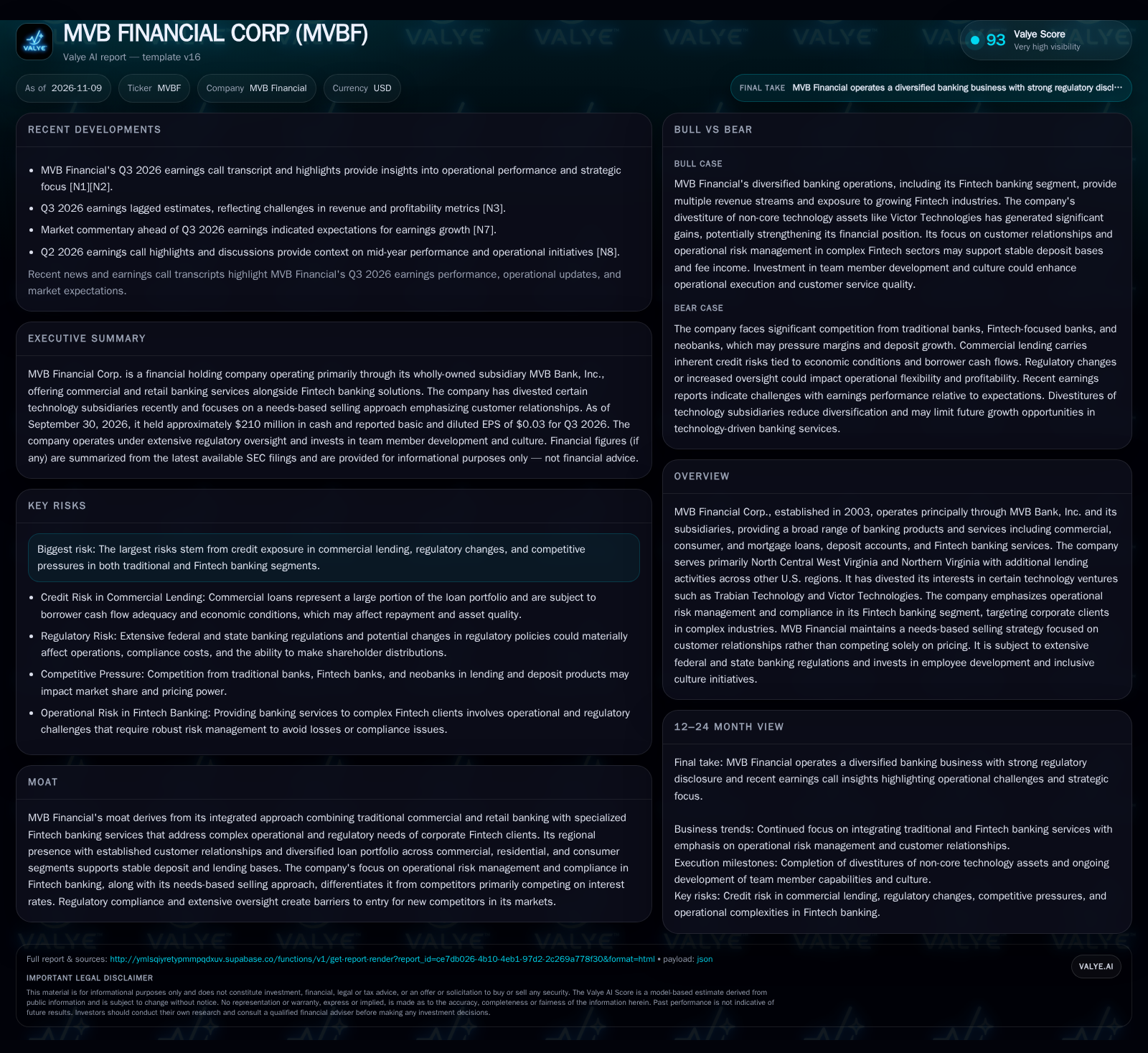
MVB Financial operates through commercial, retail, and Fintech-focused banking, with a significant presence in West Virginia and Virginia. The company’s recent technology divestitures yielded a major gain, but Q3 2026 earnings lagged expectations, raising questions about near-term profitability. Its Fintech banking segment serves complex clients in payments and gaming, emphasizing compliance and operational risk management. The balance between traditional relationships and specialized Fintech offerings will shape MVB’s ability to defend margins and grow in a competitive, regulated landscape. [S1] [S2] [N1] [N2] [N3]
MVB Financial finds itself at a pivotal juncture in 2026, balancing the legacy strengths of regional commercial banking with the promise—and operational complexity—of Fintech-focused services. While the company’s divestiture of Victor Technologies delivered a windfall, Q3 earnings have disappointed, and the evolving mix of traditional and digital banking raises questions about sustainable growth and risk management. The next phase for MVB hinges on whether its blend of relationship-driven banking and specialized Fintech offerings can offset intensifying competition, regulatory demands, and the persistent challenge of achieving profitable scale.
Recent Earnings Miss and Technology Divestitures Reshape the Strategic Landscape
MVB Financial’s Q3 2026 earnings lagged analyst expectations, with basic and diluted EPS reported at $0.03, reflecting both revenue and profitability challenges in the period. [S2] [N3] This underperformance comes on the heels of a major strategic shift: in September 2025, the company sold substantially all assets and operations of Victor Technologies, realizing a $34.2 million pre-tax gain. The company reported cash and liquidity metrics for the period; these figures do not by themselves establish operating runway, investment capacity, financial flexibility, or financing capacity. [S1] [S2]
The company’s lending mix remains heavily weighted to commercial loans ($1.71 billion, or 72.9% of total loans as of year-end 2025), with residential real estate and consumer lending representing smaller portions. [S1] The strategic challenge now centers on deploying capital from divestitures to support core segments and Fintech initiatives while restoring earnings momentum.
How MVB Financial’s Model Converts Relationships and Compliance Into Revenue Streams
MVB Financial’s economics depend on a blend of interest income from loans, fee income from specialized services, and, episodically, gains from asset sales. The core Banking segment generates revenue through a traditional spread-based model: deposits are gathered primarily from regional clients, and funds are deployed into commercial and residential loans. The company’s stated approach is needs-based selling, emphasizing customer service and relationships rather than competing solely on rates. This strategy could support higher retention and cross-sell opportunities, but may limit rapid deposit growth in a highly competitive market. [S1]
The Fintech banking segment is positioned as a differentiated fee generator, serving corporate clients in sectors such as payments, banking-as-a-service, and gaming. Here, MVB acts as a regulated banking partner, providing compliance, operational risk management, and access to the U.S. payments system. Economics in this segment likely depend on account, transaction, and compliance fees, with revenue tied to client activity volume and the value of risk management. Margins could be attractive if operational scale is achieved, but client concentration and regulatory costs may constrain profitability.
Mortgage banking, conducted primarily through equity method investments, provides exposure to origination and servicing fees but is sensitive to interest rate cycles and housing demand. The divestiture of Victor Technologies provided a one-time capital gain, but also removed a potential recurring revenue source from technology-driven services.
Fixed costs stem from branch operations, compliance infrastructure, and regulatory reporting, while variable costs are tied to loan origination, servicing, and Fintech client onboarding. The mix of fixed and variable costs means operating leverage could improve with scale, but recent earnings suggest that current revenue growth is not yet sufficient to deliver consistent margin expansion.
Relationship Banking Meets Fintech: Differentiation and Its Limits
MVB Financial’s competitive positioning hinges on its dual identity: a regional commercial bank with deep customer relationships and a specialized provider of Fintech banking services. In its core markets of North Central West Virginia and Northern Virginia, MVB competes against regional banks, credit unions, and superregional players for both deposits and loans. Its needs-based, relationship-driven model may foster loyalty and provide some insulation from pure rate wars, but larger competitors can exert pricing pressure and benefit from broader product suites. [S1]
The Fintech banking segment sets MVB apart from most traditional banks, allowing it to tap into fast-growing and compliance-intensive verticals such as payments and gaming. However, this space is also targeted by other Fintech-friendly banks and banking-as-a-service platforms, many of which are investing heavily in technology and compliance capabilities. MVB’s regulatory expertise and operational risk management focus are potential differentiators, but the company may face customer acquisition costs, technology investment requirements, and client churn risks if larger or more tech-forward banks enter the space.
Switching costs for commercial banking clients can be moderate due to embedded relationships and operational dependencies, but for Fintech clients, switching may be dictated by regulatory compliance comfort and integration complexity. The real test for MVB is whether its compliance-first approach can create sticky, recurring fee streams and defend against both Fintech-native and traditional competitors.
Leveraging Fintech Relationships and Capital Gains to Accelerate Fee-Based Growth
The most favorable outcome for MVB Financial involves successfully reinvesting proceeds from technology divestitures into scaling its Fintech banking segment and deepening its commercial client base. If MVB can attract additional high-growth Fintech clients—especially in payments and gaming—while maintaining rigorous compliance and operational risk standards, fee income could expand meaningfully. This would reduce reliance on traditional spread income and enhance margin stability.
Confirmation of this scenario would come from a rebound in earnings growth, increasing fee income as a share of total revenue, and announcements of new, multi-client Fintech partnerships. Evidence of operating leverage—such as expense growth lagging revenue growth—would further support this view. A sustained increase in core deposit balances and cross-sell metrics in CoRe Banking would also point to successful execution of the relationship model.
Falsification would be indicated by stagnant or declining fee income, loss of Fintech clients, or continued underperformance on earnings relative to expectations. A sharp increase in regulatory or compliance costs without corresponding revenue growth would also undermine this scenario.
Incremental Growth in Core Banking with Measured Expansion of Fintech Services
A more plausible middle path is that MVB Financial achieves steady—if unspectacular—growth in its core commercial and retail banking operations, while its Fintech segment expands gradually but faces ongoing margin and regulatory pressures. Loan growth in core markets may be moderate, tempered by economic conditions and credit discipline. Fee income from Fintech services could rise, but client wins may be offset by elevated compliance costs and the need for ongoing technology investment.
This scenario would be confirmed by modest improvements in quarterly EPS, stable or slowly rising loan and deposit balances, and incremental growth in fee-based revenues. MVB’s capital position would remain solid, but not materially improved from recent levels. The company would continue to emphasize culture, compliance, and relationship banking, but would not break out from the pack in terms of profitability or growth.
Falsification would come from a sharp deterioration in credit quality, significant Fintech client losses, or a return to inconsistent or declining earnings.
Rising Credit Losses and Fintech Churn Erode Profitability and Strategic Flexibility
The adverse case for MVB Financial is driven by a combination of credit deterioration in the commercial loan book and setbacks in the Fintech banking segment. If economic conditions worsen, leading to higher commercial loan defaults or loss provisions, MVB’s earnings could come under significant pressure. At the same time, increased competition or regulatory scrutiny could prompt Fintech clients to exit or demand concessions, shrinking fee income and raising compliance costs.
This scenario would be confirmed by rising non-performing loan ratios, elevated credit loss provisions, declining fee income from Fintech services, and further earnings misses. Regulatory actions or adverse examination findings would further exacerbate the downside.
Falsification would be indicated by stable or improving asset quality, retention and growth of Fintech clients, and a return to positive earnings momentum.
What Will Determine If MVB Financial’s Hybrid Model Delivers Durable Value?
Growth rate and composition of fee income, particularly from Fintech banking clients; a useful metric would be the share of total revenue derived from Fintech-related fees, if disclosed.
Quarterly trends in net interest margin and loan growth, especially within the commercial portfolio, to gauge core banking health.
Credit quality metrics such as non-performing loan ratios and provision expenses, which would test resilience in a slowing economy or stress scenario.
Retention and new client acquisition in the Fintech banking segment; announcements of major client wins or losses would be especially telling.
Changes in compliance and regulatory costs relative to revenue growth, as rising costs without revenue offset could pressure margins.
Use of proceeds from technology divestitures—whether redeployed to support core or Fintech growth, used for capital return, or held as a liquidity buffer.
Evidence of operating leverage, such as expense growth trailing revenue growth, especially as the Fintech segment scales.
Disclaimer: This is research-only, informational analysis and not investment advice. It may include AI-generated interpretation and general industry context. Always verify important details using primary sources.

Comments