
Harvard Ave Acquisition Corp 2026: SPAC Search Dynamics, Structural Constraints, and the Stakes of the First Deal
With its $145 million trust still untouched and no target identified, Harvard Ave Acquisition Corp faces the classic SPAC tension: leveraging a well-credentialed team and flexible mandate to secure a credible business combination before time and competition erode its optionality.
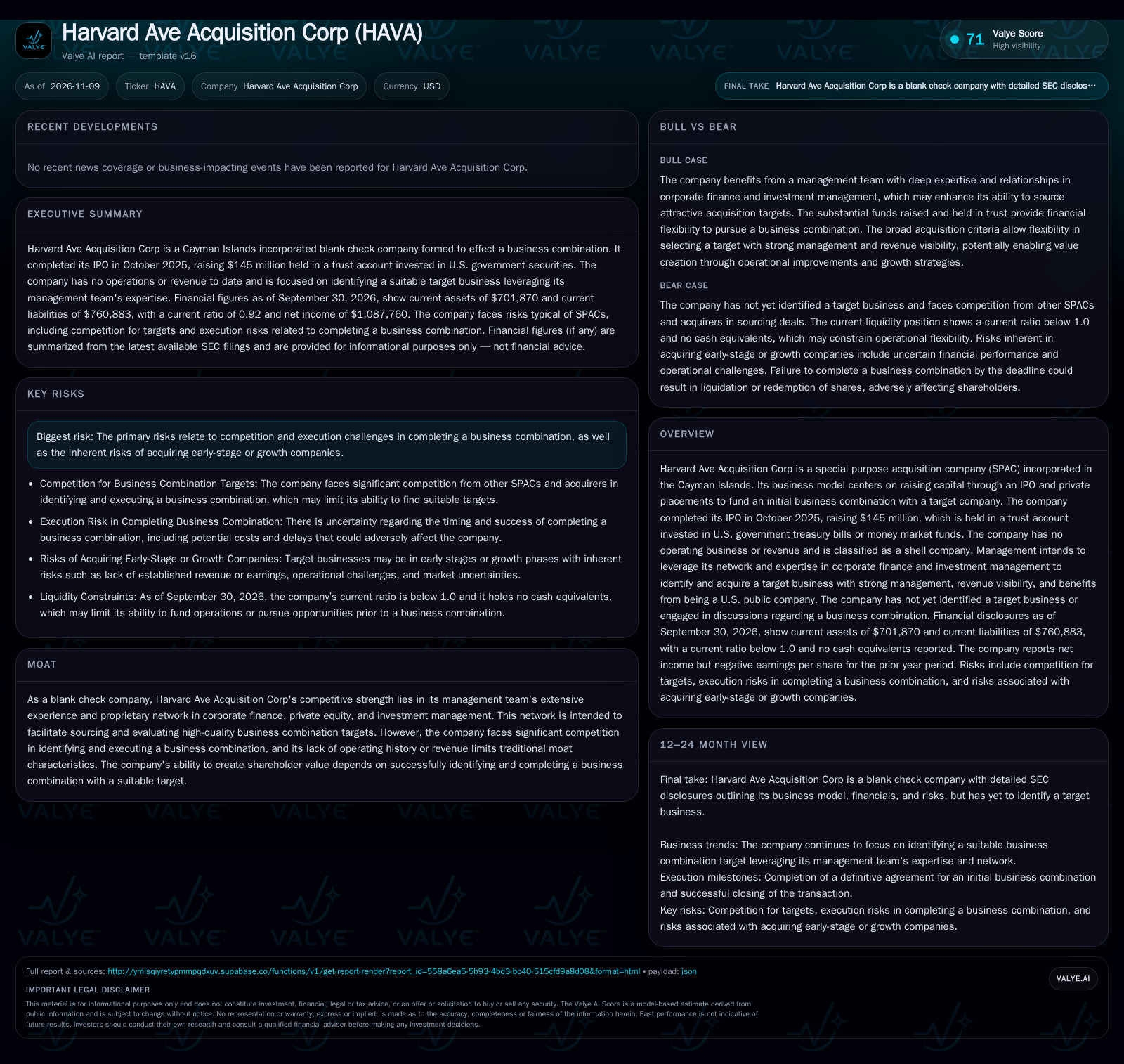
Harvard Ave Acquisition Corp remains in the pre-deal phase with $145 million in trust from its 2025 IPO, no target company identified, and standard SPAC pressures mounting as its search window advances. The firm's experienced team and open acquisition mandate offer flexibility, but competitive deal sourcing, trust erosion, and execution risk define its next chapter. The outcome—and ultimate shareholder value—hinges on identifying, negotiating, and closing a deal that meets both regulatory and market expectations. [S1] [S2]
Harvard Ave Acquisition Corp is at a pivotal moment common to many SPACs: flush with $145 million in IPO proceeds but still searching for its defining transaction. With no target identified and the clock ticking, the company's future will be determined by its ability to deploy its financial and managerial resources to secure, negotiate, and close a business combination that meets both regulatory thresholds and market expectations. The challenge is heightened by intense competition for attractive targets and the operational constraints inherent in the SPAC structure. What happens next will test the true leverage of its well-connected leadership and the flexibility of its acquisition mandate.
Where Harvard Ave Acquisition Corp Stands: Cash in Trust, No Target, and a Narrowing Window
As of November 2026, Harvard Ave Acquisition Corp remains a pure-play SPAC: it has not commenced operations, generated revenue, or identified a target company for acquisition [S1] [S2]. The $145 million raised in its October 2025 IPO is held in a U.S. trust account, invested in government securities or money market funds, and cannot be used for operating purposes except in connection with a business combination or redemption [S1].
The company’s latest balance sheet shows current assets of $701,870 and current liabilities of $760,883, with a current ratio of 0.92 and no cash equivalents reported outside the trust [S2]. This reflects the standard SPAC structure, where working capital is limited and most resources are sequestered until a deal closes. The company has reported net income for the period, but negative earnings per share in the prior year, further underscoring the absence of operating activity [S2].
No target has been identified or negotiated with, and the company faces the typical SPAC risks: competition for deals, execution risk, and the possibility of forced liquidation or redemption if no qualifying business combination is completed within the regulatory window [S1] [S2].
How Value Is Created (or Lost) in the SPAC Model: Funding, Incentives, and Deal Dynamics
A SPAC like Harvard Ave Acquisition Corp is essentially a financial shell: its economic value hinges entirely on the identification, negotiation, and successful closing of a business combination. Until a deal is consummated, the company earns only modest interest income on its trust assets and incurs ongoing legal, compliance, and due diligence costs [S1] [S2].
The principal economic levers are the size of the trust, the terms of the eventual acquisition, and the dilution from sponsor incentives and redemptions. The $145 million in trust is the core bargaining chip, but deal economics can erode quickly if a significant portion is redeemed by shareholders or if the target company commands a premium valuation.
Operating leverage is structurally high post-combination, should the acquired business have scalable fixed costs. However, prior to a deal, the fixed public company costs eat into the limited working capital, increasing pressure to close a transaction before funds are depleted by ongoing expenses. SPACs often rely on additional PIPE (private investment in public equity) financing to supplement trust funds for larger deals or to offset redemptions, but terms and availability can be highly variable depending on market conditions and the perceived quality of the target.
The capital needs of the combined entity depend entirely on the chosen target’s sector, stage, and growth profile. If the target is early-stage or capital-intensive, further fundraising or dilution may follow; if it is mature and profitable, the merged company could drive value through operating leverage and public-market access.
Deal Sourcing and Selection: Why SPACs Face Intense Competition and Shrinking Moats
Harvard Ave Acquisition Corp’s core advantage is its management team’s experience in private equity, corporate finance, and investment management, which is intended to provide access to proprietary deal flow and the ability to evaluate complex transactions [S1]. However, this edge is subject to diminishing returns: dozens of other SPACs and traditional acquirers are chasing a finite pool of attractive targets, particularly those with defensible market positions and long-term revenue visibility.
Unlike operating businesses, SPACs have no inherent product, customer base, or recurring revenue stream prior to a deal. Their competitive position is defined by their ability to source, negotiate, and close a transaction that public investors will support. The open mandate—no sector or geography restriction—offers flexibility but also exposes the company to a broader set of rivals, including private equity sponsors, corporate acquirers, and other SPACs.
Switching frictions are minimal for targets, who can entertain multiple offers or opt for traditional IPOs or private funding. The only durable advantages in this landscape are speed, reputation, and the ability to creatively structure deals. Harvard Ave Acquisition Corp’s future moat, if any, will be entirely a function of the operating business it ultimately acquires.
Unlocking Shareholder Value: What Would a Successful SPAC Transaction Require?
The most favorable outcome for Harvard Ave Acquisition Corp is the identification and successful acquisition of a target with proven management, defensible market positioning, and strong, visible revenue streams. If the management team can leverage its network to source a proprietary deal at a reasonable valuation—ideally with limited redemptions and strong PIPE participation—the merged entity could create significant value for public shareholders.
Confirmation of this scenario would include: announcement of a definitive merger agreement with a well-regarded private company, favorable investor reception (low redemption rates), and the ability to secure additional PIPE capital if needed to support the deal. The market would also look for robust disclosure on the target’s financials, growth prospects, and alignment with the stated acquisition criteria.
Falsification would occur if the company announces a target perceived as speculative, early-stage, or overvalued, leading to high redemptions, difficulty raising supplemental capital, and a tepid market response.
Most Likely Path: Prolonged Search, Deal Competition, and Execution Risk
The most plausible outcome is that Harvard Ave Acquisition Corp continues its search for a suitable target, facing intensifying competition from other SPACs and acquirers. As the regulatory deadline approaches, deal urgency increases, potentially reducing negotiating leverage and raising the risk of settling for a less attractive or more speculative target.
If a deal is announced, it may be met with moderate redemptions, requiring additional capital or restructuring of terms to close. The quality of the target and the terms of the transaction will largely determine post-merger value creation. Confirmation would be a timely announcement of a deal that meets regulatory requirements and secures sufficient capital to close, with manageable redemption rates.
Falsification would be continued delays, deal rumors that do not materialize, or the announcement of a target that fails to excite the market or meet regulatory thresholds, leading to deal abandonment or extension requests.
Deal Failure and Liquidation: How the SPAC Model Can Unwind
Should Harvard Ave Acquisition Corp fail to secure and close a qualifying business combination within the mandated timeframe, the company would be forced to liquidate, returning the trust proceeds (minus allowable expenses) to public shareholders. This outcome is increasingly common among SPACs that cannot differentiate themselves in a crowded field or that encounter insurmountable regulatory or market obstacles.
Confirmation would be the expiration of the search window without a definitive agreement, announcements of extension votes, or a significant portion of shareholders opting for redemption. Early warning signs include mounting expenses relative to working capital, lack of credible deal rumors, or management turnover.
Falsification would require clear evidence of a target announcement and a credible path to closing with sufficient shareholder support.
Milestones and External Cues That Will Determine Harvard Ave Acquisition Corp’s Fate
Announcement of a definitive business combination agreement, including details on the target company’s sector, financial profile, and rationale for the transaction.
Redemption rates at the time of shareholder vote—low redemptions would signal market support, while high redemptions could jeopardize deal economics and closing.
PIPE financing commitments or other supplemental capital raised in conjunction with a proposed transaction, if disclosed.
Timing and results of any shareholder extension votes if no target is announced as the deal window closes.
Disclosure of any exclusive negotiations, letters of intent, or regulatory filings indicating progress toward a deal.
Changes in management or sponsor group composition, as these could signal shifting strategy or execution risk.
Working capital trends and expense run rate prior to deal announcement, as sustained outflows could pressure the search timeline.
Disclaimer: This is research-only, informational analysis and not investment advice. It may include AI-generated interpretation and general industry context. Always verify important details using primary sources.

Comments