
U-Haul 2026: Fleet Rotation, Dealer Scale, and the Stakes of Regulatory Disruption
U-Haul’s vast rental network and integrated fleet management support strong core economics, but rising vehicle costs, supply chain dependencies, and looming regulatory changes around electrification and autonomy threaten to reshape the business model. The company’s ability to navigate these pressures while leveraging its dealer footprint and used-truck sales will define its resilience and upside.
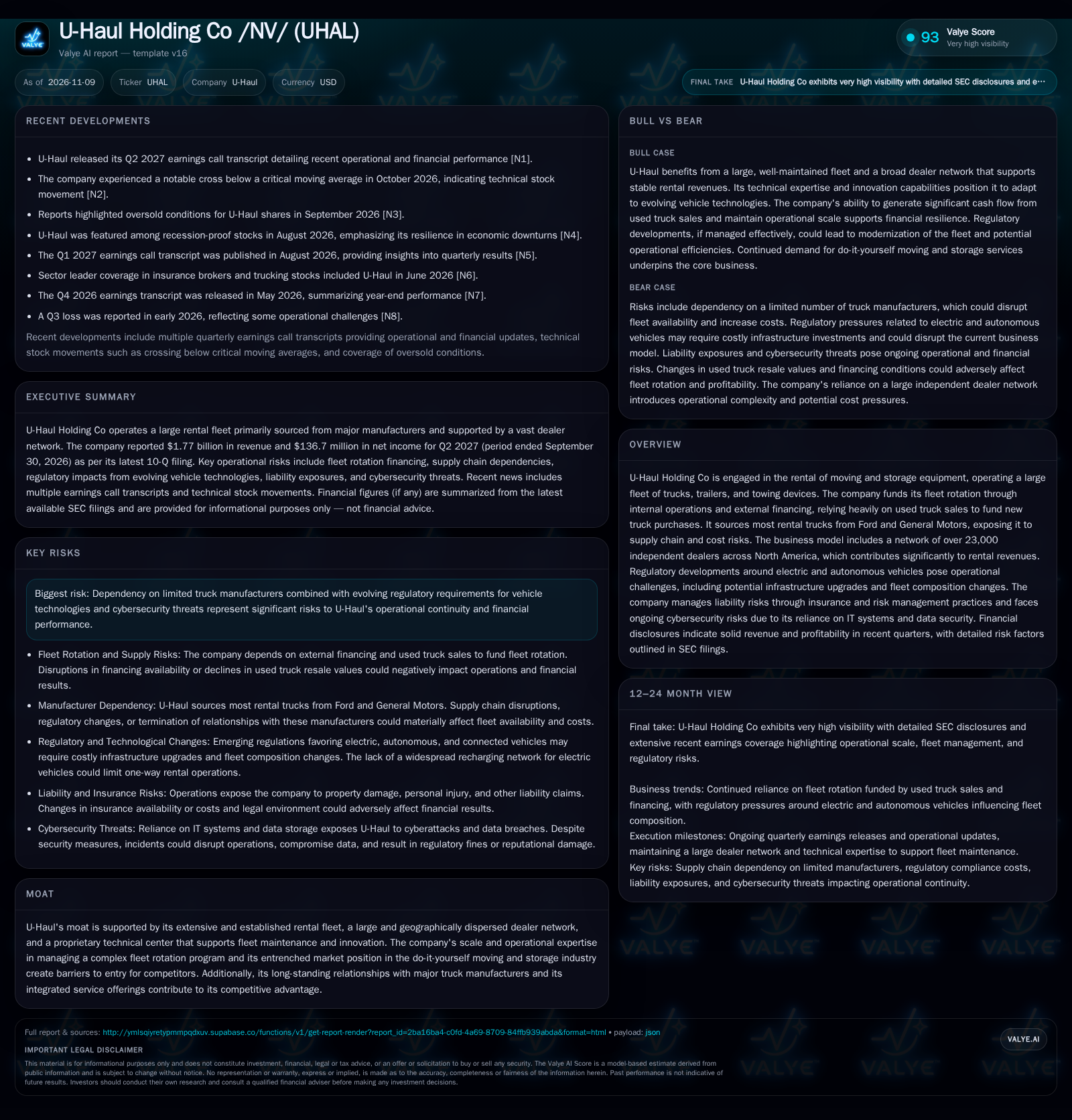
U-Haul reported $1.77 billion in revenue and $136.7 million in net income for the quarter ended September 30, 2026, maintaining solid profitability despite a recent Q3 loss earlier in the year. The company’s business model is anchored in fleet rotation funded by used-truck sales and external financing, but faces rising truck acquisition costs and potential supply risks due to its reliance on Ford and GM. California’s Advanced Clean Fleets regulation and broader shifts toward electric and autonomous vehicles could drive significant capital needs and operational changes. U-Haul’s large independent dealer network remains a core strength, but regulatory disruption and supply chain volatility are watchpoints for future performance. [S2] [N1] [N8]
U-Haul Holding Co stands at a crossroads as the traditional economics of its moving and storage business are tested by rising vehicle costs, supply chain concentration, and accelerating regulatory change. The company’s latest quarter showed robust revenue and profit, but a prior Q3 loss and ongoing cost inflation in truck acquisition highlight the fragility of its fleet rotation model. As California and other jurisdictions push for electric and autonomous vehicle adoption, U-Haul’s need to adapt its fleet, invest in new infrastructure, and manage manufacturer dependencies will shape its future value proposition and operational resilience. The interplay between its large dealer network, used-truck sales, and regulatory adaptation presents both risk and opportunity as the business navigates a period of structural transition. [S2] [N1] [N8]
Fleet Economics and Regulatory Overhang in the Latest Quarter
U-Haul reported approximately $1.77 billion in revenue and $136.7 million in net income for the quarter ending September 30, 2026, underscoring ongoing profitability after a Q3 loss earlier in the year. This rebound suggests a degree of resilience, but does not fully offset the volatility experienced in prior periods. The company reported cash and liquidity metrics for the period; these figures do not by themselves establish operating runway, investment capacity, financial flexibility, or financing capacity. However, the cost of acquiring new rental trucks has continued to rise, driven by inflation, supply chain constraints, and vendor concentration—U-Haul sources most of its trucks from Ford and GM, creating a supply risk if disruptions or price hikes occur. At the same time, regulatory pressures, particularly California’s Advanced Clean Fleets regulation, threaten to accelerate capital requirements for electrification and infrastructure upgrades, potentially disrupting U-Haul’s established operating model. [S2] [N1] [N8]
How U-Haul’s Cash Flows and Fleet Rotation Drive Core Profitability
U-Haul’s business model is fundamentally tied to the economics of fleet rotation: the company acquires new trucks (primarily from Ford and GM), deploys them in its rental network, and funds replacements through a combination of internal cash flow, external debt/lease financing, and proceeds from selling used trucks. Used truck sales are a crucial funding lever, but are sensitive to macroeconomic cycles, demand for pre-owned vehicles, inventory levels, and external factors such as tariffs or fuel costs. Rising acquisition costs for new trucks compress the spread between purchase and resale value, tightening margins and making the timing of fleet turnover more consequential.
The company’s dealer network—spanning over 23,000 independent locations—generates just under half of U-Move rental revenue, providing both scale and geographic reach. However, this model creates operational complexity and requires ongoing investment in dealer relationships, technology platforms, and customer service oversight. U-Haul also generates incremental revenue from moving supplies, towing accessories, and self-storage, layering additional margin streams on top of its core rental business. Capital needs are episodic and linked to fleet refresh cycles, with external financing playing a variable but sometimes critical role during periods of high replacement demand or when used truck markets soften.
Dealer Network Scale and Manufacturer Dependence: U-Haul’s Moat and Its Weak Points
U-Haul’s moat is anchored in its broad and deeply integrated dealer network, which enables national coverage, convenience, and dense local presence for DIY movers. The network effect—where more locations attract more customers—creates high switching costs for competitors seeking to match U-Haul’s ubiquity. Its proprietary technical center and expertise in fleet maintenance further reinforce operational efficiency and innovation.
However, the company’s dependence on Ford and GM for new truck supply is a structural vulnerability. Any disruption—whether from labor issues, supply chain shocks, or abrupt regulatory shifts—could limit fleet availability or raise costs materially. Competing rental and storage platforms, regional truck rental providers, and emerging mobility companies represent potential substitutes, especially as electrification and autonomy lower barriers to entry or change the economics of vehicle ownership and operation. U-Haul’s ability to maintain its lead will hinge on managing these dependencies and adapting its service mix as the industry evolves.
Upside Hinges on Fleet Modernization and Regulatory Adaptation
If U-Haul successfully navigates rising vehicle costs and regulatory mandates, it could leverage its scale to modernize the fleet ahead of peers—potentially extracting pricing power or operational efficiencies as competitors struggle to comply. Early investments in electrification and digital rental platforms could position U-Haul as the go-to provider for green mobility solutions in the moving sector. The company’s technical center and history of operational innovation may allow it to pilot new business lines, such as electric-only rentals, autonomous truck deployment, or expanded moving-helper services, capturing incremental share as customer preferences shift.
Evidence for this scenario would include: sustained or improving rental margins despite higher truck acquisition costs; successful roll-out of electric or autonomous fleet segments; regulatory compliance achieved with less capital strain than feared; and continued growth in dealer participation or digital engagement. Falsification would be signaled by margin contraction, major delays in fleet upgrades, or loss of market share to new entrants exploiting regulatory transitions.
Status Quo with Mounting Pressures: Incremental Adaptation and Margin Management
The most plausible path forward sees U-Haul maintaining its core rental economics through incremental adaptation—continuing to rotate its fleet, manage used-truck sales, and invest selectively in electrification and digital capabilities. Rising truck acquisition costs and regulatory pressures are partially offset by pricing adjustments or cost efficiencies, but margin expansion is limited. The company’s broad dealer network continues to deliver market reach, but operational complexity and technology investment needs rise as customer expectations shift toward digital and environmentally friendly solutions.
Confirmation would come from stable or gradually rising revenue and profit, ongoing dealer network expansion, and manageable capital outlays for regulatory compliance. Signs of stress—such as declining rental margins, persistent negative free cash flow, or visible dealer attrition—would challenge this middle-case thesis.
Disruption from Supply Chain Shocks and Regulatory Costs
The primary downside risk is a confluence of adverse supply chain events and regulatory disruption: if Ford or GM experience production delays, or if the used truck market deteriorates, U-Haul could face both fleet shortages and compressed margins. Simultaneously, if regulatory timelines for electric or autonomous vehicle adoption accelerate or infrastructure upgrades prove more expensive than anticipated, capital needs could outstrip available funding, forcing U-Haul to defer fleet rotation, raise prices, or shrink its network.
This scenario would be confirmed by a steep drop in fleet utilization, negative operating leverage as fixed costs outpace revenue, or a spike in debt or equity financing to cover compliance costs. Persistent Q3 losses, shrinking cash balances, or negative trends in dealer participation would further validate the downside thesis.
What Will Prove U-Haul’s Resilience or Vulnerability Through 2027?
Quarterly trends in gross rental margin, especially as new truck costs and regulatory spending rise—if disclosed.
Volume and pricing trends in used truck sales, which directly influence fleet rotation funding and capital needs.
Dealer network count and geographic coverage, as any net attrition or regional contraction could signal competitive or operational strain.
Fleet composition metrics: the proportion of electric or autonomous vehicles in the active fleet, and related infrastructure investment, if disclosed.
Incidents or disclosures of supply chain disruption from Ford or GM, including delays, price increases, or allocation reductions.
Ongoing regulatory compliance costs and timing of required fleet upgrades, particularly in California and other early-adopter jurisdictions.
Customer adoption of digital rental, mobile app, and self-service options, which may buffer operating costs and support service quality.
Any material cybersecurity, insurance, or liability event that disrupts operations or results in outsized financial impact.
Disclaimer: This is research-only, informational analysis and not investment advice. It may include AI-generated interpretation and general industry context. Always verify important details using primary sources.

Comments