
Lyell Immunopharma 2026: Clinical Momentum, Capital Infusion, and the Stakes of CAR T-Cell Differentiation
Lyell Immunopharma advances its dual-targeting CAR T-cell platform with promising mid-stage clinical results in lymphoma and a recent $80 million capital raise. The company’s ability to convert clinical promise into durable commercial value will hinge on pivotal trial outcomes, manufacturing execution, and its ability to carve a niche amid intensifying competition in cell therapy.
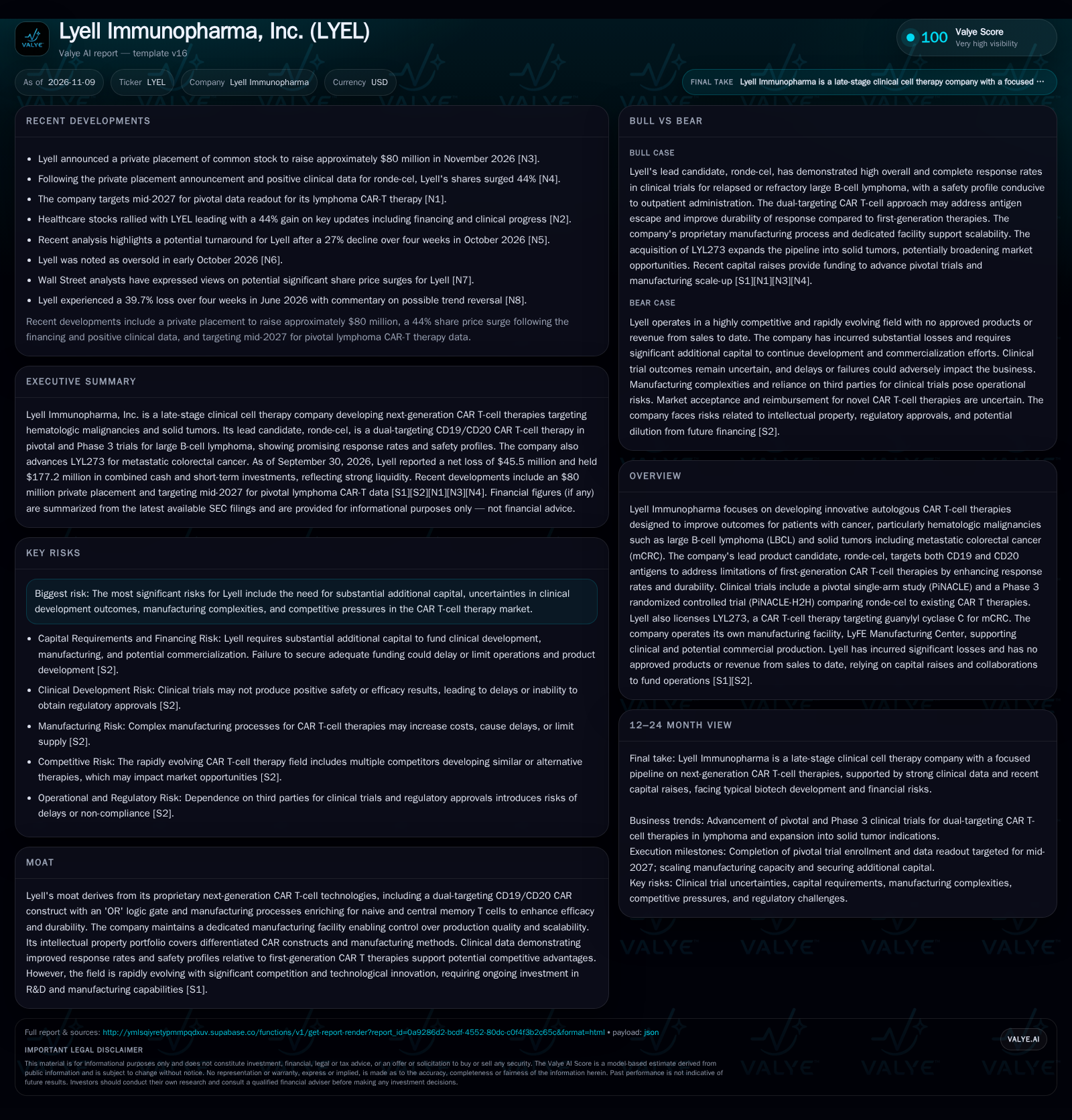
Pivotal trial data expected in mid-2027 will be critical for value inflection and future funding options. [S1] [S2] [N1] [N3] [N4]
As Lyell Immunopharma enters late 2026, the company stands at a critical juncture: promising clinical data for its next-generation CAR T-cell therapies have been matched by renewed investor interest and a fresh $80 million capital injection. With ronde-cel advancing through pivotal trials in large B-cell lymphoma and a pipeline expansion into solid tumors, Lyell’s near-term future will be defined by its ability to translate scientific differentiation and manufacturing control into regulatory approval, commercial traction, and sustainable financial footing. The next 18-24 months—culminating in a pivotal data readout—will test whether Lyell can emerge as a durable player in the competitive CAR T-cell therapy landscape.
Recent Clinical and Financial Developments Set the Stage for a Transformative Year
The company reported cash and liquidity metrics for the period; these figures do not by themselves establish operating runway, investment capacity, financial flexibility, or financing capacity. These developments are pivotal because they demonstrate both clinical momentum and improved potential financial flexibility, positioning Lyell to complete key trials and scale manufacturing ahead of a potential first product launch. [S1] [S2] [N1] [N3] [N4]
Pathways to Value Creation: Autologous CAR T Economics and Capital Demands
Lyell’s business model is built around the development and eventual commercialization of autologous CAR T-cell therapies. In this model, revenue generation depends entirely on clinical success, regulatory approval, and payer adoption. Pricing for CAR T therapies historically exceeds $350,000 per patient in the U.S., but reimbursement is closely tied to demonstrated clinical benefit and durability of response. Dual-targeting constructs like ronde-cel aim to justify premium pricing by addressing limitations of first-generation CD19 CAR Ts, such as antigen escape and limited durability.
Manufacturing is capital- and labor-intensive, especially for autologous (patient-specific) cell therapies. Lyell’s LyFE Manufacturing Center—capable of producing over 1,200 doses per year at full staffing—provides both quality control and scalability, potentially supporting better gross margins if capacity is efficiently utilized. However, fixed costs are high, and underutilization could depress margins until commercial scale is reached. The company’s ongoing net losses and lack of product revenue mean continued dependence on external capital until pivotal data unlocks either commercial sales or partnership opportunities. [S1] [S2]
Operating leverage could materialize if Lyell achieves approval and ramp-up, as incremental manufacturing volumes would spread fixed costs and potentially improve gross margins. However, the need for ongoing R&D investment and potential commercial buildout implies that profitability—even post-approval—may not be immediate.
Competitive Moats and the Realities of the CAR T-Cell Therapy Landscape
Lyell’s core differentiation rests on its dual-targeting (CD19/CD20) CAR construct and proprietary manufacturing processes that enrich for naive and central memory T cells, which could drive improved efficacy and durability relative to first-generation therapies. Early clinical data suggest robust response rates and a safety profile that may enable outpatient administration—a meaningful advantage if confirmed in larger trials.
However, the field is crowded and fast-moving. Approved CAR T therapies (such as axi-cel and liso-cel) have set efficacy and safety benchmarks, and competitors are pursuing similar multi-antigen targeting, allogeneic (off-the-shelf) approaches, and novel constructs. Intellectual property, manufacturing scalability, and long-term clinical outcomes will be key battlegrounds. Lyell’s dedicated manufacturing facility and IP portfolio provide some defensibility, but the ultimate competitive position will depend on head-to-head trial results, speed to market, and the ability to secure payer adoption in a cost-sensitive environment. [S1]
The company’s expansion into solid tumors via LYL273 for metastatic colorectal cancer represents a higher-risk, higher-reward frontier, as no CAR T has yet demonstrated durable commercial success in solid tumors.
What If Ronde-cel Delivers: A Roadmap to Commercial Breakout
The favorable scenario sees ronde-cel’s pivotal and Phase 3 trials delivering superior or at least non-inferior efficacy and safety compared to incumbent CAR T therapies, with outpatient administration providing a differentiated value proposition for patients, providers, and payers. This would support strong regulatory approval prospects and robust payer coverage, enabling rapid commercial uptake in the third- and second-line LBCL settings.
If manufacturing scale-up proceeds smoothly, Lyell could leverage its facility to meet demand without significant supply bottlenecks, capturing attractive pricing and gross margins. Expansion into solid tumors via LYL273 could provide a second growth engine if early efficacy and safety signals translate into later-stage success.
Evidence confirming this scenario would include: positive pivotal trial results with statistical superiority or clear non-inferiority versus standard of care; regulatory filings and approvals on schedule; commercial supply readiness; and initial payer contracts or reimbursement wins.
Execution-Dependent Progress: From Clinical Data to Potential Launch
The most plausible trajectory is that Lyell advances ronde-cel through pivotal readout by mid-2027, with results that are competitive but not dramatically superior to existing CAR T therapies. Regulatory submission follows, with approval possible in late 2027 or 2028. Manufacturing buildout continues, but commercialization is gradual as payers scrutinize outcomes data and providers weigh operational logistics.
The company continues to invest in pipeline development, particularly LYL273, but progress in solid tumors remains incremental given higher biological and clinical risk.
This scenario would be confirmed by on-time trial enrollment and data release, regulatory engagement without major setbacks, and disclosures of manufacturing scale-up activity. Evidence against it would include material trial delays, negative safety signals, or inability to secure additional capital as cash burn continues.
When Clinical or Financial Risks Materialize: The Threat of Setbacks
The adverse scenario involves disappointing pivotal trial results for ronde-cel—such as lower-than-expected efficacy, safety concerns, or failure to demonstrate differentiation versus established CAR T therapies. Regulatory delays or denials could follow, and payers may be reluctant to reimburse a non-superior therapy, especially if cost advantages are unclear.
Manufacturing or scale-up challenges could exacerbate the situation, resulting in higher-than-anticipated costs, batch failures, or supply constraints. In the absence of commercial revenue, cash burn accelerates, forcing Lyell to seek additional capital in a potentially unreceptive market, risking shareholder dilution or operational cutbacks.
This scenario would be confirmed by negative or inconclusive pivotal data, trial discontinuations, regulatory setbacks, or large-scale layoffs/restructuring. Delayed or failed solid tumor programs would compound the downside, especially if competitors leapfrog Lyell with next-generation or allogeneic products.
How to Assess Lyell’s Progress: Milestones That Will Shape the CAR T-Cell Thesis
Pivotal trial enrollment rates and interim data updates for ronde-cel—progress here will signal whether mid-2027 data timing remains on track.
Comparative efficacy and safety data from the Phase 3 head-to-head trial versus incumbent CAR T therapies—a useful metric would be progression-free survival and outpatient administration rates, if disclosed.
Updates on LyFE Manufacturing Center utilization and batch success rates—evidence of efficient manufacturing scale-up would support margin and supply assumptions.
Cash burn and remaining runway post-private placement—quarterly updates will clarify whether further capital raises are likely before commercialization.
Regulatory feedback and timelines for BLA (Biologics License Application) submission—notifications of delays or requests for additional data would be significant.
Initial payer and provider feedback on ronde-cel’s value proposition, if disclosed—early signals of reimbursement or adoption would support commercial ramp-up assumptions.
Progress and additional data for LYL273 in metastatic colorectal cancer—expansion beyond hematologic malignancies could materially shift Lyell’s long-term opportunity set.
Disclaimer: This is research-only, informational analysis and not investment advice. It may include AI-generated interpretation and general industry context. Always verify important details using primary sources.

Comments