
Cadre Holdings 2026: Acquisitions, Recurring Safety Demand, and the Stakes of Government Reliance
Cadre Holdings' mix of strong backlog growth, recent strategic acquisitions, and exposure to government-driven safety cycles positions it for continued expansion—but integration costs, procurement volatility, and compliance risks complicate the outlook.
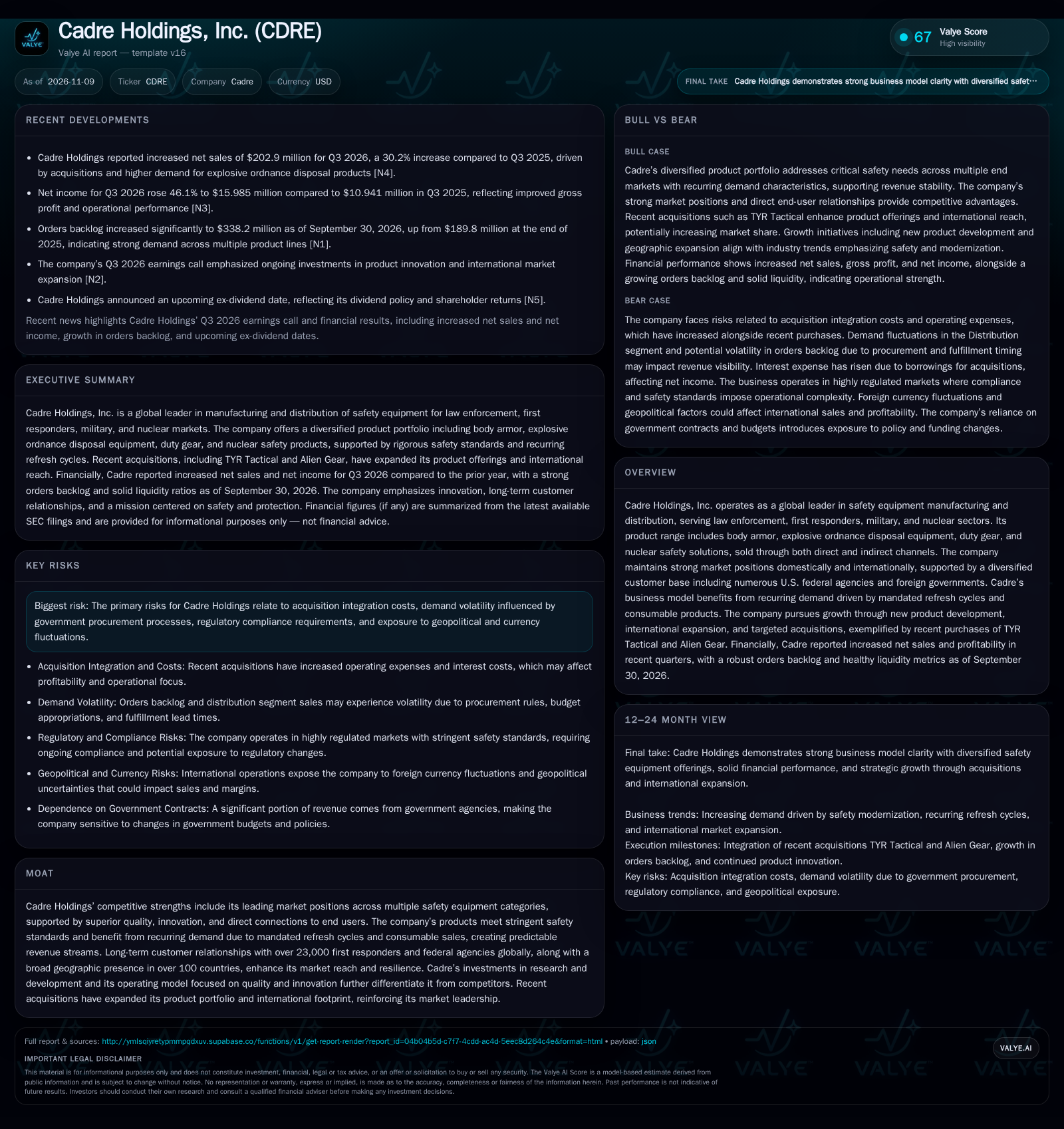
Cadre Holdings reported a 30.2% year-over-year sales increase in Q3 2026, fueled by acquisitions and heightened demand for explosive ordnance disposal equipment. Its orders backlog has surged to $338.2 million, reflecting robust customer appetite and multi-segment strength. The company is investing in innovation and international expansion, but must navigate acquisition integration costs, regulatory complexity, and the unpredictability inherent in government procurement cycles. Near-term performance will hinge on successful integration of new businesses, sustained demand, and effective risk management across global operations. [N1] [N2] [N4]
Cadre Holdings, Inc. stands at a strategic inflection point in late 2026: its core safety equipment business is bolstered by a sharply increased orders backlog, recent high-profile acquisitions, and a surge in demand for specialized products like explosive ordnance disposal gear. Yet, these growth levers come with real execution risks—ranging from integrating new businesses and absorbing higher operating expenses to managing the inherent unpredictability of government procurement cycles and regulatory demands. The company’s ability to sustain momentum will depend on how effectively it balances recurring demand and innovation with the operational complexity and risks of its expanding global footprint. [N1] [N2] [N4]
Backlog Expansion, Acquisition Activity, and Demand Surge: What’s Changed in 2026
Cadre Holdings reported net sales of $202.9 million in Q3 2026, a 30.2% increase versus Q3 2025, with gains attributable to both the integration of acquired businesses and elevated demand for explosive ordnance disposal equipment. The company’s orders backlog jumped to $338.2 million as of September 30, 2026—up substantially from $189.8 million at the end of 2025—supporting near-term revenue visibility and suggesting robust multi-segment demand. Recent acquisitions of TYR Tactical and Alien Gear have broadened Cadre’s portfolio and international presence, but have also increased operating and integration costs. Cadre’s management has highlighted ongoing investments in product innovation and overseas expansion as current strategic priorities. [N1] [N2] [N4]
How Recurring Demand and Product Breadth Drive Cadre’s Economic Engine
Cadre’s revenue model rests on recurring demand from institutional customers—law enforcement, first responders, military, and nuclear sectors—where safety equipment is subject to mandated refresh cycles and consumable usage. This creates a steady baseline of demand even in the absence of new customer wins. The company’s product mix spans high-specification body armor, ordnance disposal gear, duty gear, and nuclear safety solutions, allowing for cross-selling and diversified exposure across procurement cycles.
Pricing power is generally limited in government and regulated end-markets, but Cadre can offset this with volume, product innovation, and a reputation for meeting stringent safety standards. The addition of TYR Tactical and Alien Gear likely increases addressable market and average deal size, but also raises integration complexity and associated costs. Operating leverage may improve if recent acquisitions are integrated efficiently and if incremental sales flow through to the bottom line, but the risk is that higher fixed costs from acquired operations outpace revenue synergies.
Capital needs are driven by inventory requirements, R&D for new product development, and working capital to support large contracts with extended procurement cycles. The company reported a reported liquidity position as of September 30, 2026 [S2], but the real test will be sustaining cash generation through integration and potential procurement lulls.
Market Leadership, Moat Drivers, and the Pressures of a Fragmented Safety Equipment Landscape
Cadre’s competitive edge derives from its longstanding relationships with over 23,000 first responders and federal agencies, broad geographic presence in over 100 countries, and a reputation for high-quality, compliant products. Its ability to meet strict regulatory and safety standards—and to supply both consumables and capital equipment—differentiates it from many niche or regional players.
However, the safety equipment value chain is highly fragmented. Competitor categories include specialized body armor manufacturers, global diversified defense suppliers, and local duty gear providers. While Cadre’s breadth and recurring customer base offer resilience, the company must continually invest in product innovation and compliance to avoid commoditization. Larger defense firms could increasingly target adjacent markets, and procurement cycles may compress or stretch depending on government budgets and geopolitical dynamics.
Switching costs are moderate: while end-users are risk-averse and resistant to changing suppliers for critical gear, government procurement processes can drive price-based competition and force re-bidding, eroding margin stability.
Integration Success and International Wins Could Unlock Step-Change Value
If Cadre successfully integrates TYR Tactical and Alien Gear—with minimal disruption, rapid cost synergies, and cross-selling into new geographies—the company could see sustained margin expansion and outsize revenue growth. Continued backlog growth, especially from international customers, would confirm that product innovation and expanded reach are resonating beyond core U.S. markets.
The upside scenario would be validated by evidence such as: year-over-year EBITDA margin improvement despite higher operating expenses; new multi-year contracts (if disclosed) in international markets; and a stable or growing orders backlog even as major contracts are fulfilled. Further, a reduction in acquisition-related expenses and interest costs—alongside cash flow growth—would suggest that the integration phase is moving into a value-creation cycle.
Sustained Demand, Integration Headwinds, and Procurement Volatility Define the Near-Term Outlook
The most plausible trajectory for Cadre is continued revenue growth supported by a strong backlog and recurring demand from mandated refresh cycles, tempered by elevated operating expenses and integration friction from recent acquisitions. Procurement volatility—driven by government budget timing and fulfillment lead times—will likely result in uneven revenue recognition across quarters.
Base-case evidence would include: modest incremental margin improvement as integration progresses but does not fully offset cost increases; stable or slightly declining backlog as large contracts are delivered; and ongoing investments in R&D and international sales infrastructure. If Cadre maintains its reported liquidity position [S2] and avoids major contract losses, the business is positioned for steady, if lumpy, expansion.
Acquisition Drag, Budget Shocks, and Compliance Failures Threaten the Thesis
Adverse outcomes could arise if acquisition integration proves more costly or disruptive than anticipated, leading to margin compression or operational distraction. A material reduction in government procurement—due to budget cuts, policy shifts, or geopolitical tensions—could cause revenue shortfalls, especially given Cadre’s reliance on government contracts.
Downside confirmation might come from: a sharp decline in orders backlog; rising operating expenses outpacing sales growth; or regulatory/compliance setbacks that result in product recalls, lost contracts, or legal penalties. Currency volatility and international instability could further erode profitability if overseas expansion outpaces risk controls.
Milestones to Test Cadre’s Expansion and Integration Thesis in 2026–2027
Orders backlog trend: Sustained growth or stability in the $338 million+ range would support the demand thesis; a drop-off would signal procurement headwinds.
EBITDA and operating margin progression: If disclosed, these would clarify whether integration and cost synergies are materializing.
Acquisition integration updates: Management commentary and expense line items related to TYR Tactical and Alien Gear will be critical for assessing progress.
International sales growth: A useful metric would be the share of revenue from non-U.S. markets and new contract wins abroad.
Product innovation cadence: Announcements of new or upgraded safety equipment—especially with adoption by major agencies—would confirm R&D effectiveness.
Distribution segment volatility: Quarterly segment breakdowns, if disclosed, would reveal underlying demand trends and exposure to procurement cycles.
Regulatory or compliance events: Any product recalls, compliance failures, or adverse regulatory actions would materially impact the risk profile.
Interest expense and leverage: Monitoring changes in debt service costs and overall leverage would help gauge potential financial flexibility and risk from acquisition funding.
Disclaimer: This is research-only, informational analysis and not investment advice. It may include AI-generated interpretation and general industry context. Always verify important details using primary sources.

Comments