
Voya Financial 2026: Scale, Integration, and the Stakes of Technology-Led Workplace Benefits
Voya Financial’s $1.1 trillion platform blends retirement, investment management, and employee benefits at institutional scale. As technology partnerships and acquisitions reshape the business, the question is whether integration and digital execution can deliver sustained growth amid competitive and market pressures.
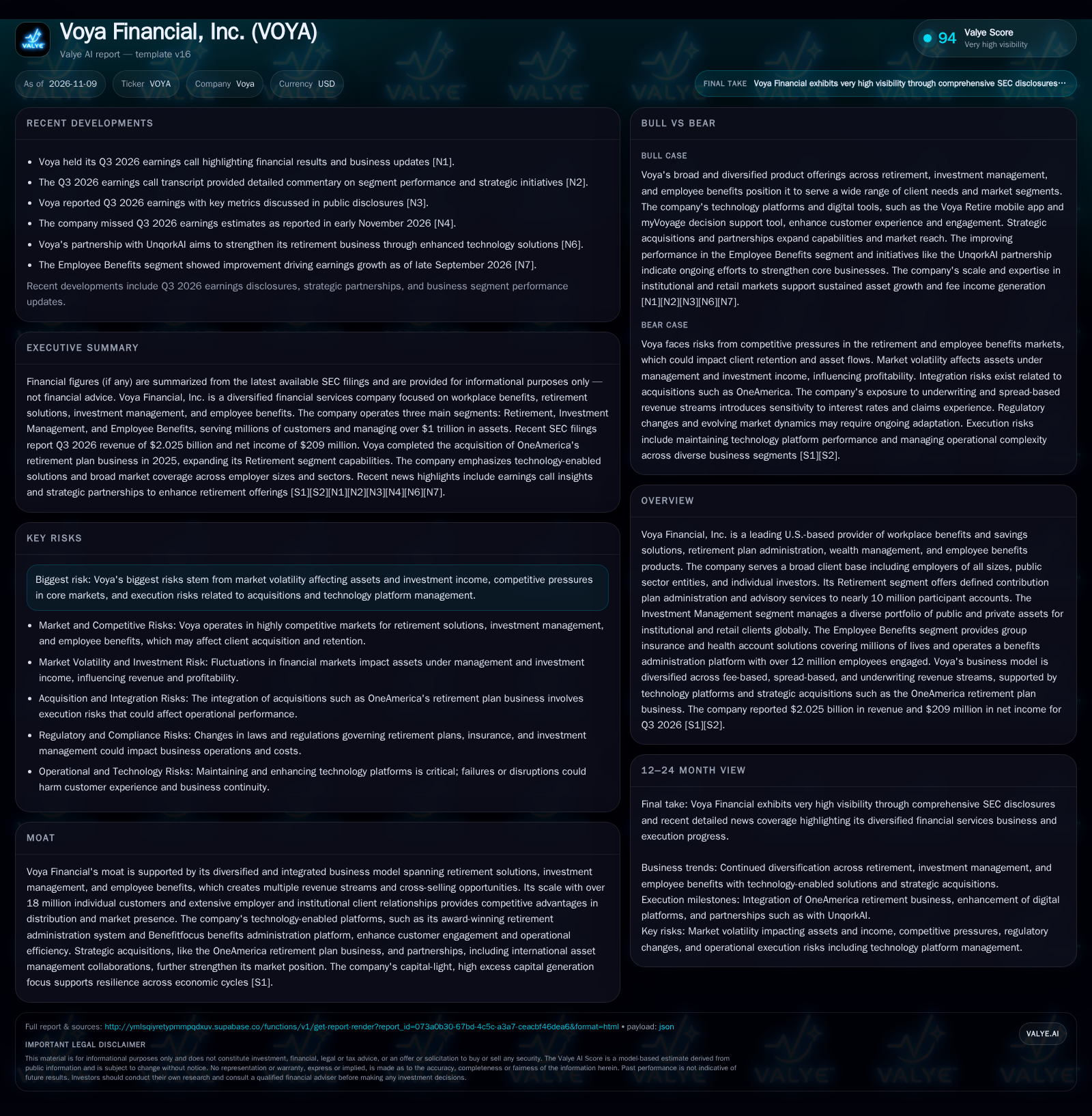
Voya Financial operates across three major segments—Retirement, Investment Management, and Employee Benefits—serving over 18 million individual customer relationships and managing $1.1 trillion in assets as of year-end 2025. The recent acquisition of OneAmerica’s retirement business and a partnership with UnqorkAI underscore a strategic shift toward technology-driven growth and operational scale. Q3 2026 results show $2.025 billion in revenue and $209 million in net income, with Employee Benefits performance improving. The company’s challenge is to maintain momentum through integration, digital platform execution, and resilience against market volatility and competitive threats. [S1] [S2] [N1] [N2] [N3] [N6] [N7]
Voya Financial stands at the intersection of scale, diversification, and digital transformation in the U.S. workplace benefits and retirement landscape. With more than 18 million individual customer relationships and over $1.1 trillion in assets under management and administration, Voya has leveraged acquisitions and technology partnerships to expand its reach and deepen its product capabilities. As Q3 2026 results highlight both progress and competitive challenges, the company’s future may hinge on its ability to integrate new businesses, execute on digital initiatives, and navigate a volatile and crowded market.
What Recent Scale, Acquisitions, and Digital Moves Reveal About Voya’s Strategic Position
Voya Financial ended 2025 with $1.1 trillion in total assets under management and administration, serving over 18 million individual customer relationships and more than 50,000 institutional clients [S1]. This scale is foundational for its competitive position in workplace benefits and retirement services. The January 2025 acquisition of OneAmerica’s full-service retirement plan business materially expanded the Retirement segment, adding capabilities and participant accounts. In Q3 2026, Voya reported $2.025 billion in revenue and $209 million in net income, with the Employee Benefits segment highlighted as a driver of recent earnings improvement [S2] [N7]. Additionally, the company’s partnership with UnqorkAI is intended to strengthen its retirement business through enhanced digital solutions [N6]. These developments matter because they collectively reshape Voya’s operational scale, technology platform, and value proposition at a time of evolving client demands and industry competition.
Dissecting Voya’s Revenue Engine: Fee, Spread, and Underwriting Dynamics
Voya’s business model blends fee income (both asset-based and participant-based), investment income from general account assets, and underwriting revenue from insurance products [S1]. In the Retirement segment, administrative and recordkeeping fees are typically charged as a percentage of assets or on a per-participant basis, creating operating leverage as scale increases. Investment Management generates management fees, which are sensitive to changes in assets under management (AUM) driven by market performance and net flows. Employee Benefits revenue arises from premiums and underwriting margin, with profitability tied to claims experience and pricing discipline.
The mix of capital-light fee revenue and capital-intensive underwriting creates a hybrid risk profile. While growing AUM and participant counts can drive margin expansion through fixed-cost leverage, underwriting exposes Voya to interest rate risk and claims volatility. The acquisition of OneAmerica’s retirement business likely adds to both the scale of fee-based revenue and the complexity of integration, with potential synergies in administrative cost structure and cross-sell opportunities. Technology investments—such as the UnqorkAI partnership—could reduce servicing costs or enable new product features, but require upfront capital and execution discipline. The path to higher profitability depends on Voya’s ability to capture scale economies, maintain pricing power, and manage underwriting risk as market conditions fluctuate.
How Voya’s Integrated Model Stacks Up Against Industry Rivals and Disruptors
Voya operates in highly competitive markets for retirement plan administration, asset management, and group benefits. Its closest peers include diversified insurers, asset managers, and technology-enabled benefits administrators. Voya’s scale—particularly post-OneAmerica acquisition—provides a distribution advantage and allows for broader product offerings. The integration of technology platforms (such as Benefitfocus) and digital decision tools (like myVoyage) may enhance customer retention and engagement, but these are increasingly table stakes in a market where fintech entrants and established administrators are investing heavily in user experience.
Competitive counterforces include aggressive fee compression, persistent switching incentives for large plan sponsors, and the risk that technology-native platforms could disintermediate legacy providers. Voya’s broad product suite and cross-segment integration may create cross-selling opportunities and some switching friction, especially for large employers seeking bundled solutions. However, innovation cycles are shortening, and customer expectations for digital self-service and personalization continue to rise. Voya’s challenge is to sustain differentiation through both scale and technology innovation while defending against margin erosion and client churn.
Technology-Driven Integration Unlocks Margin Expansion and New Growth Vectors
In a favorable scenario, Voya successfully integrates the OneAmerica retirement business, capturing administrative synergies and expanding its participant base without major client attrition. Digital investments—such as the UnqorkAI partnership—enable the company to launch new platform features, automate more processes, and improve participant engagement, resulting in higher retention and increased product uptake per client. The Employee Benefits segment, already showing improved performance in late 2026 [N7], continues to grow through cross-selling and tailored voluntary benefits, leveraging the Benefitfocus platform’s scale.
This chain of events could drive operating leverage, allowing fee and premium revenue growth to outpace expense increases. Confirmation would come from sustained net asset inflows in Retirement and Investment Management, rising participant counts, expanding adjusted operating margins, and a declining expense ratio relative to AUM and covered lives. Evidence would also include positive updates on technology deployments, client wins attributed to new digital features, and segment-level earnings acceleration.
Sustained Diversification with Moderate Growth and Ongoing Integration Hurdles
The most plausible trajectory for Voya over the next 12–24 months is steady revenue and earnings growth, driven by its diversified fee and underwriting model, but tempered by persistent integration and competitive challenges. The OneAmerica acquisition adds scale, but full synergy realization may take time, with possible near-term margin pressure from integration costs and overlapping systems. Technology initiatives (e.g., UnqorkAI) gradually improve platform capabilities and client experience, but their impact on net client growth or pricing power is incremental rather than transformative in the short run.
Revenue growth likely tracks industry averages, with some volatility tied to market performance and group benefits claims experience. The Employee Benefits segment maintains its improved contribution, but is subject to competitive pricing and cyclical claims risk. Confirmation of this scenario would be stable to modestly increasing AUM, continued growth in participant and covered life counts, and stable aggregate margins. Falsification would involve significant client losses, cost overruns from integration, or stalled digital platform deployment.
Competitive and Market Shocks Undermine Scale Advantages and Earnings Visibility
An adverse scenario emerges if competitive pressures intensify across core segments—leading to fee compression, higher client churn, or lost mandates in Retirement and Investment Management. Technology execution risks—such as delays or failures in UnqorkAI or Benefitfocus platform upgrades—could erode customer satisfaction, increase servicing costs, or prompt plan sponsors to switch providers. Integration issues from the OneAmerica acquisition may result in elevated expenses, operational disruptions, or the loss of key accounts.
Market volatility—such as a prolonged downturn—would negatively impact AUM, investment income, and fee revenue, while adverse claims experience in Employee Benefits could pressure underwriting margins. This would likely manifest as declining or stagnant revenue, margin compression, and negative net flows. Early warning signs would include a deterioration in net asset flows, elevated integration charges, higher attrition rates, or negative customer feedback on platform transitions.
Milestones and Metrics That Will Determine Voya’s Ability to Deliver Scalable, Tech-Enabled Growth
Net asset flows in the Retirement and Investment Management segments: Persistent inflows would support the thesis of scale and product competitiveness; outflows would challenge it.
Participant account and covered life growth: Tracking the number of participant accounts in Retirement and individual lives covered in Employee Benefits would indicate client acquisition and retention success.
Expense ratio relative to AUM and covered lives: A declining ratio would signal operating leverage and integration progress; a rising ratio could indicate cost pressures or integration setbacks.
Segment-level operating margin trends: Improvement, especially in Employee Benefits, would confirm successful execution of recent initiatives.
Client retention and attrition rates, if disclosed: High retention would signal effective integration and digital engagement.
Updates on UnqorkAI and other digital platform deployments: Milestones in rollout, adoption, and client feedback would help test the impact of technology investments.
Integration cost disclosures and synergy realization from the OneAmerica acquisition: Progress here would validate management’s ability to extract value from M&A activity.
Competitive pricing environment: Evidence of fee compression or aggressive competitor moves would pressure the thesis of sustainable margin expansion.
Disclaimer: This is research-only, informational analysis and not investment advice. It may include AI-generated interpretation and general industry context. Always verify important details using primary sources.

Comments