
Precigen’s PAPZIMEOS Revenue Surge: Can Product Concentration Deliver Sustainable Growth?
Precigen posted a profitable Q3 2026 with $35.8 million in net income and $72.9 million in PAPZIMEOS revenue, supported by a reported liquidity position.
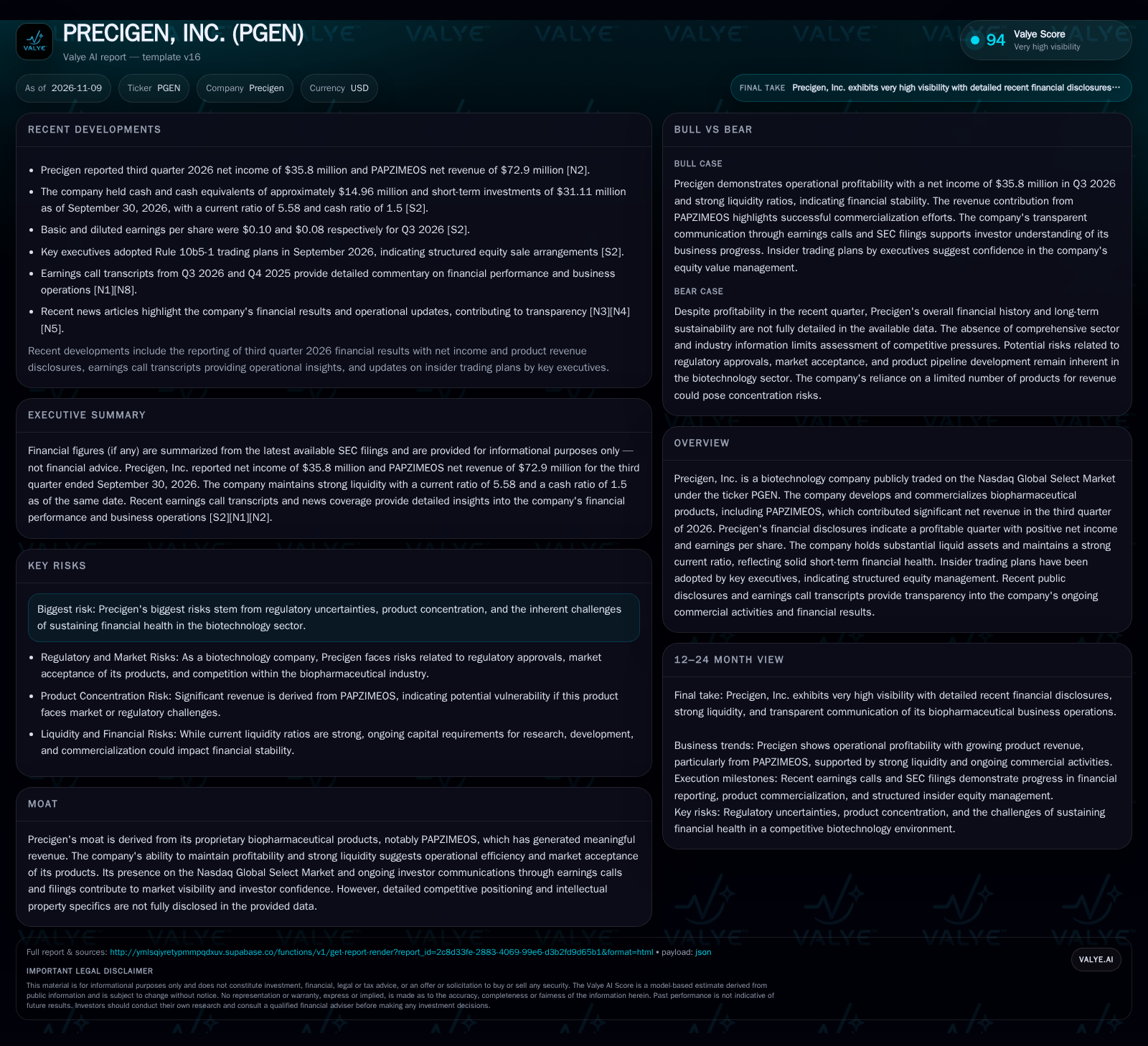
Precigen posted a profitable Q3 2026 with $35.8 million in net income and $72.9 million in PAPZIMEOS revenue, supported by a reported liquidity position. The company’s near-term outlook is closely tied to continued commercial execution and the performance of its lead product, but longer-term resilience will depend on its ability to diversify revenue streams, manage regulatory hurdles, and sustain operational momentum in a competitive biotech landscape. [S2] [N2]
Precigen, Inc. delivered a profitable third quarter in 2026, propelled by the commercial performance of its lead biopharmaceutical product, PAPZIMEOS. With $35.8 million in net income and $72.9 million in product revenue, the company’s financial disclosures highlight robust near-term liquidity and operational momentum. However, Precigen’s reliance on a single revenue driver, exposure to regulatory uncertainties, and limited disclosure about pipeline diversification suggest that sustaining this success will require careful navigation of sector headwinds and strategic execution beyond its current product base. [S2] [N2]
Q3 2026: Profitability and Product Concentration Define the Moment
Precigen reported $35.8 million in net income for the third quarter of 2026, underpinned by $72.9 million in net revenue from PAPZIMEOS. This marks a period of operational profitability, a notable achievement in the biotechnology sector where many peers remain pre-revenue or loss-making. The company’s reported liquidity position includes $46.07 million in liquid assets and a current ratio of 5.58 as of September 30, 2026. The company reported cash and liquidity metrics for the period; these figures do not by themselves establish operating runway, investment capacity, financial flexibility, or financing capacity. PAPZIMEOS remains the primary revenue generator, exposing the company to product concentration risk if demand or regulatory status for this product shifts. [S2] [N2]
The concentration of revenue in PAPZIMEOS also implies that Precigen's financial resilience is tightly linked to the product's lifecycle stage and market dynamics. For example, patent expiration timelines, potential generic entry, or shifts in clinical guidelines could materially impact demand and pricing power. Additionally, the company's liquidity, while appearing robust, must be evaluated in the context of ongoing operational expenses, potential capital expenditures, and investment needs to support pipeline advancement. If the company faces unforeseen regulatory delays or market access challenges, its ability to sustain operations without diluting shareholder value or increasing leverage could be tested.
How PAPZIMEOS Drives Precigen’s Revenue and Cost Structure
The core of Precigen’s current business economics is the commercialization of PAPZIMEOS. While the report does not disclose unit pricing, gross margin, or specific contract structures, the fact that PAPZIMEOS generated $72.9 million in net revenue and supported significant net income suggests at least moderate margin leverage—unusual for a biotech at this stage. This implies either high product pricing, cost containment, or both. Biopharmaceutical products typically command premium pricing, especially if addressing unmet needs, but also require ongoing investment in manufacturing, regulatory compliance, and post-market surveillance.
Operating leverage in this model arises from the ability to scale revenue without a commensurate increase in fixed costs, particularly if PAPZIMEOS has a scalable manufacturing process or is reaching a broader patient population. However, the capital intensity of biotech—driven by R&D, clinical trials, and regulatory processes—means that positive net income in a single quarter does not guarantee sustained free cash flow.
The cost structure associated with PAPZIMEOS likely includes significant fixed costs related to manufacturing facilities, quality assurance, and regulatory compliance, which may not scale linearly with sales volume. Consequently, incremental revenue growth could disproportionately enhance profitability, provided that the company efficiently manages variable costs such as raw materials and distribution. However, if PAPZIMEOS requires specialized production processes or relies on third-party manufacturers, supply chain disruptions or capacity constraints could introduce margin volatility. Furthermore, ongoing investments in post-market studies or pharmacovigilance to satisfy regulatory commitments might impose recurring expenses that temper free cash flow generation despite reported net income.
Product Differentiation and Market Risks in an Unforgiving Sector
Precigen’s competitive position centers on the commercial traction of PAPZIMEOS, but without detailed disclosure on intellectual property, market exclusivity, or differentiation, it is unclear how defensible this advantage is. In biopharma, sustainable outperformance often depends on a combination of proprietary technology, regulatory barriers to entry, and physician or payer adoption. If PAPZIMEOS addresses a niche with limited competition or offers superior efficacy/safety, Precigen may enjoy temporary pricing power. However, the absence of information on pipeline breadth or therapeutic area concentration leaves open the risk of disruption by larger pharmaceutical firms, generics, or next-generation therapies.
Peer competition in biotechnology is fierce, with many companies vying for overlapping indications and rapid innovation cycles. The lack of disclosed multi-product revenue suggests that Precigen’s moat is currently narrow, and the company could be vulnerable if competitors introduce superior alternatives or if reimbursement dynamics shift.
The durability of Precigen’s competitive position also depends on the company’s ability to navigate payer dynamics and reimbursement frameworks that vary across regions and evolve over time. Even with a differentiated product, shifts in healthcare policy, cost-containment pressures, or the emergence of biosimilars could erode pricing power and market share. Moreover, physician adoption is influenced by clinical data robustness, ease of administration, and real-world outcomes; any perceived inferiority or safety concerns could accelerate switching to alternatives. The company's strategic response to these external pressures—such as investing in real-world evidence generation or engaging in value-based contracting—will be critical to maintaining its market foothold.
Leveraging PAPZIMEOS Momentum into a Broader Commercial Portfolio
The most favorable scenario for Precigen is that PAPZIMEOS continues to gain market share, supported by strong clinical outcomes, robust payer coverage, and minimal competitive encroachment. If the company can parlay its current profitability and reported liquidity into accelerated pipeline development or targeted acquisitions, it could transition from a single-product to a multi-product portfolio, reducing concentration risk and enhancing revenue durability.
Confirmation of this scenario would include evidence of expanding indications for PAPZIMEOS, successful new product launches, or material licensing/partnering agreements. A sustained trend of positive net income, growing liquid assets, and stable or increasing margins would also reinforce the thesis that current momentum is not a one-off event but the beginning of a longer-term growth trajectory.
Sustaining Current Profitability While Managing Biotech Volatility
The most plausible trajectory is that Precigen maintains operational profitability in the near term, with PAPZIMEOS revenue providing a solid base but subject to the usual volatility of biopharma commercialization—such as fluctuating demand, reimbursement headwinds, or periodic regulatory reviews.
If future earnings calls and filings show stable or modestly growing PAPZIMEOS sales, prudent cost management, and incremental pipeline progress, this would confirm that Precigen is executing a disciplined commercial strategy. However, any signs of plateauing sales, regulatory setbacks, or increased competition in PAPZIMEOS’s market would challenge the durability of this base case.
Product Setback or Regulatory Shock Could Expose Concentration Risk
The principal risk is that PAPZIMEOS faces an adverse regulatory decision, safety concern, or competitor disruption, leading to a sharp contraction in revenue. Given the product’s outsized contribution to the company’s top line, any material event affecting its commercial trajectory could rapidly erode profitability and force Precigen to draw down its liquid assets or seek external financing.
Signs of this scenario would include declining PAPZIMEOS sales, negative regulatory or clinical updates, or cost escalation that outpaces revenue. In a worst-case outcome, the lack of diversified revenue streams could leave the company exposed to restructuring or strategic alternatives if it cannot replace lost revenue in a timely manner.
Milestones and Metrics That Will Determine Precigen’s Long-Term Trajectory
PAPZIMEOS quarterly and annual sales growth—evidence of sustained or expanding market adoption would reinforce the company’s commercial momentum.
Gross margin trends on PAPZIMEOS (if disclosed)—to assess the scalability and profitability of the product as sales volumes change.
Pipeline development updates—progress on new product candidates, clinical trial milestones, or regulatory submissions would help test diversification efforts.
Regulatory status changes or label expansions for PAPZIMEOS—indications of de-risking or new revenue opportunities.
Updates on payer coverage, reimbursement rates, or formulary inclusion for PAPZIMEOS, which could affect pricing power and patient access.
New partnership, licensing, or co-commercialization agreements—signaling strategic expansion or risk mitigation.
Changes in insider trading activity or management commentary on capital allocation, which may provide clues to internal confidence and strategic priorities.
Disclosure of customer concentration or channel mix, if available, to gauge the breadth and resilience of the commercial base.
Disclaimer: This is research-only, informational analysis and not investment advice. It may include AI-generated interpretation and general industry context. Always verify important details using primary sources.

Comments