
Semnur Pharmaceuticals: Liquidity Squeeze and the Uncertain Road to Business Model Clarity
Semnur Pharmaceuticals faces acute liquidity pressure and ongoing operating losses, with a lack of transparency around its product portfolio and commercial model. The company’s ability to convert reported revenue into a sustainable, cash-generative operation is in question, making near-term funding and operational pivot scenarios critical to watch.
[S2] Despite reporting $50 million in revenue for Q2 2025, the company lacks clear disclosure on commercial strategy, product specifics, or recurring revenue mechanics.
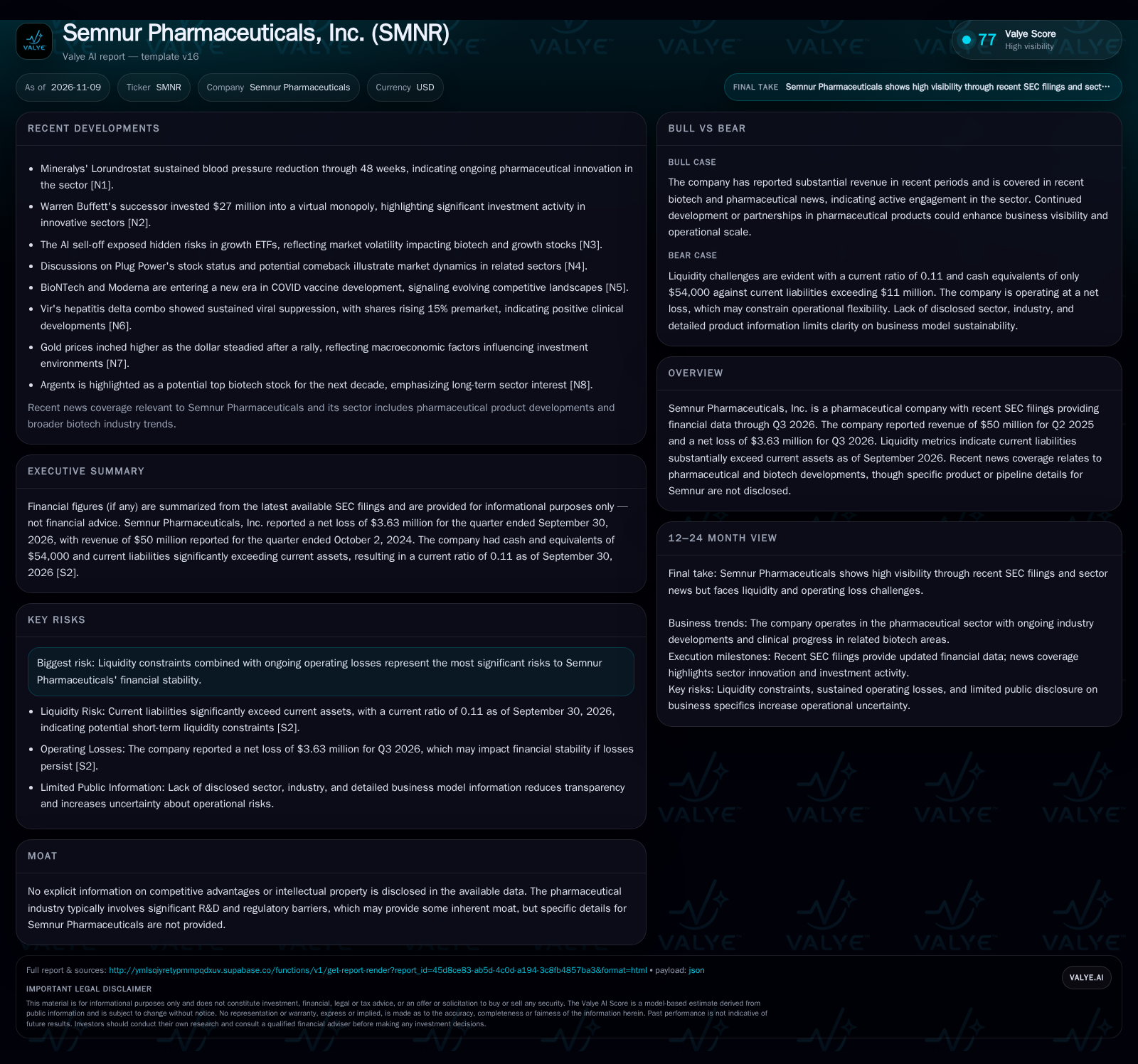
Semnur Pharmaceuticals stands at a precarious crossroads: the company’s latest financials reveal an acute liquidity crunch, with just $54,000 in cash versus over $11 million in current liabilities as of September 2026. Despite having reported $50 million in revenue for Q2 2025, persistent net losses and a lack of transparency on business model mechanics or product specifics cloud the company’s outlook. The immediate question is whether Semnur can secure new capital or pivot operationally before its obligations come due—a scenario that could determine its survival, relevance, or exit from the sector.
Acute Liquidity Strain and Unclear Revenue Sustainability
As of September 30, 2026, Semnur Pharmaceuticals’ financials reveal a stark imbalance: just $54,000 in cash and cash equivalents, current assets of $1.26 million, and current liabilities of $11.28 million, yielding a current ratio of 0.11 and a cash ratio of zero [S2]. This signals an immediate short-term liquidity crisis, as the company lacks the liquid resources to meet its obligations. The net loss of $3.63 million in the most recent quarter further erodes balance sheet resilience [S2].
While the company reported $50 million in revenue for Q2 2025, there is no disclosure of product-level detail, customer concentration, or the nature of revenue—leaving open whether this was a one-off event, milestone payment, licensing, or recurring product sales [S2]. The absence of operational transparency makes it difficult to assess the durability of this revenue or its potential to support future cash flow.
How Might Semnur Generate Sustainable Value?
In the pharmaceutical sector, business economics are typically defined by a mix of high upfront R&D costs, long regulatory timelines, and the potential for high-margin product sales or licensing deals upon approval. Semnur’s reported revenue suggests either the launch of a commercial product, a significant licensing milestone, or an upfront payment; however, the lack of disclosure prevents confirmation.
If revenue is product-based, margins in specialty pharma can be high once scale is achieved—but only if gross profit is not eroded by high cost of goods, salesforce expense, or rebates. The company’s capital needs are therefore acute and recurring, with little room for error or delay in new funding or operational realignment.
A critical factor in assessing Semnur's economic sustainability lies in understanding its cost structure beyond headline revenue figures. Pharmaceutical firms often face disproportionate fixed costs related to clinical trials, regulatory compliance, and manufacturing scale-up, which can delay profitability despite substantial top-line growth. If Semnur's revenue is primarily milestone-driven or licensing-related, these inflows may be episodic rather than indicative of a recurring revenue stream, complicating cash flow predictability. Furthermore, the company's ability to leverage economies of scale, optimize supply chain efficiencies, and control sales and marketing expenses will directly impact gross and operating margins, which are pivotal for transitioning from cash burn to cash generation.
Competitive Dynamics Without Transparency: Moat or Mirage?
Semnur operates in a pharmaceutical landscape where barriers to entry are typically high—driven by intellectual property, regulatory exclusivity, and established distribution relationships. However, there is no explicit disclosure of Semnur’s IP position, product pipeline, or clinical/regulatory milestones. This lack of transparency makes it impossible to assess whether the company possesses any defensible moat.
Competitors in the sector range from large integrated pharma companies to nimble biotech startups. Without information on Semnur’s therapeutic area, target patient population, or stage of commercialization, it is unclear whether the company faces entrenched rivals, generic substitution risk, or meaningful switching costs for customers. The absence of disclosed differentiation leaves Semnur exposed to both competitive and funding pressures, as investors and partners may demand greater clarity before committing new resources.
In the absence of disclosed intellectual property rights or regulatory exclusivities, Semnur's competitive position may depend heavily on intangible factors such as speed to market, strategic partnerships, or niche therapeutic focus. The pharmaceutical market often rewards companies that can demonstrate differentiated clinical efficacy or safety profiles, which justify premium pricing and reimbursement. Without clarity on these elements, Semnur risks commoditization and pricing pressure, especially if competitors offer bioequivalent or generic alternatives. Additionally, the company's access to distribution channels and payer networks can materially influence market penetration and revenue sustainability, aspects that remain opaque given the current disclosures.
Unlocking Value Through Funding or Strategic Partnerships
A favorable scenario for Semnur would involve securing new capital—whether through equity, debt, or strategic partnerships—that enables the company to continue operations, invest in product development, and clarify its commercial model. If the $50 million in revenue reflects an initial product launch or a recurring contract, follow-on quarters should show sustained or growing topline, improved gross margins, and reduced operating losses.
Evidence confirming this path would include announcements of successful financings, licensing deals with upfront and milestone payments, or new commercial partnerships. Disclosure of a robust pipeline, clinical data, or regulatory approvals would further support the upside scenario. Falsification would occur if subsequent filings show continued cash depletion, missed milestones, or inability to secure external support.
Operational Uncertainty and the Search for a Lifeline
The most plausible near-term outcome is continued operational uncertainty, with Semnur seeking emergency funding or strategic alternatives to address its liquidity gap. The company may attempt to raise capital at unfavorable terms, pursue asset sales, or initiate cost-cutting measures to preserve cash. Unless new recurring revenue sources are established or operating losses are dramatically reduced, the risk of insolvency or forced restructuring remains elevated.
Confirmation of this scenario would come from bridge financing announcements, going-concern language in filings, or disclosures of workforce reduction and R&D reprioritization. Falsification would require a clear pivot to sustainable revenue growth or a transformative deal that resolves near-term liquidity needs.
Liquidity Exhaustion and the Prospect of Asset Liquidation
If Semnur fails to secure new funding or generate positive cash flow, the company faces the real prospect of running out of cash and defaulting on its obligations. This could trigger asset sales, creditor negotiations, or bankruptcy proceedings. Without a clear product or IP portfolio disclosed, the value to potential acquirers or creditors is highly uncertain.
Evidence supporting this scenario would include further declines in cash, inability to meet payroll or payables, missed debt or lease payments, or explicit bankruptcy warnings. Absence of external financing or partnership announcements in the coming quarters would also tilt the balance toward this outcome.
What Would Move the Needle for Semnur Pharmaceuticals?
Disclosure of new financing events, such as equity raises, credit facilities, or strategic investments, would help test management’s ability to address the liquidity gap.
Quarterly progression in cash and equivalents—if disclosed—would clarify whether the company is stabilizing or accelerating toward insolvency.
Evidence of recurring revenue, major customer contracts, or product reorders would help validate the sustainability of the reported revenue base.
Announcements of new product launches, regulatory approvals, or clinical milestones would clarify the company’s commercialization prospects.
Workforce reductions, R&D reprioritization, or other cost containment measures—if announced—would indicate management’s response to financial pressure.
Explicit going-concern language or risk disclosures in upcoming filings would signal the degree of financial distress.
Details on intellectual property, product pipeline, or therapeutic focus would be crucial to understanding competitive positioning and long-term potential.
Any indication of partnership, M&A, or asset sale activity would shed light on Semnur’s strategic alternatives and potential value realization.
Disclaimer: This is research-only, informational analysis and not investment advice. It may include AI-generated interpretation and general industry context. Always verify important details using primary sources.

Comments