
Texas Pacific Land’s Royalty Model, Water Ambitions, and Data Center Gambit: Unlocking Value from Permian Acreage
Texas Pacific Land Corp’s unique asset base—spanning 882,000 acres in the Permian Basin—anchors a royalty-driven business model now extending into water services and digital infrastructure. Its latest financials and strategic moves highlight the tension between low-capex cash flows and the risks of diversification into new, capital-intensive ventures.
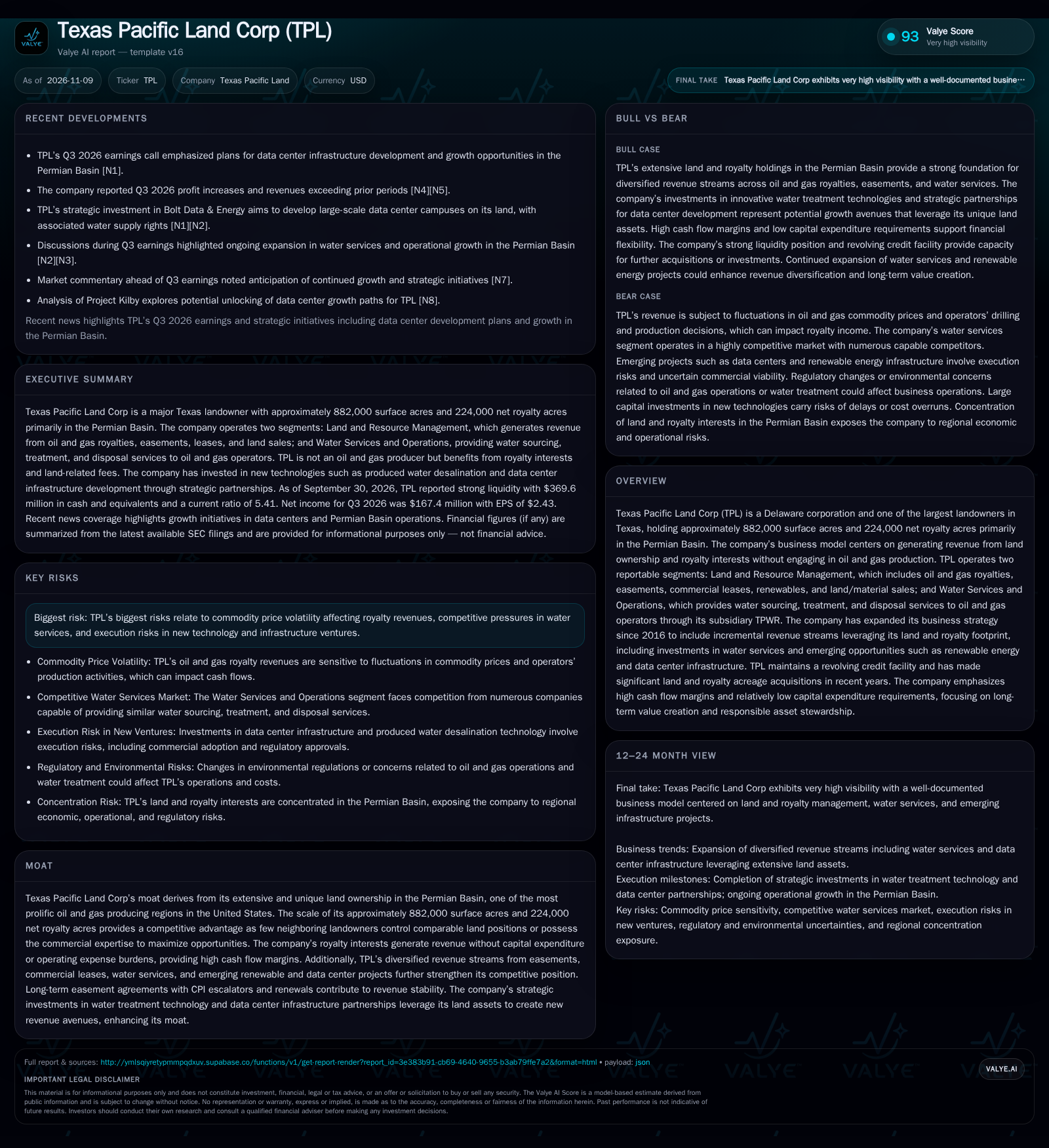
Texas Pacific Land Corp (TPL) leverages vast Permian Basin holdings to generate high-margin royalty and easement income, while expanding into water services and data center infrastructure. Q3 2026 results show strong profitability and liquidity. The company’s future hinges on oil and gas activity, water segment execution, and the commercial success of new ventures like data centers, all set against commodity and regional risks. [S1] [S2] [N1] [N2] [N4] [N5]
Texas Pacific Land Corp stands apart as a landowner and royalty manager, not an operator, in the heart of the Permian Basin. Its business model—anchored by oil and gas royalties—has delivered enviable margins with minimal capital intensity. Yet, the company’s recent moves into water services and data center infrastructure signal a strategic evolution beyond passive asset monetization.
Financial Strength Meets Strategic Diversification in 2026
The company reported a current ratio of 5.41 for the period. [S2] The company’s Q3 2026 net income was $167.4 million, with basic EPS of $2.43 [S2]. The company reported cash and liquidity metrics for the period; these figures do not by themselves establish operating runway, investment capacity, financial flexibility, or financing capacity.
TPL’s core still lies in its 882,000 surface acres and 224,000 net royalty acres in the Permian Basin [S1]. In 2025, oil and gas royalties contributed $411.7 million (52% of Land and Resource Management revenue), while water services contributed $307.5 million, or 38% of consolidated revenue [S1].
Recent initiatives include a $50 million minority investment in Bolt Data & Energy to develop large-scale data centers on TPL land, and $38.8 million invested in a produced water desalination pilot facility as of year-end 2025 [S1]. These moves signal a push toward leveraging land assets for new digital and sustainability-driven revenue streams.
Royalty Economics: Low-Capex Margins, Water Leverage, and New Ventures
TPL’s royalty model is structurally high-margin: the company collects oil and gas royalties and easement fees without bearing drilling or production costs, enabling cash flows that track operator activity and commodity prices but require minimal capital outlay [S1].
The Water Services and Operations segment, by contrast, is more operationally intensive. Revenue comes from water sales, treatment, and disposal services to Permian oil and gas operators [S1]. While this segment diversifies TPL’s income and may benefit from regional drilling activity, it also introduces direct operating costs, capital needs (such as for treatment technology), and potential margin compression if pricing competition intensifies or operators internalize these services.
Easements and leases—often long-term with CPI escalators—further augment recurring revenue with limited incremental expense [S1].
The recent push into data centers (via the Bolt Data & Energy partnership) and produced water desalination could change TPL’s capital profile. These ventures may require upfront investment and longer payback periods, making their economics more akin to infrastructure or utilities than traditional land royalties. If successful, they could unlock new, durable cash flows, but execution and market demand are critical uncertainties.
Land Monopoly and the Moat: Defensible, but Not Unassailable
TPL’s core moat is its unparalleled land position in the Permian Basin, a region central to U.S. oil and gas output [S1]. Few entities possess comparable contiguous acreage or the commercial sophistication to monetize it across royalties, easements, and water services. This scale enables TPL to negotiate favorable terms with operators and infrastructure developers, and to pursue new ventures like data centers or renewables that require large, contiguous sites.
However, TPL’s competitive advantages are not absolute. In water services, the company faces a fragmented but capable set of competitors—many of whom can offer similar sourcing, treatment, and disposal solutions to oil and gas operators. Margins in this segment could come under pressure if operators seek to negotiate aggressively or develop in-house capabilities.
For emerging lines such as data centers, TPL’s land and water rights are valuable, but it competes with other landowners and infrastructure developers across the Southwest for hyperscale and enterprise clients. The moat here is less about exclusivity and more about execution, speed, permitting, and the ability to offer bundled solutions (land, power, water) at competitive economics.
Unlocking New Value: If Permian Activity and Digital Infrastructure Converge
The most favorable trajectory for TPL would see sustained or rising Permian drilling activity, driving both royalty and water services revenue. If commodity prices remain robust and operators continue to expand production, TPL’s royalty stream could grow with no incremental capital required.
Simultaneously, if the Bolt Data & Energy partnership successfully attracts data center tenants—leveraging TPL’s land, water rights, and proximity to energy infrastructure—this could open an entirely new, high-value recurring revenue stream. Early commercial agreements, land leases, or anchor tenant announcements would confirm progress. Successful scaling of produced water desalination could further position TPL as an indispensable Permian service provider, enhancing pricing power and stickiness.
The upside case is confirmed by evidence of multi-year data center lease signings, water technology commercialization, or a step-change in royalty income linked to new drilling on TPL acreage.
Steady-State Royalty Harvesting with Incremental Diversification
The most plausible outlook is that TPL continues to harvest high-margin cash flows from oil and gas royalties and easements, with water services providing incremental (but more volatile) growth. New ventures in data centers and water treatment move forward slowly, contributing modestly to revenue over the next 1–2 years but not yet transforming the business mix.
This scenario assumes that Permian drilling activity remains at or near current levels, commodity prices are neither disruptive nor especially favorable, and water services maintain current market share despite competitive pressures. Data center and desalination projects progress through pilot phases, with larger-scale commercialization still pending.
Confirmation would come from stable or gradually rising royalty and water services revenue, continued high cash conversion, and periodic updates on project milestones without major capital overruns or delays.
Commodity Shocks and Execution Stumbles: How TPL’s Model Could Be Tested
A negative scenario would see a sharp decline in oil and gas prices, leading Permian operators to curtail drilling and production. This would directly reduce royalty income and potentially dampen demand for water services, as fewer wells require sourcing, treatment, or disposal.
If water services margins come under sustained pressure from aggressive competitors or customer insourcing, TPL could see both revenue and profitability erode. On the new ventures front, failure to secure anchor data center tenants or regulatory roadblocks in water desalination could turn recent investments into sunk costs rather than new revenue streams.
Downside confirmation would be a pronounced drop in royalty revenue, shrinking water segment profits, project write-downs, or evidence that capital is being tied up in underperforming or stranded initiatives.
Testing the TPL Thesis: Metrics and Milestones That Will Shape the Outcome
Quarterly oil and gas royalty revenue trends, particularly as a percentage of total revenue, to gauge resilience and commodity exposure [S1] [S2].
Permian Basin well permit and drilling/completion activity on TPL’s royalty acreage, as disclosed, to monitor near-term volume drivers [S1].
Water Services and Operations segment margin trends, and any disclosed customer concentration or contract renewal rates, to assess competitive dynamics and pricing power (if disclosed).
Updates on data center project milestones—such as land lease signings, anchor tenant announcements, or construction progress—would help validate the digital infrastructure strategy (if disclosed) [N1] [N2] [N8].
Capital expenditure disclosures for new ventures, especially produced water desalination and data centers, to track investment risk and balance sheet impact [S1].
Any regulatory developments or environmental policy changes affecting Permian oil and gas activity or water use, which could materially impact both legacy and new businesses.
Evidence of large-scale operator insourcing of water services or new market entrants offering disruptive water solutions in the Permian Basin.
Disclaimer: This is research-only, informational analysis and not investment advice. It may include AI-generated interpretation and general industry context. Always verify important details using primary sources.

Comments