
UNG’s Role in Volatile Natural Gas Markets: Tracking, Constraints, and the ETF Structure’s Limits
United States Natural Gas Fund (UNG) offers investors synthetic exposure to natural gas prices via futures, but persistent NAV declines, regulatory position limits, and structural headwinds from futures market dynamics challenge its ability to track the commodity. Recent ETF outflows and technical trading signals highlight the fund’s sensitivity to both market sentiment and the underlying volatility of gas markets.
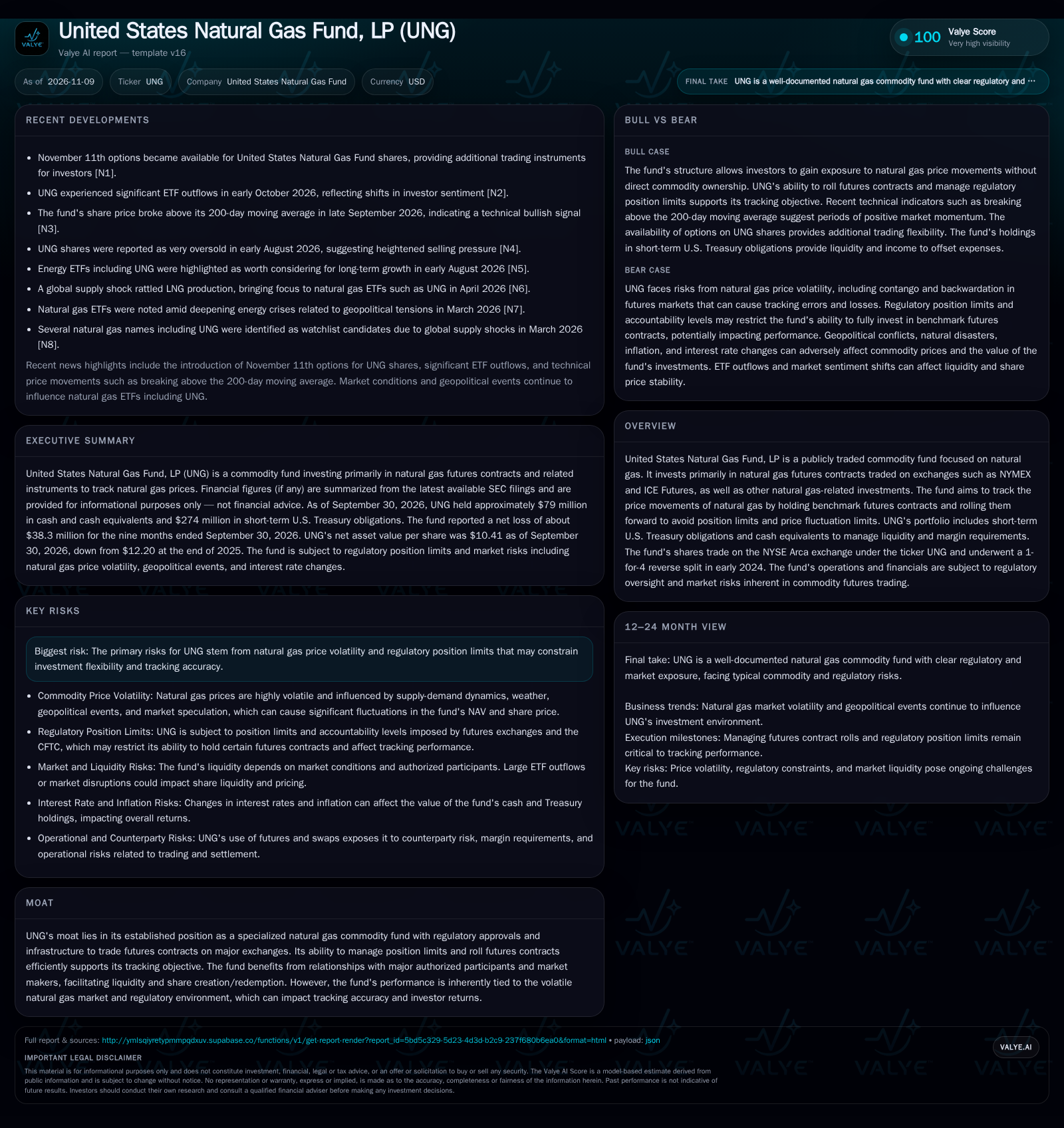
UNG’s recent net asset value decline and net loss underscore the difficulty of tracking natural gas prices amid market volatility and regulatory position limits. The fund’s structure and reliance on futures contracts expose it to the mechanics of rolling, contango/backwardation, and investor sentiment swings, as seen in recent ETF outflows and price reversals. Tracking error, regulatory constraints, and the underlying commodity’s instability remain the primary business risks.[S2] [N2]
United States Natural Gas Fund (UNG) stands as a high-profile vehicle for investors seeking exposure to natural gas price movements without directly trading the commodity. Despite its liquidity and established infrastructure, the fund’s net asset value has declined sharply in the past year, primarily reflecting the volatility of the underlying market and the structural frictions inherent in rolling futures. Recent ETF outflows, technical price swings, and persistent regulatory constraints further illustrate the dual challenges of tracking a volatile commodity and managing investor sentiment. As natural gas markets remain subject to geopolitical shocks and supply/demand swings, UNG’s performance will continue to hinge on its ability to navigate these structural and market-specific challenges.[S2] [N2] [N3]
Recent Performance and Market Sentiment: NAV Decline, Net Loss, and ETF Outflows
UNG’s net asset value per share dropped from $12.20 at the end of 2025 to $10.41 as of September 30, 2026, with the fund reporting a net loss of about $38.3 million for the nine months ended September 30, 2026.[S2] This decline reflects the pronounced volatility in natural gas prices over the period, as well as the structural drag induced by futures rolling and market contango. The fund experienced significant ETF outflows in early October 2026, signaling a shift in investor sentiment and possibly amplifying NAV pressure during periods of commodity weakness.[N2] Meanwhile, technical indicators such as breaking above the 200-day moving average in late September pointed to short-term bullish momentum, but these signals have not offset the broader trend of NAV erosion.[N3]
Futures Structure, Rolling Costs, and Sources of Tracking Error
UNG generates returns by holding and rolling front-month and near-dated natural gas futures, aiming to track spot price movements. However, the economics of this model are shaped by the futures curve: when the market is in contango (future prices above spot), rolling contracts incurs negative roll yield as higher-priced contracts are bought and lower-priced ones are sold. In backwardation, the opposite effect can provide a tailwind. The fund’s operating costs include management fees, margin requirements, and transactional frictions, while its liquidity is managed through holdings in U.S. Treasuries and cash equivalents (about $353 million combined as of September 30, 2026).[S2] Because UNG must comply with regulatory position limits and accountability levels, it sometimes cannot fully replicate the benchmark futures exposure, which can further exacerbate tracking error. The fund’s economics are thus a function of natural gas price volatility, futures curve shape, and the cost of maintaining synthetic exposure—plus the impact of investor flows and redemptions.
A critical aspect influencing UNG’s tracking error arises from the timing and execution of futures contract rolls. The fund typically rolls contracts over several days to mitigate market impact, but during periods of heightened volatility or low liquidity, this staggered approach can lead to execution slippage relative to the benchmark index, which assumes instantaneous roll. Additionally, margin requirements fluctuate with market volatility, affecting the fund’s cash allocation and potentially reducing capital efficiency. These factors, combined with the fund’s inability to hold contracts beyond regulatory limits, mean that even under stable price conditions, tracking error can persist due to operational constraints rather than pure market movements.
UNG’s Position in the Commodity ETF Landscape and Structural Counterforces
UNG occupies a leading role among commodity ETFs focused on natural gas, offering retail and institutional investors a liquid, exchange-traded alternative to direct futures trading. Its relationships with major authorized participants (e.g., Goldman Sachs, Morgan Stanley, Citadel Securities) support active share creation and redemption, which helps maintain market liquidity and alignment with NAV.[S2] However, UNG competes not only with other natural gas ETFs and ETNs, but also with broader commodity funds and direct trading platforms that may offer lower fees or different risk profiles. Its key vulnerabilities stem from the inherent inefficiency of rolling futures in a persistently contango environment, regulatory constraints limiting exposure, and the absence of a structural edge in tracking the spot price. Unlike physically-backed commodity funds, UNG cannot eliminate the risk of roll yield losses, making its competitive position heavily dependent on the prevailing futures curve and operational execution.
From a competitive standpoint, UNG’s reliance on a synthetic futures-based structure exposes it to risks that physically-backed commodity funds avoid, such as negative roll yield and regulatory limits on position sizes. While direct futures trading platforms offer more precise exposure, they demand higher capital and expertise, limiting accessibility for retail investors. UNG’s ETF structure bridges this gap but at the cost of inherent inefficiencies. Moreover, the fund’s fee structure and operational costs must be balanced against the potential benefits of ease of access and liquidity. If alternative products emerge with lower fees or improved tracking through innovative roll strategies or collateral management, UNG’s market share could face pressure despite its established brand.
When Backwardation and Supply Shocks Align: Potential for Outperformance
UNG could outperform if a combination of sustained backwardation in the natural gas futures curve and sharp upward moves in spot prices occur, possibly triggered by supply shocks, extreme weather, or geopolitical disruptions. In such cases, rolling contracts could generate positive roll yield, amplifying returns relative to spot. Evidence supporting this scenario would include observable backwardation in the NYMEX natural gas curve, rising spot prices, and a narrowing or positive tracking differential between UNG’s NAV and the underlying commodity index. Additional bullish confirmation would come from net ETF inflows, increased trading volume, and technical indicators showing persistent price strength. The scenario would be falsified if the futures curve remains in contango, NAV continues to lag spot price rebounds, or investor flows remain negative despite commodity rallies.
Structural Headwinds Persist Despite Episodic Volatility
The most plausible path for UNG is a continuation of episodic volatility in natural gas prices, with the fund’s performance hampered by persistent contango, regulatory position limits, and periodic investor outflows. Tracking error is likely to remain a recurring issue, particularly if the futures curve does not shift materially in UNG’s favor. The fund’s liquidity and infrastructure will allow it to absorb moderate swings in demand and redemptions, but NAV is likely to underperform spot returns over time due to roll costs and expenses. This scenario would be confirmed by ongoing NAV declines during contango periods, continued ETF outflows or choppy flows, and the absence of a sustained shift to backwardation. It would be challenged if regulatory reforms, a structural change in natural gas supply/demand, or new hedging mechanisms reduce tracking error.
Compounding Losses: Prolonged Contango, Regulatory Tightening, and Liquidity Stress
The adverse scenario for UNG involves a prolonged period of contango in the futures market, sustained natural gas price weakness, and tighter regulatory position limits, all contributing to compounding NAV losses and widening tracking error. If large-scale ETF outflows accelerate during periods of commodity weakness, the fund could experience additional pressure from forced contract unwinds and reduced liquidity. Confirmation of this scenario would come from continued NAV erosion relative to spot, a persistently negative roll yield, further regulatory interventions, and shrinking asset base. Conversely, stabilization of flows, improvement in tracking, or a shift in the futures curve could challenge the downside thesis.
What Will Signal a Structural Shift for UNG’s Performance and Investor Value?
The shape of the natural gas futures curve (contango vs. backwardation), as this determines roll yield and core tracking economics.
UNG’s NAV-to-spot price tracking differential, which would highlight improvements or deterioration in tracking accuracy (if disclosed).
ETF net inflows/outflows on a weekly or monthly basis, as persistent outflows could signal waning investor confidence or amplify NAV pressure.
Regulatory announcements or CFTC/exchange position limit changes that could alter UNG’s ability to replicate benchmark exposure.
The fund’s expense ratio and disclosed roll costs, which directly affect net returns to shareholders (if disclosed).
The market’s response to technical trading signals (e.g., moving average breakouts or oversold conditions), which may drive short-term flows.
Any new product launches or changes by competitors (e.g., lower-fee ETFs or alternative exposure vehicles), which could affect UNG’s market share.
Disclaimer: This is research-only, informational analysis and not investment advice. It may include AI-generated interpretation and general industry context. Always verify important details using primary sources.

Comments