
Vistra 2026: Integrated Power, Nuclear Leverage, and the Stakes of Data Center Electrification
Vistra Corp.'s 2026 strategy hinges on its integrated retail-generation model, a diversified fuel mix, and bold moves into data center and AI-driven power demand. With new nuclear PPAs, a major gas acquisition, and $1 billion earmarked for digital infrastructure, the company faces both unprecedented growth opportunities and acute supply chain and regulatory risks.
Vistra is leveraging its integrated retail and generation platform, expanded gas and nuclear capacity, and new long-term PPAs with technology giants to position itself as a key supplier to the surging U.S. data center market. While recent financials are robust, the company must navigate supply chain bottlenecks, commodity price swings, and evolving regulatory frameworks to realize its vision of stable, carbon-free, and flexible power delivery.
Vistra Corp. stands at a critical juncture in 2026, blending the scale and reliability of legacy power generation with the agility to serve the rapidly evolving needs of digital infrastructure. The company’s recent acquisition of Cogentrix, large-scale nuclear PPAs with technology giants, and a billion-dollar commitment to data center power solutions underscore its ambition to become the backbone of the next wave of U.S. electricity demand. Yet, as Vistra pursues these growth avenues, it must confront persistent supply chain constraints, volatile commodity markets, and regulatory uncertainty—each of which could reshape the economics and risk profile of its integrated model.
Recent Moves Reshape Vistra’s Growth Profile
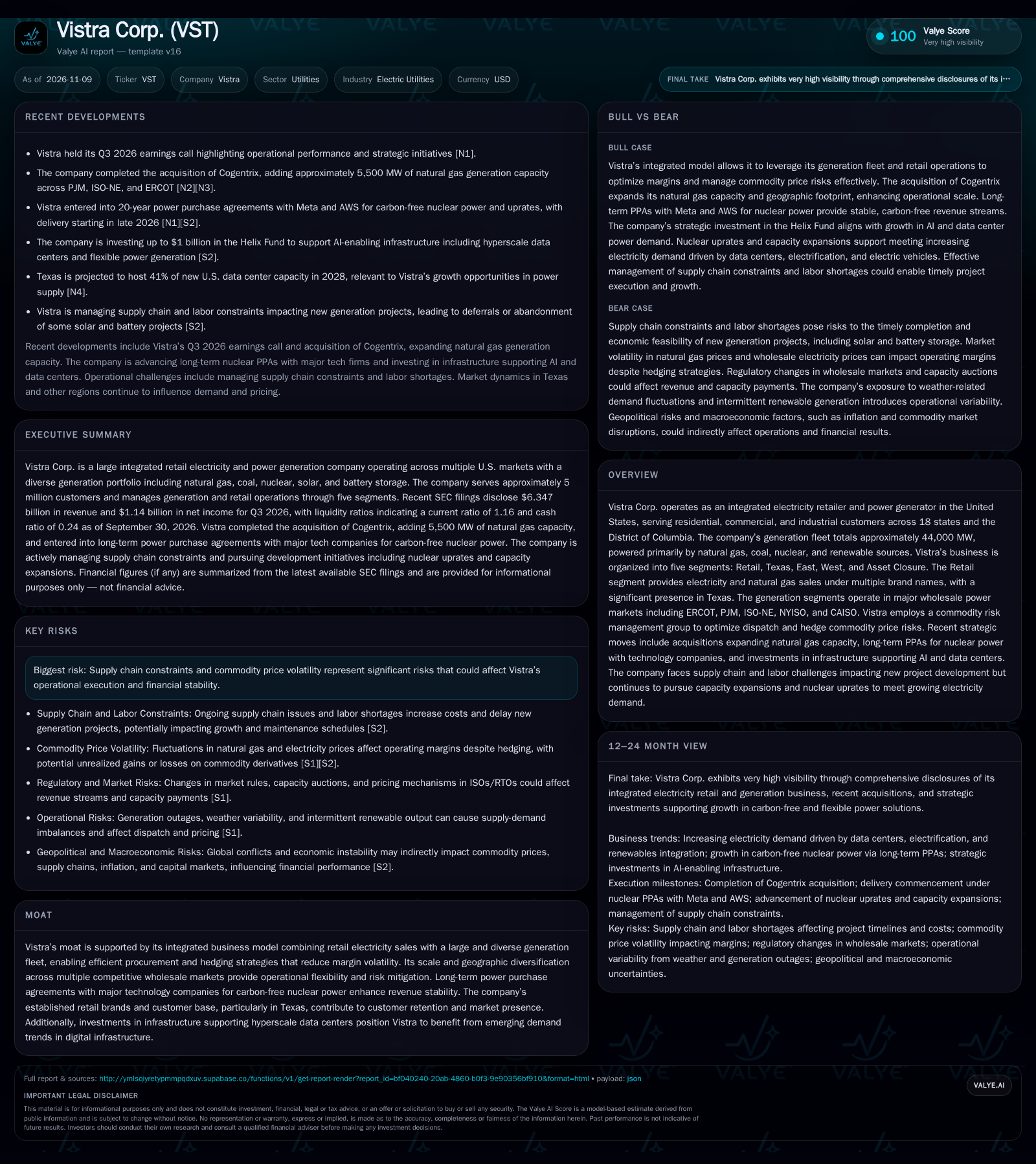
Vistra’s financial and strategic posture has shifted meaningfully in late 2026. The company reported Q3 revenue of $6.347 billion and net income of $1.14 billion, signaling strong profitability amid ongoing market volatility [S2]. The October 2026 acquisition of Cogentrix added approximately 5,500 MW of modern natural gas generation across PJM, ISO-NE, and ERCOT, materially expanding Vistra’s presence and optionality in key wholesale markets [N1] [N2] [S2]. In parallel, Vistra secured 20-year power purchase agreements with Meta and AWS for carbon-free nuclear power, with deliveries beginning in late 2026 and extending through 2034 [S2]. These PPAs provide multi-year revenue visibility and align with surging demand from data center operators seeking reliable, low-carbon electricity. On the capital allocation front, Vistra is investing up to $1 billion in the Helix Fund, targeting assets critical to AI infrastructure and hyperscale data centers [S2]. However, the company is also contending with supply chain and labor shortages, which have led to deferrals and even abandonment of some solar and battery storage projects [S2].
Integrated Model, Fuel Mix, and the Economics of Flexibility
Vistra’s integrated retail and generation operations allow it to capture margin across the electricity value chain, from wholesale production to end-customer sales. The business benefits from the scale and diversity of its 44,000 MW generation fleet, with natural gas (62%), coal (20%), and nuclear (15%) as the dominant fuels, complemented by a small but growing solar and battery component [S1]. This mix provides both baseload reliability and the ability to manage peak demand and price volatility.
The company’s commodity risk management group actively hedges expected generation volumes, aiming to smooth earnings despite fluctuations in natural gas prices and market heat rates [S1] [S2]. The long-term nuclear PPAs with Meta and AWS may further enhance earnings stability, as such contracts typically provide fixed or indexed pricing for large, predictable offtake—a highly attractive proposition in an environment of rising demand and regulatory pressure for decarbonization.
The economics of new investments are shifting, however. Data center and AI-driven power demand is highly location-sensitive and requires both reliability and flexibility, favoring assets like nuclear and fast-ramping gas. Vistra’s Helix Fund initiative suggests a strategy to participate in the growing market for power supply to hyperscale customers, but the actual pricing mechanisms and contract structures for these projects are not fully disclosed. Capital intensity and project lead times remain high. Meanwhile, deferred or abandoned renewables projects highlight the vulnerability of capital deployment to supply chain disruption and labor shortages, which can erode returns or delay cash flows.
Operating leverage in the business is significant: incremental margins on new or uprated nuclear and gas capacity can be strong if utilization is high and fuel costs are managed, but asset-heavy models also expose the company to regulatory and market shocks.
Where Vistra Stands in a Fragmented, Shifting Power Landscape
Vistra competes in a fragmented U.S. power sector, with regional variations in market rules, pricing, and competitive intensity. Its integrated model—combining retail brands with a large, geographically diversified generation fleet—confers advantages in procurement, risk management, and customer retention, particularly in Texas where it serves about 2.6 million retail customers [S1].
In wholesale markets like ERCOT, PJM, ISO-NE, NYISO, and CAISO, Vistra’s mix of gas, coal, and nuclear provides both scale and flexibility, while its nuclear assets are increasingly differentiated as carbon-free baseload becomes more valuable to large corporate buyers. The company’s recent nuclear PPAs with Meta and AWS position it as a potential preferred partner for hyperscale and technology clients who require both green attributes and reliability.
However, Vistra’s advantages face counterforces. Supply chain disruptions can flatten the playing field by delaying all new capacity, while regulatory changes—such as shifts in capacity market rules or carbon pricing—could erode the value of legacy assets or alter competitive dynamics. Renewable-heavy entrants and distributed energy providers remain a long-term threat, especially if battery costs decline sharply or regulatory mandates accelerate the retirement of fossil generation. Whether Vistra’s scale, hedging sophistication, and asset diversity will continue to offset these risks as the market evolves remains an open question.
What Could Unlock Supernormal Returns: Data Center Demand Meets Execution
A favorable scenario for Vistra hinges on two reinforcing trends: surging power demand from U.S. data centers (especially in Texas) and successful execution of its nuclear and flexible generation strategy. If electricity demand from hyperscale operators grows as projected, and Vistra’s Helix Fund investments secure high-value contracts for both new and existing capacity, the company could lock in premium margins and long-term cash flows.
Confirmation of this scenario would come from evidence such as additional long-term PPAs with major technology or AI companies, rapid ramp-up of new or uprated nuclear and gas capacity, and visible progress on Helix Fund-backed projects. Sustained high utilization rates across the nuclear and modern gas fleet, supported by robust demand growth in ERCOT and PJM, would further validate the upside case.
Falsification would come from project execution failures, inability to secure premium pricing, or a slowdown in data center buildouts due to macroeconomic or regulatory headwinds.
Stability Through Integration—But with Project Delays and Margin Variability
The most plausible outcome is that Vistra leverages its integrated model and diverse fleet to maintain earnings stability, but faces ongoing project delays and margin pressure from supply chain constraints and commodity volatility. Retail and wholesale operations continue to provide a natural hedge, with the nuclear PPAs and Cogentrix acquisition contributing incremental stability and earnings growth.
Moderate growth in data center and electrification demand offsets some of the headwinds from deferred renewables projects, but capital deployment is lumpy and returns on new investments are mixed. The company’s hedging program buffers but does not eliminate swings in input costs and market prices.
Evidence supporting this base case would include steady quarterly revenue and net income, incremental capacity additions or uprates coming online with some delay, and a continued mix of both new long-term contracts and spot market sales. Signals against this scenario would include a sharp drop in project execution, significant regulatory changes reducing capacity payments, or a sudden collapse in wholesale power prices.
How Adverse Shocks Could Undermine the Thesis: Execution, Regulation, and Volatility
A negative scenario for Vistra would be triggered by a convergence of adverse factors: persistent supply chain and labor shortages causing widespread project delays or cancellations, severe swings in natural gas or power prices overwhelming the company’s hedging program, and/or significant regulatory shifts that reduce capacity payments or force uneconomic retirements of legacy assets.
Such a scenario could also involve underperformance of new investments in the Helix Fund, either due to lower-than-expected data center growth or increased competition from renewables and distributed energy providers. In this case, Vistra could face shrinking margins, stranded capital, and greater earnings volatility.
Confirmation would come from a string of project deferrals or impairments, rising costs without commensurate contract wins, deterioration in retail customer retention, or regulatory actions that disadvantage the company’s core generation assets.
Testing the Vistra Thesis: What Will Reveal the Company’s Next Act?
Progress and terms of new long-term power purchase agreements with hyperscale, AI, or technology customers—especially additional nuclear or flexible gas contracts—would help test the premium-pricing thesis.
On-time execution and cost discipline for nuclear uprates and new capacity additions; if disclosed, tracking capital expenditures versus plan and project commissioning dates will be crucial.
Updates on Helix Fund investments: the scale, contract structure, and customer mix of new data center-linked projects will illuminate Vistra’s ability to capture next-generation power demand.
Margins and utilization rates on the newly acquired Cogentrix gas fleet, especially in markets with volatile pricing or capacity constraints, would reveal integration success.
Retail customer retention and churn rates in Texas, if disclosed, as a test of the benefit from integrated retail-generation operations.
Impact of ongoing supply chain and labor constraints on the pipeline and economics of solar and battery storage projects—both in terms of delays and potential write-offs.
Regulatory developments in ERCOT, PJM, and other key markets, particularly any changes to capacity market rules, carbon pricing, or incentives for nuclear and flexible generation.
Disclaimer: This is research-only, informational analysis and not investment advice. It may include AI-generated interpretation and general industry context. Always verify important details using primary sources.

Comments