
Vivid Seats 2026: Seller Tools, Marketplace Scale, and the Stakes of Live Event Volatility
Vivid Seats’ two-segment model leverages proprietary seller software and a broad ticket marketplace, but faces pressure from event-driven demand swings, platform innovation requirements, and intense competition. Integration of recent acquisitions and the evolution of seller tools like Skybox Drive could determine whether the platform sustains its relevance and margin profile.
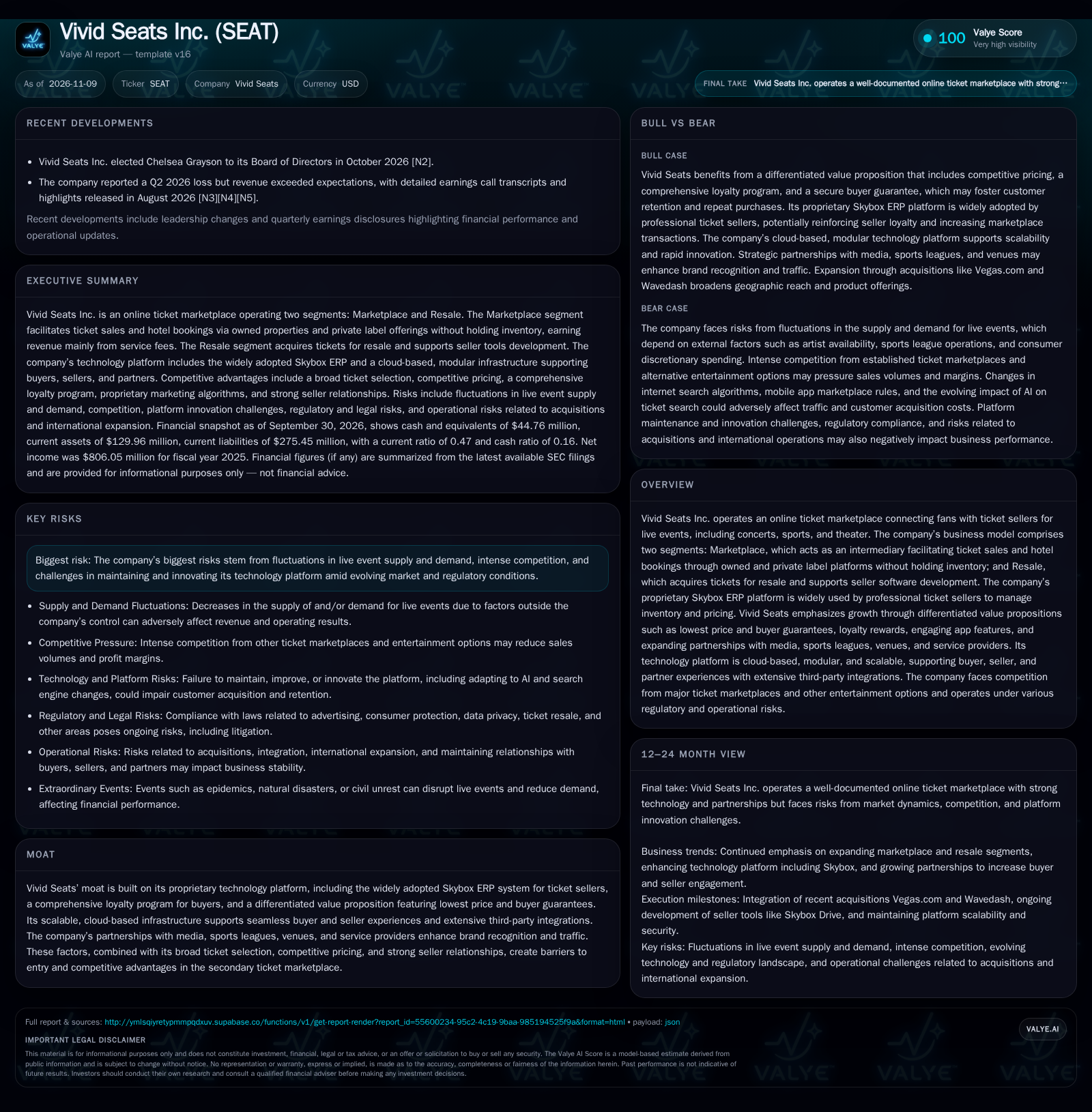
Vivid Seats operates a dual-segment platform: a ticket marketplace that connects buyers and sellers without holding inventory, and a resale business that acquires and resells tickets while supporting seller tools. Its Skybox ERP is widely used by professional sellers, and the company has expanded through acquisitions like Vegas.com. Recent financials show a 2025 net income of $806 million, but a Q2 2026 loss despite exceeding revenue expectations. Competitive threats, live event volatility, and the need to innovate in seller software and partnerships remain central challenges and opportunities. [S1] [S2] [N3] [N4] [N5]
Vivid Seats sits at the intersection of technology, entertainment, and e-commerce, operating a dual-segment model that connects fans with ticket sellers via a scalable, cloud-based platform. Its core differentiator is the Skybox ERP suite, a set of tools that have become deeply embedded in the workflows of professional ticket sellers. Yet, the business faces structural challenges: live event demand is inherently volatile, platform innovation is a moving target, and aggressive competition from larger rivals and new entrants is an ever-present threat. The company’s recent financials and acquisition activity provide both opportunities and risks as it seeks to defend and expand its marketplace position.
Recent Earnings, Seller Platform Focus, and Strategic Acquisitions Shape 2026 Outlook
Vivid Seats reported a net income of $806.05 million for fiscal year 2025, but posted a loss in Q2 2026 even as revenue exceeded expectations, underscoring the volatility inherent in event-driven marketplaces. [S2] [N5] The company’s core Marketplace segment does not hold ticket inventory, instead earning revenue from service and delivery fees, while the Resale segment acquires tickets directly and provides seller software support, notably through the widely adopted Skybox ERP. [S1] Recent acquisitions—Vegas.com in November 2023 and Wavedash in September 2023—have expanded the platform’s reach and local market authority. [S1] The election of Chelsea Grayson to the board in October 2026 signals ongoing governance refresh. [N2]
Marketplace Fee Model, Seller Tool Monetization, and Platform-Driven Operating Leverage
Vivid Seats’ primary economic engine is its Marketplace segment, which collects service and delivery fees from buyers and referral fees from third-party insurance providers. As an intermediary, it avoids direct ticket inventory risk in the Marketplace segment, resulting in a structurally asset-light model with scalable economics. The Resale segment, which does acquire inventory, exposes the company to price and demand risk but also enables the development and monetization of proprietary seller tools such as Skybox.
Skybox, and its subscription-based add-on Skybox Drive (launched in December 2024), allow Vivid Seats to capture recurring software revenue from professional sellers, potentially increasing platform stickiness and providing a higher-margin revenue stream than transaction fees alone. If adoption of dynamic pricing tools grows, the company could see improved seller retention and incremental revenue per seller.
The platform’s cloud-based, modular architecture supports high throughput with limited incremental costs, suggesting positive operating leverage as transaction volumes rise. However, the costs of technology development, customer acquisition, and maintaining competitive loyalty programs represent significant ongoing investments. Capital needs are generally moderate due to the asset-light model, but the Resale segment’s ticket purchases and technology investments could increase working capital requirements if the competitive environment intensifies.
Seller Loyalty, Buyer Guarantees, and the Battle for Ticketing Platform Share
Vivid Seats’ competitive advantages hinge on its comprehensive seller tools, notably Skybox, and its loyalty and guarantee programs for buyers. Seller-side technology creates high switching frictions for professional resellers, especially as inventory management, pricing, and fulfillment become more automated and integrated. The lowest price guarantee and 100% buyer guarantee, combined with a broad ticket selection and engaging app features, help attract and retain buyers, but these are also replicable by larger or better-funded competitors.
The company’s main rivals—StubHub, Ticketmaster, SeatGeek, and TicketNetwork—offer similar core value propositions, often with larger marketing budgets, deeper integrations with primary ticket sources, or exclusive partnerships. The risk is that if competitors match or exceed Vivid Seats’ technology and loyalty offerings, or if search/app-store platform rules change, both buyer and seller churn could rise. The ongoing evolution of AI-driven search and dynamic pricing tools further levels the playing field, making continued innovation in seller and buyer experience crucial to defending share.
If Seller Tools and Partnerships Drive Marketplace Share Gains
A favorable outcome for Vivid Seats would see continued adoption and monetization of Skybox and Skybox Drive, leading to higher seller retention, increased inventory flowing through the platform, and greater transaction volumes. Integration of Vegas.com and Wavedash could provide local authority and cross-selling opportunities, attracting new buyers and event partners. If the loyalty program and buyer guarantees demonstrably reduce churn and increase repeat purchasing, Vivid Seats could improve take rates and customer lifetime value.
Evidence confirming this scenario would include sustained share gains among professional sellers (if disclosed), rising subscription revenue from seller tools, increased engagement and retention metrics among buyers, and successful integration milestones for recent acquisitions. Expansion of exclusive partnerships with sports leagues, venues, or media platforms would further reinforce this trajectory.
Sustaining Share in a Volatile, Competitive Marketplace
The most plausible near-term outcome is that Vivid Seats maintains its position as a leading secondary ticketing platform, with modest growth driven by ongoing investment in seller tools and loyalty features. Event-driven volatility will likely continue to cause swings in quarterly results, but the asset-light Marketplace model and recurring software revenue from Skybox can provide some resilience.
This scenario would be confirmed by stable or gradually increasing transaction volumes, steady adoption rates for Skybox and Skybox Drive, and successful integration of Vegas.com and Wavedash without major operational disruptions. Margins may remain pressured by intense competition and ongoing technology investment needs, but the company would avoid major share losses or a deterioration in platform relevance.
When Live Event Shocks and Platform Stagnation Erode Marketplace Economics
The primary downside risk is a confluence of negative shocks: a decline in live event supply (due to macroeconomic deterioration, public health issues, or artist/sports league disruptions), coupled with failure to keep pace with competitors’ technology, loyalty, or partnership innovations. In this scenario, buyer and seller churn would rise, transaction volumes would fall, and fixed costs associated with technology, marketing, and acquisitions would not be offset by revenue growth.
Additional downside triggers include unfavorable changes to search engine or app store algorithms, regulatory headwinds in ticket resale, or unsuccessful integration of recent acquisitions, leading to operational distractions or write-downs. Confirmation would come from declining transaction volumes, lower seller tool adoption, negative buyer retention trends, or evidence of partnership losses.
Milestones That Will Test Vivid Seats’ Seller Retention, Platform Economics, and Acquisition Integration
Adoption and subscription revenue growth for Skybox and Skybox Drive—if disclosed—would clarify the trajectory of seller loyalty and monetization.
Quarterly transaction volume and gross merchandise value (GMV) trends: rising or stable figures would support the resilience thesis, while declines would signal competitive or demand issues.
Buyer retention and repeat purchase rates—if available—would demonstrate the effectiveness of loyalty and guarantee programs.
Integration progress and financial contributions from Vegas.com and Wavedash, including cross-selling metrics and local market share gains.
New or deepened partnerships with sports leagues, venues, or major media platforms, which could drive exclusive inventory and incremental traffic.
Operational efficiency metrics, such as marketing spend as a percentage of revenue and technology development costs, would indicate scalability and margin trajectory.
Material changes in search engine or app store rules: monitoring referral traffic sources and customer acquisition cost trends would help detect early impacts.
Exposure to event-driven shocks: tracking live event supply indicators and external demand signals (e.g., macroeconomic or public health data) would help anticipate demand volatility.
Disclaimer: This is research-only, informational analysis and not investment advice. It may include AI-generated interpretation and general industry context. Always verify important details using primary sources.

Comments