
Neuraxis 2026: Insurance Access, Pediatric Focus, and the Stakes of GI Neuromodulation Adoption
Neuraxis leverages first-mover advantage in pediatric GI neuromodulation with IB-Stim, underpinned by FDA clearance, academic guidelines, and a new CPT code. Expanded insurance coverage and a Federal Supply Schedule contract open access, but persistent net losses, execution risk in adult expansion, and heavyweight neurostimulation competition define both the opportunity and the uncertainties.
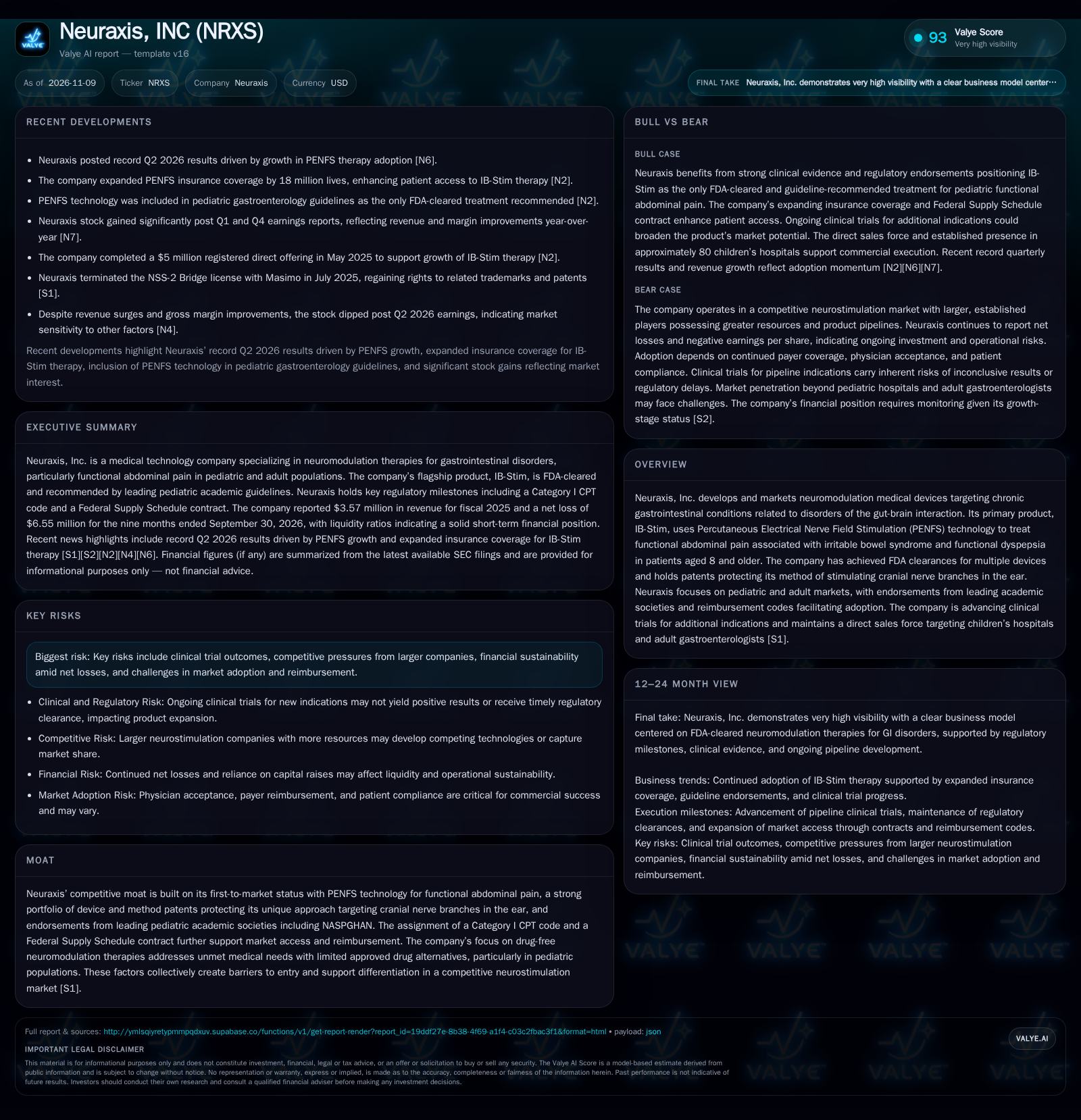
Neuraxis is driving adoption for its FDA-cleared IB-Stim device through expanded insurance coverage, a new CPT code, and Federal Supply Schedule access, targeting both pediatric and adult GI neuromodulation markets. Clinical data, academic guideline support, and patent protection provide barriers to entry, but the company remains loss-making, and must prove broader physician uptake and payer acceptance amid intense competition and ongoing clinical risk. [S1] [S2] [N2] [N6]
Neuraxis, Inc. sits at the intersection of medical device innovation and the evolving landscape of GI neuromodulation, with its IB-Stim device representing a rare convergence of regulatory, clinical, and commercial milestones in pediatric care. The company has leveraged FDA clearance, academic guideline endorsement, and a first-to-market position to drive adoption, recently bolstered by expanded insurance coverage and a new Category I CPT code. Yet, persistent losses and the challenge of scaling beyond the pediatric niche into broader GI and pain markets underscore both the promise and the execution risk facing Neuraxis as it seeks a durable foothold amid larger neurostimulation competitors.
Insurance Expansion, CPT Code, and Federal Contracts: Three Pillars of 2026 Momentum
Neuraxis’ most material recent developments center on expanded access and reimbursement for its flagship IB-Stim device. In 2026, the company secured expanded insurance coverage for its PENFS therapy, adding 18 million covered lives—a step change for patient access and a key driver behind record Q2 results. This comes alongside the assignment of a Category I CPT code (64567), effective January 2026, which standardizes reimbursement for PENFS procedures and provides greater credibility with payers and providers. Additionally, the December 2025 Federal Supply Schedule contract opens up procurement channels in the Veterans Affairs system and other federal facilities for FDA-cleared indications. Combined, these milestones strengthen Neuraxis’ market position, potentially accelerating adoption and revenue growth, especially in the pediatric segment where the device is already guideline-endorsed. However, the company reported a net loss of $6.55 million for the first nine months of 2026, with revenue for 2025 at $3.57 million, indicating that profitability remains a work in progress despite recent operational wins. [S1] [S2] [N2] [N6]
Device Pricing, Margin Structure, and the Economics of PENFS Adoption
Neuraxis’ business model is built around the IB-Stim device, which lists at $1,195 per unit and $4,780 per patient—suggesting a multi-unit treatment course per patient and a revenue model that could scale with broader adoption. The company reports strong gross margins, consistent with medical device economics where once regulatory and clinical hurdles are cleared, incremental device sales can drive operating leverage. However, the model is also characterized by high fixed costs in R&D, regulatory, and commercial infrastructure, as reflected in ongoing net losses. The direct sales force targets children’s hospitals and adult GI specialists, but scaling into the adult segment could require stepped-up commercial investment. The new CPT code may improve physician willingness to adopt and bill for the procedure, but actual payer reimbursement rates and provider uptake will determine the realized economics. Expansion into additional indications (e.g., post-concussion, fibromyalgia) could diversify revenue, but each carries further clinical and regulatory investment requirements. While gross margin improvements have been reported, the path to profitability will hinge on accelerating volume growth, maintaining pricing, and controlling SG&A as the company expands beyond its pediatric core.
Barriers and Battlegrounds: Neuraxis’ Moat in a Crowded Neuromodulation Arena
Neuraxis enjoys several competitive advantages—a first-to-market status for PENFS in pediatric functional abdominal pain, method and device patents targeting cranial nerve branches in the ear, and the distinction of being the only FDA-cleared device recommended by leading pediatric guidelines (NASPGHAN). These factors create real, but not insurmountable, barriers to entry; larger neurostimulation companies with deeper pockets and broader pipelines are active in adjacent indications and could seek to develop alternative approaches or pursue similar reimbursement pathways. The assignment of a Category I CPT code and Federal Supply Schedule access enhance Neuraxis’ defensibility in the short term, but over time, the persistence of its moat will depend on continued clinical evidence, physician loyalty, and payer acceptance. Substitution risk remains if competitors can demonstrate equal or superior efficacy, ease of use, or cost-effectiveness—especially in the adult market, where Neuraxis’ brand and academic relationships are less entrenched. Device commoditization and price pressure are longer-term risks if the field becomes more crowded or if payers push back on reimbursement.
What If IB-Stim Becomes Standard of Care Across Pediatric and Adult GI Disorders?
The most favorable scenario for Neuraxis is that IB-Stim, underpinned by robust clinical data and guideline endorsements, is rapidly adopted as the standard of care not only in pediatric functional abdominal pain but also in adult GI and pain indications. Expanded insurance coverage and the new CPT code could drive large-scale physician uptake, especially if reimbursement rates remain attractive and minimal administrative friction exists. Success in ongoing clinical trials for new indications (such as post-concussion syndrome and fibromyalgia) would further expand the addressable market and diversify revenue sources. Confirmation of this scenario would come from accelerating revenue growth, expanded hospital and physician adoption (especially in adult settings), rapid coverage decisions from major payers, and publication of positive clinical trial results supporting new indications. If gross margins remain high and SG&A growth is outpaced by revenue, Neuraxis could achieve operating leverage and move toward profitability. Evidence against this scenario would include stagnating revenue, slow adult market penetration, or disappointing trial outcomes.
Pediatric Core Drives Steady Growth, Adult Expansion Proves Gradual
The most plausible near-term outcome is that Neuraxis continues to build on its pediatric franchise, leveraging guideline support, insurance expansion, and direct sales into children’s hospitals. Revenue grows at a moderate pace as more pediatric GI centers adopt IB-Stim and payer coverage becomes more universal, but penetration into adult GI and pain markets is incremental rather than explosive. The company maintains high gross margins but requires ongoing investment in sales, R&D, and regulatory efforts for new indications, keeping the business loss-making or breakeven at best in the next 12-24 months. Confirmation would come from continued hospital wins in the pediatric segment, additional payer coverage, and stable or improving gross margin, with SG&A scaling in line with revenue. Falsification would be evident if pediatric adoption stalls, coverage expansion reverses, or gross margins compress due to pricing or cost pressure.
Clinical or Commercial Setbacks Undermine Growth and Liquidity
The adverse scenario involves a combination of clinical, commercial, and financial risks materializing. If ongoing clinical trials for new indications yield inconclusive or negative results, Neuraxis could lose its pipeline momentum and fail to broaden its market beyond the current pediatric indication. Simultaneously, if payers resist reimbursement—either by restricting coverage, lowering rates, or introducing administrative barriers—adoption could stall even in the pediatric core. Larger competitors may introduce alternative neuromodulation solutions or secure broader clinical support, eroding Neuraxis’ first-mover advantage. On the financial front, persistent net losses and the need for further capital raises could dilute existing shareholders and constrain investment in growth. Confirmation of this scenario would include flat or declining revenue, negative trial outcomes, payer pushback, or a need for dilutive capital raises in the face of liquidity pressure.
Metrics and Milestones That Will Shape Neuraxis’ GI Neuromodulation Trajectory
Trends in IB-Stim revenue growth by segment (pediatric vs. adult), if disclosed, will reveal the breadth and depth of market penetration.
Updates on insurance coverage expansion or contraction, including payer policy changes and CPT code reimbursement rates, would help test the sustainability of access gains.
Clinical trial enrollment progress and topline results for pipeline indications such as post-concussion syndrome, cyclic vomiting, and fibromyalgia pain will be critical for future market expansion.
Gross margin trends and SG&A expense scaling, as reported, will indicate whether Neuraxis is moving toward sustainable operating leverage.
Hospital and physician account growth, especially in adult GI and pain management settings, if disclosed, would confirm successful expansion beyond the pediatric core.
Any competitive product launches or new guidelines from academic societies could signal shifts in the competitive landscape or barriers to continued adoption.
Capital raise activity and cash burn rates, as disclosed in future filings, will determine whether Neuraxis’ current liquidity is sufficient to support its growth ambitions.
Disclaimer: This is research-only, informational analysis and not investment advice. It may include AI-generated interpretation and general industry context. Always verify important details using primary sources.

Comments