
Sable Offshore 2026: Dependency, Disruption, and the Stakes of California Platform Survival
With heavy debt, ongoing regulatory scrutiny, and costly compliance obligations, the company's future hinges on restoring sales channels, securing alternative financing, and navigating California’s complex offshore oil landscape.
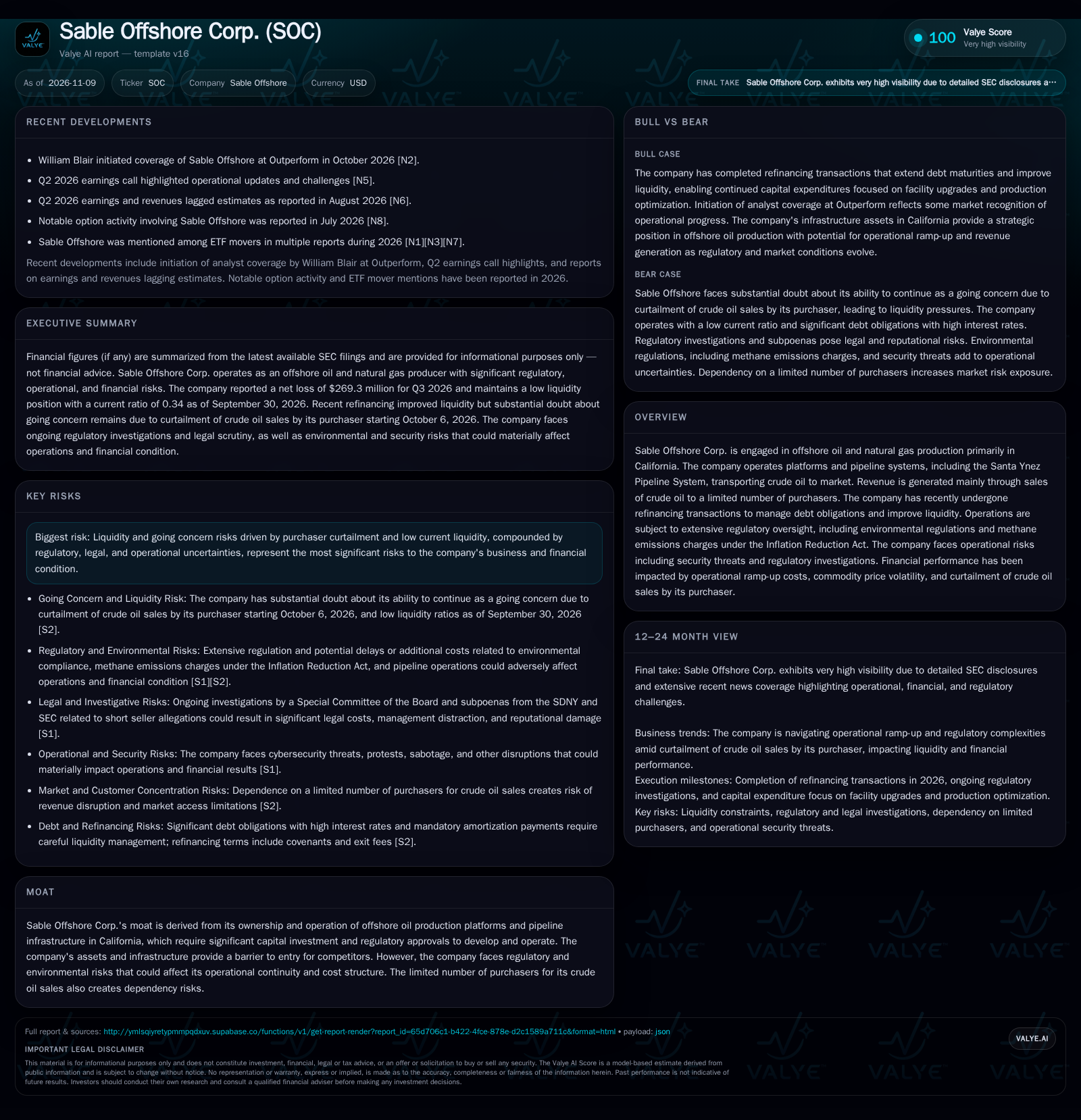
While recent refinancing improved near-term liquidity, persistent net losses, heavy debt, and regulatory investigations cloud prospects. The company’s survival depends on reestablishing revenue flows, managing debt, and meeting stringent regulatory and environmental demands in a challenging California market. [S2]
Sable Offshore Corp. stands at a critical inflection point following the curtailment of crude oil sales by its principal purchaser in October 2026—a move that has thrown its already precarious liquidity position into sharper relief. While recent refinancing provided some breathing room, persistent net losses, a highly concentrated revenue base, and mounting regulatory and legal challenges threaten the company’s ability to operate as a going concern. The core question is whether Sable Offshore can restore revenue flows, manage debt, and sustain operations in the face of California’s stringent offshore energy environment and intensifying compliance demands.
Sales Curtailment Exposes Revenue Fragility and Triggers Going Concern Alarm
The most material recent development for Sable Offshore is the curtailment of crude oil sales by its primary purchaser beginning October 6, 2026. This single event has created substantial doubt about the company’s ability to continue as a going concern, as disclosed in its latest quarterly filing. Sable’s customer concentration risk became acute: substantially all revenue as of September 30, 2026, depended on one purchaser, leaving the company with limited alternatives when that channel closed [S2].
The company reported a net loss of $269.3 million and negative EPS of -$1.37 for the quarter, reinforcing the severity of operational and liquidity pressures [S2].
Recent refinancing in July 2026—including new term debt and convertible notes—provided temporary liquidity relief but did not resolve the underlying vulnerability of Sable’s business model to customer disruptions and high debt service [S2].
The company is simultaneously under regulatory investigation following short-seller allegations, with subpoenas from the SDNY and SEC, adding potential legal costs and reputational risk to an already fragile situation [S1] [S2].
Offshore Platform Economics: High Fixed Costs, Volume Dependency, and Debt Overhang
Sable Offshore’s business model is defined by high fixed costs—both operating and capital—associated with maintaining offshore platforms, pipelines, and regulatory compliance. Margins are highly sensitive to production volume and realized oil prices, but the company’s ability to flex costs is limited given the infrastructure-intensive nature of offshore extraction.
Revenue flows are fundamentally tied to the ability to sell crude, and with sales now curtailed, fixed costs and debt service quickly consume available liquidity. The company’s July 2026 refinancing extended maturities and may have reduced near-term default risk, but it left Sable with significant interest obligations and restrictive covenants. The need for ongoing capital expenditures (facility upgrades, maintenance, production optimization) further strains cash resources, especially as some projects may now be deferred or require alternate funding sources [S2].
Sable’s reliance on derivative instruments for commodity price hedging introduces additional credit and market risks. In a stressed liquidity scenario, margin calls or adverse hedge settlements could exacerbate cash outflows [S2].
With offshore operations in California, Sable faces some of the nation’s strictest environmental and pipeline regulations, potentially increasing both baseline operating costs and the risk of sudden capital requirements tied to compliance or environmental incidents.
Structural Barriers and the Limits of Asset-Based Moats in California Offshore Oil
Sable Offshore’s core competitive asset is its ownership and operation of offshore production platforms and the Santa Ynez Pipeline System, which represent high barriers to entry due to capital intensity and the lengthy permitting processes in California. In theory, these assets should confer a degree of moat, as few new entrants are likely to replicate them.
However, Sable’s competitive position is undercut by its dependence on a single or very limited set of crude oil purchasers. This customer concentration not only reduces pricing power but also leaves the company vulnerable to abrupt revenue disruptions—as evidenced by the 2026 sales curtailment [S2].
Additionally, Sable operates under regulatory crosshairs, subject to ongoing investigations and potential environmental liabilities. Competitors in the California offshore oil sector face similar compliance burdens, but larger, better-capitalized players may be better positioned to absorb regulatory shocks or invest in emissions mitigation technologies.
Substitution risk is high in the broader energy market, as California’s policy environment increasingly favors renewables and electrification over fossil fuel expansion. Over the medium term, policy shifts and consumer preferences could erode the strategic value of Sable’s offshore assets, making long-term reinvestment less attractive.
Restoring Sales Channels and Managing Debt Could Enable Short-Term Recovery
A favorable outcome for Sable Offshore would require the rapid restoration of crude oil sales—either through renegotiation with the former primary purchaser or by securing new buyers. If Sable can reestablish consistent revenue flows, even at compressed margins, it may be able to service debt, fund minimum capital expenditures, and defer distress for several quarters.
The refinancing completed in July 2026 provides a window to pursue operational optimization and cost discipline. If management can leverage this window to improve unit economics, demonstrate regulatory compliance, and resolve legal investigations without major penalties, Sable could gradually rebuild market confidence.
Confirmation of this scenario would come from new or reinstated sales contracts, improved cash flow from operations, and disclosure of progress in resolving regulatory investigations. A rebound in California oil prices or a regulatory reprieve on methane emissions costs would further support recovery prospects.
Falsification would be evident if no alternative sales channels emerge, legal risks escalate into material penalties, or if operational disruptions (such as pipeline incidents or sabotage) further constrain production.
Prolonged Revenue Disruption, Deferred Capex, and Escalating Financial Strain
The most plausible trajectory is that Sable Offshore remains in a distressed state, with little or no revenue following the purchaser curtailment. Fixed platform costs, debt service, and required maintenance outlays rapidly deplete remaining cash, forcing the company to defer capital expenditures and potentially seek emergency financing or asset sales.
In this scenario, regulatory and legal investigations persist, adding uncertainty and potential costs, while management’s focus is diverted from operational improvements. The company may negotiate with creditors to restructure obligations, but options are limited without a credible path to restored sales or positive cash flow.
Evidence supporting this scenario would include continued negative cash flow, further deferral of capex, lack of new sales contracts, and ongoing legal disclosures. If Sable draws down remaining liquidity without material improvement in its sales outlook, the risk of insolvency or asset liquidation rises.
A deviation from this scenario would require either a rapid and unexpected restoration of sales or a major external intervention (such as a strategic investment or acquisition by a better-capitalized peer).
Extended Sales Freeze, Regulatory Escalation, and Eventual Insolvency
In a more adverse scenario, Sable Offshore fails to restore crude oil sales for an extended period, leading to a rapid depletion of cash and inability to meet debt service or essential maintenance obligations. The company may default on its obligations, triggering creditor action, asset foreclosure, or bankruptcy proceedings.
Meanwhile, regulatory investigations could escalate, resulting in fines, mandated operational shutdowns, or forced divestitures. Environmental incidents, security breaches, or further legal actions would accelerate the company’s decline and erode any residual asset value.
Confirmation of this scenario would include bankruptcy filings, forced asset sales, or regulatory actions mandating cessation of operations. Disclosures of severe liquidity shortfalls, missed debt payments, or worsening legal outcomes would further corroborate an accelerating downward spiral.
A major positive surprise—such as a government intervention, favorable regulatory settlement, or acquisition by a strategic buyer—would be required to avert this outcome if core revenue channels remain blocked.
Testing Sable Offshore’s Survival: Operational, Financial, and Regulatory Milestones to Track
Restoration or replacement of crude oil sales contracts—any evidence of resumed sales or new customer agreements would be the most direct test of the company’s ability to generate revenue and service obligations.
Updates on regulatory investigations—public disclosure of settlements, penalties, or exoneration would clarify the scale of potential legal and reputational liabilities.
reported liquidity position and cash burn—a useful metric would be detailed monthly cash flow and forecasted runway under different sales and capex scenarios, if disclosed.
Progress on capital expenditure projects—status of facility upgrades and production optimization initiatives, including any deferrals or cancellations, would signal operational flexibility or distress.
Changes in debt covenants or refinancing activity—modifications to credit terms, covenant waivers, or new financing arrangements would indicate creditor confidence (or lack thereof) and near-term solvency prospects.
Commodity price sensitivity—monitoring realized oil prices, hedge effectiveness, and exposure to margin calls could help assess vulnerability to further external shocks.
Security and operational incident disclosures—reports of protests, sabotage, cybersecurity breaches, or environmental events could materially affect operations and financial outlook.
California regulatory developments—any changes in state or federal offshore drilling policy, methane charge implementation, or environmental permitting could alter both cost structure and long-term asset value.
Disclaimer: This is research-only, informational analysis and not investment advice. It may include AI-generated interpretation and general industry context. Always verify important details using primary sources.

Comments