
Ares Acquisition Corp III: SPAC Mechanics, Trust Capital, and the Clock on Deal Execution
Ares Acquisition Corp III completed a $395 million SPAC IPO in July 2026, placing proceeds in trust and reporting reported liquidity position and net income from interest. The company faces a defined window to identify and consummate a business combination, with its future value hinging entirely on the quality and execution of that eventual deal.
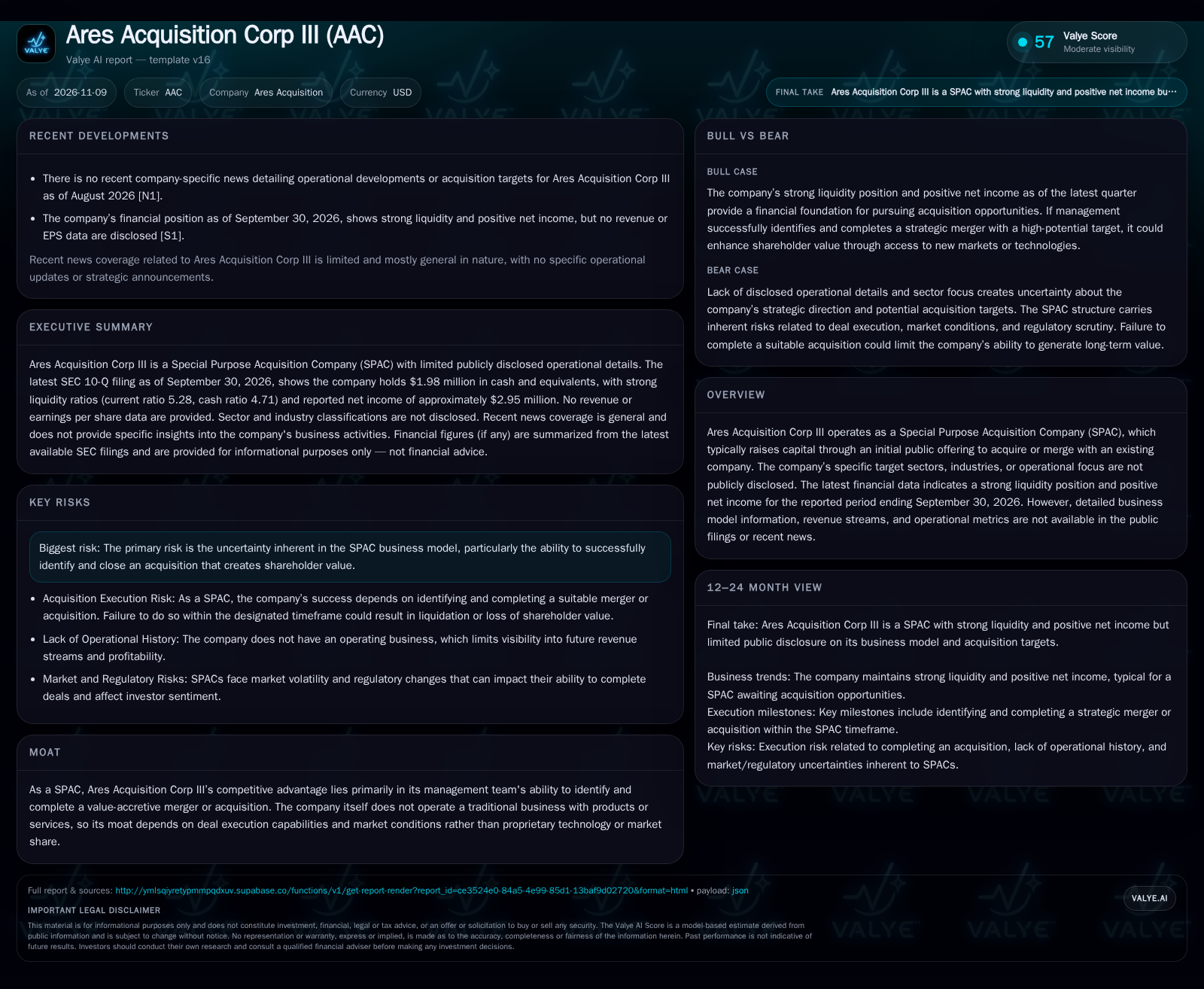
Ares Acquisition Corp III is a newly listed SPAC with $395 million in trust, reported liquidity position, and positive net income from interest as of September 2026. With no operating business or disclosed target, the company’s prospects depend on its ability to identify and close a value-creating acquisition before its 2028 deadline. Execution risk, regulatory uncertainty, and the competitive SPAC landscape are central to its future trajectory. [S1]
Ares Acquisition Corp III is a blank-check company formed in March 2026, completing a $395 million IPO in July and holding all proceeds in a trust account as required by the SPAC structure. With nearly $2 million in unrestricted cash and positive net income from interest, the company is in the early phase of its lifecycle, focused entirely on sourcing and executing a business combination before its 2028 deadline. With no operating business, revenue, or sector focus disclosed, the path forward is defined by management’s ability to identify and close a compelling transaction amid a competitive and evolving SPAC landscape. Investors face a binary outcome: the upside of a successful deal versus the risk of liquidation and capital return.
IPO Proceeds in Trust and the Early SPAC Phase: What the Balance Sheet Reveals
Ares Acquisition Corp III completed its $395 million IPO on July 1, 2026, placing the entirety of the proceeds in a U.S. trust account as required for SPACs. As of September 30, 2026, the company reported $1.98 million in cash and equivalents outside the trust, $2.23 million in current assets, and $421,541 in current liabilities, resulting in a current ratio of 5.28. The company also reported net income of $2.95 million for the period—entirely attributable to interest income from the trust, as no operating revenues or transactions have occurred. No acquisition targets, sector focus, or operational details have been disclosed. The company must identify and close a business combination by July 2028 or liquidate, returning trust funds to shareholders. [S1]
SPAC Financial Structure: Interest Income, Deferred Costs, and the Binary Outcome
Ares Acquisition Corp III’s current economics are dictated by the SPAC structure. The company generates income solely from interest earned on the $395 million held in trust, typically invested in short-term U.S. government securities. This interest covers operating expenses and, if sufficient, can result in positive net income, as seen in the reported $2.95 million for the period. However, these earnings are not related to any actual business activity or value creation—they are a byproduct of the trust’s capital preservation mandate.
The bulk of the capital is restricted and cannot be used for operational purposes until a business combination closes. Deferred underwriting fees ($13.8 million) and other offering costs ($22.6 million in total) will be settled upon a successful transaction or liquidation. The economics shift entirely upon a merger: the surviving entity inherits the cash, but also the obligation to create value exceeding the trust redemption value. If no deal is completed, the trust is returned to shareholders, minus minimal permitted withdrawals and expenses.
The entire model is capital-light until a transaction, but the economics become highly path-dependent: value is created only if the post-combination business merits a premium to trust value. Otherwise, dilution from sponsor warrants and fees can erode shareholder returns.
Deal Sourcing and Sponsor Reputation in a Crowded SPAC Market
Ares Acquisition Corp III’s competitive posture is shaped by its sponsor’s reputation, experience, and network in sourcing attractive deals. With hundreds of SPACs competing for targets, differentiation rests on the sponsor’s ability to access proprietary opportunities, negotiate favorable terms, and convince both targets and public investors of the merits of the combination.
SPACs face competition not just from each other, but from private equity, traditional IPOs, and direct listings. In recent years, regulatory scrutiny and tighter market conditions have made target companies more selective and valuations more disciplined. The Ares brand may provide some edge in credibility and deal access, but with no sector focus or target disclosed, the degree of competitive advantage remains theoretical until a transaction is announced.
The primary substitute for a SPAC merger is a traditional IPO or private sale. If market sentiment toward SPACs sours or regulatory hurdles increase, targets may prefer alternative routes, further challenging SPACs to differentiate on speed, certainty, or strategic fit.
If a High-Quality Target Is Secured: How a Transformative Deal Could Create Value
The most favorable scenario for Ares Acquisition Corp III is the identification and successful merger with a high-growth or strategically positioned private company. If the sponsor leverages its network to secure a target with strong fundamentals, scalable operations, and public-market appeal, the transaction could unlock value for shareholders through post-merger appreciation, access to new markets, or technology.
Key indicators confirming this scenario would include: a well-received deal announcement, minimal shareholder redemptions at closing, and strong aftermarket trading. Evidence would also be a sharp increase in trading volume and positive analyst or media coverage on the merits of the target.
Falsification would come from an inability to announce a deal, excessive redemptions, or market skepticism about the target’s quality or valuation.
Waiting for the Right Deal: The Typical SPAC Timeline and Likely Outcomes
The median SPAC experience involves a lengthy search for a suitable target, often with several months of negotiation and regulatory review before a merger is announced. During this period, Ares Acquisition Corp III’s capital remains in trust, generating modest interest income to cover expenses. The most plausible outcome is a deal announcement within 12-24 months, followed by a shareholder vote and possible redemptions.
Confirmation of this path would be the filing of a merger proxy, public disclosure of a target, and completion of the shareholder approval process. A moderate level of redemptions (typical for SPACs in this market) would suggest an average outcome. Falsification would be a failure to announce a deal as the deadline nears, or an announced deal that is withdrawn or fails to gain approval.
Deal Failure, Liquidation, or Value Erosion from Adverse Market Trends
The principal risk is that Ares Acquisition Corp III fails to secure or close a business combination before the July 2028 deadline. In this case, the trust would be liquidated and returned to shareholders, minus allowed expenses. While this preserves most capital, it typically results in negligible or negative returns for public shareholders after accounting for opportunity cost and potential dilution from warrants.
A second downside risk is a low-quality or overvalued deal that results in heavy shareholder redemptions, poor post-merger performance, or regulatory intervention. In these circumstances, the merged entity may trade below trust value, and public holders could suffer losses. Confirmation would be a prolonged lack of deal activity, repeated extensions, or a deal announcement met with negative market reaction and high redemption rates.
Milestones That Will Determine Whether Ares Acquisition Corp III Delivers Value
Announcement of a definitive merger agreement with a credible, attractive target—this would be the pivotal event for the SPAC’s future.
Level of shareholder redemptions at the time of deal closing, which will reveal market confidence in the target and affect the capital available to the combined entity.
Regulatory or SEC communications affecting SPAC market rules or deal approval timelines, which could impact execution risk.
Changes in the trust account balance, including permitted withdrawals for expenses or interest income trends, as an indicator of capital preservation.
Any extension or amendment to the SPAC’s deadline, which may signal difficulty in securing a deal.
Sponsor or management team communications regarding sector focus, deal criteria, or progress updates—if disclosed.
Trading volume and share price movement following any deal announcement, which would indicate market reception and expectations.
Disclaimer: This is research-only, informational analysis and not investment advice. It may include AI-generated interpretation and general industry context. Always verify important details using primary sources.

Comments