
United States Gasoline Fund (UGA): Tracking Gasoline Price Volatility in a Tightening Regulatory Landscape
UGA provides investors with direct exposure to gasoline price movements through an ETF structure that manages regulatory limits, but faces challenges from shifting futures curves, asset volatility, and evolving commodity ETF demand.
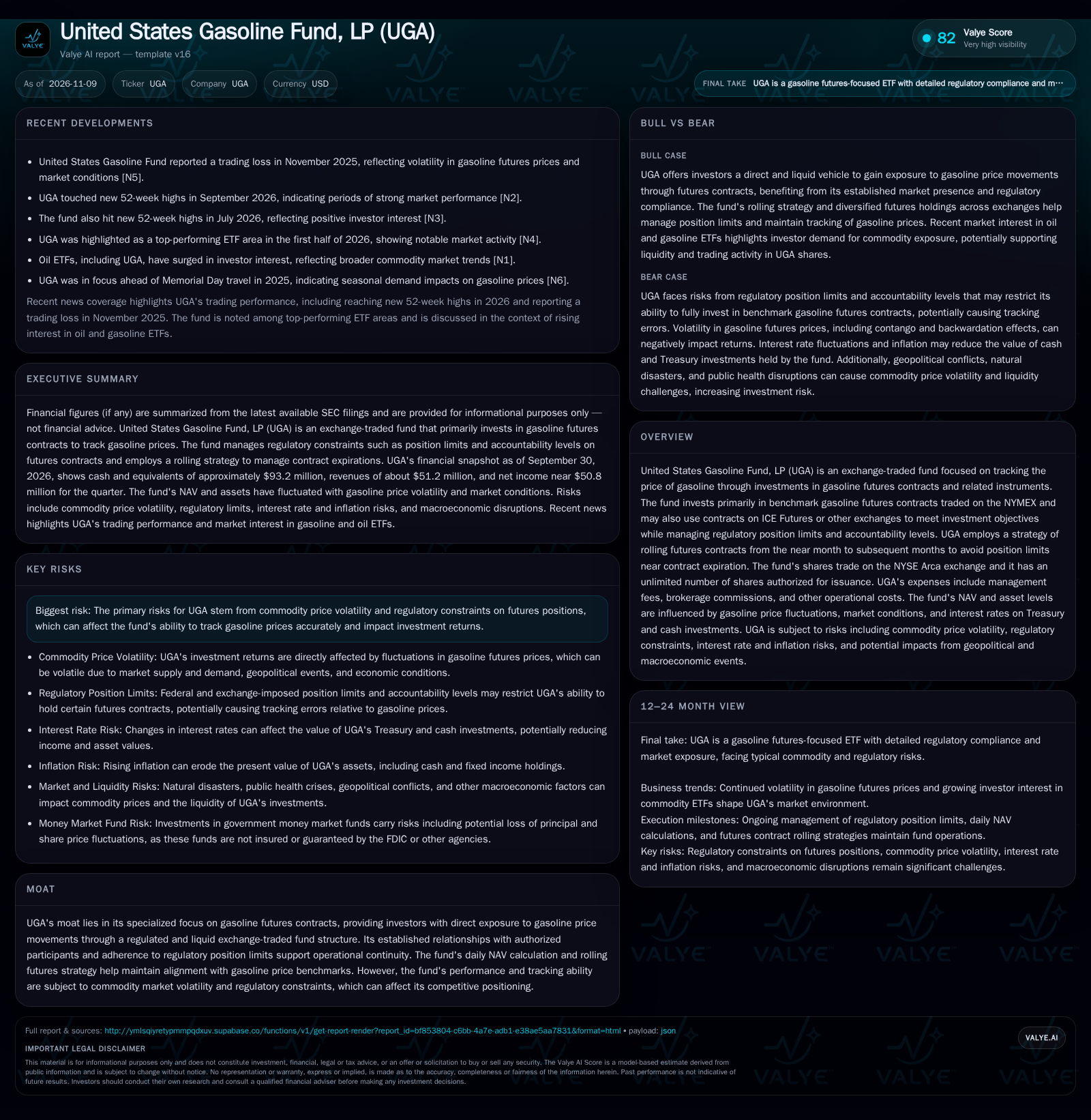
United States Gasoline Fund, LP (UGA) is an ETF that tracks gasoline prices via futures contracts, with $93.2 million in cash/equivalents and $51.2 million in quarterly revenue as of September 2026. UGA’s NAV and asset base are sensitive to gasoline price swings, regulatory position limits, and interest rate changes. Recent 52-week highs in 2026 highlight renewed investor interest, but the fund’s returns remain vulnerable to futures market structure and macroeconomic shocks. Ongoing regulatory compliance and contract-rolling strategies remain central to UGA’s ability to track its benchmark effectively. [S2] [N2] [N3]
The United States Gasoline Fund, LP (UGA) offers investors a liquid, exchange-traded vehicle for tracking U.S. gasoline prices through direct ownership of gasoline futures contracts. Recent quarters have seen the fund’s net asset value and asset base move in lockstep with commodity price swings, underscoring its pure-play exposure to the gasoline market. While UGA’s 2026 performance includes periods of strong investor demand—evidenced by new 52-week highs—the fund remains structurally exposed to regulatory position limits, futures market dynamics, and broader macroeconomic volatility. Understanding UGA’s mechanics and vulnerabilities is essential for assessing its role in a diversified portfolio and its ability to deliver on its tracking mandate. [S1] [S2] [N2] [N3]
Recent Asset Movements and Regulatory Framing Define UGA’s 2026 Landscape
As of September 30, 2026, UGA held approximately $93.2 million in cash and cash equivalents, reported $51.2 million in revenue, and generated $50.8 million in net income for the quarter. The fund’s assets under management have declined from $100.5 million in 2024 to $77.0 million in 2025, mirroring lower gasoline prices and futures contract values. UGA’s structure and investment strategy remain tightly bound by CFTC and exchange-imposed position limits, which dictate the fund’s ability to allocate capital to benchmark gasoline futures. Notably, UGA hit new 52-week highs in July and September 2026, reflecting periods of renewed investor interest and positive commodity price momentum. However, reported trading losses in November 2025 underscore the persistent volatility inherent in gasoline futures exposure. [S1] [S2] [N2] [N3] [N5]
How UGA’s Structure Translates Gasoline Price Movements into Returns—and Risks
UGA earns (or loses) money based on the daily mark-to-market changes in the value of its gasoline futures contracts, minus management and operational expenses. The fund typically rolls its positions from the front-month contract to the next, aiming to minimize regulatory friction while maintaining benchmark exposure. This rolling process can introduce slippage, especially when the futures curve is in contango (where later-dated contracts are more expensive than near-term ones), causing the fund to 'sell low and buy high.' Conversely, backwardation can enhance returns. UGA’s income from cash and Treasury holdings supplements total return, but interest rate declines in 2025 reduced its yield from 4.92% to 4.01%. Management fees are a function of total net assets, so declining NAV directly depresses fee income and may increase the fund’s expense ratio as a percentage of assets. The ETF’s open-ended structure allows creation and redemption of shares to match investor demand, but does not shield investors from the underlying volatility and tracking error that can arise from regulatory limits or futures market anomalies. [S1] [S2]
UGA’s Niche: Direct Gasoline Exposure in a Crowded Commodity ETF Arena
UGA’s competitive positioning is rooted in its specialization: it is one of the few ETFs offering direct exposure to gasoline price movements via regulated futures contracts. This appeals to investors seeking a pure-play gasoline hedge or speculative vehicle, distinct from broader energy or oil ETFs. However, the ETF landscape is crowded, with peers providing exposure to oil, refined-product baskets, or broader commodity indices. Potential substitutes include other commodity ETFs, oil-focused funds, and even equity-based energy funds. UGA’s moat is its regulatory compliance, transparency, and the ability to closely track the gasoline benchmark—so long as position limits do not force allocations into less-correlated contracts. Counterforces include potential regulatory tightening, the risk of tracking error during periods of high retail/institutional inflows, and the rise of alternative vehicles such as swaps or structured notes. The fund’s liquidity and established relationships with authorized participants help maintain secondary market efficiency, but do not guarantee tracking precision if market structure shifts or regulatory capacity is strained. [S1]
A Tight Physical Market and ETF Demand Could Drive Outperformance
UGA’s most favorable scenario would be a period of robust physical gasoline demand, supply constraints (e.g., refinery outages or geopolitical disruptions), and a backwardated futures curve. In this environment, spot and near-term gasoline prices could surge, and rolling futures contracts would be accretive rather than dilutive to returns. Elevated investor interest—potentially triggered by macroeconomic uncertainty or inflation hedging—could drive further inflows, supporting liquidity and possibly allowing UGA to operate near its intended benchmark allocations without breaching regulatory limits. Confirmation would come from sustained increases in average daily net assets, a narrowing of any observed tracking error versus spot gasoline prices, and positive media coverage of UGA as a top-performing commodity ETF. A falsification would be if, despite rising gasoline prices, the fund’s returns lagged due to persistent contango, regulatory-driven allocation shifts, or operational slippage. [N2] [N3]
Tracking with Friction: Managing Contango, Position Limits, and Investor Flows
The most plausible path is one of continued volatility in gasoline prices, with UGA’s returns oscillating around the performance of front-month gasoline futures, but not perfectly matching them. Regulatory position limits will periodically constrain the fund’s ability to invest fully in benchmark contracts, forcing it to diversify into other maturities or exchanges—introducing modest tracking error. Rolling costs will persist, especially if the market remains in contango, eroding returns relative to spot prices. Interest income from cash and Treasuries will provide some cushion, but declining yields could limit this offset. Investor flows could be choppy, with periods of high demand around seasonal gasoline usage (e.g., summer driving season) and pullbacks during risk-off macro episodes. Evidence confirming this scenario would include continued reporting of tracking error and periodic references to regulatory friction in fund disclosures, as well as NAV and asset swings tied closely to gasoline price volatility. [S1] [S2]
When Regulatory and Market Structure Risks Converge: The Perils of Tracking Error
An adverse scenario for UGA would combine a deep contango in the gasoline futures curve, regulatory tightening on position limits, and a sharp drop in investor demand for commodity ETFs. In this case, the fund could be forced to allocate a larger share of assets to non-benchmark contracts or cash, increasing tracking error and reducing the fund’s appeal as a gasoline play. Prolonged contango would erode returns through negative roll yield, and declining interest rates would further depress income from cash holdings. If gasoline prices collapsed due to oversupply, weak demand, or macro shocks, NAV and net assets could fall sharply, amplifying fee drag as fixed expenses become a larger share of assets. News of trading losses, widening bid-ask spreads, or large deviations from benchmark performance would confirm this scenario. [N5] [S2]
What Will Test UGA’s Ability to Track and Attract: Concrete Markers for the Next Phase
The evolution of UGA’s tracking error versus benchmark gasoline futures—if disclosed—would indicate the fund’s operational effectiveness in maintaining its mandate.
Changes in average daily net assets and number of shares outstanding would reveal shifts in investor demand and the fund’s ability to scale under regulatory constraints.
Disclosure of the proportion of assets held in non-benchmark contracts due to position limits would clarify the frequency and materiality of regulatory friction.
The impact of rolling costs—especially during periods of contango—on total returns, if reported, would help quantify structural headwinds.
Reported net interest income on cash and Treasury holdings, and its sensitivity to interest rate changes, would signal the degree of secondary income buffering NAV volatility.
Seasonal inflows or outflows tied to gasoline demand spikes (e.g., summer travel) would test the fund’s ability to accommodate liquidity without increasing slippage.
Any changes in CFTC or exchange position limit rules affecting gasoline futures would directly impact UGA’s operating model and tracking ability.
Media coverage and mentions in ETF performance roundups—such as repeated references to new 52-week highs—could reflect and reinforce shifts in investor sentiment.
Disclaimer: This is research-only, informational analysis and not investment advice. It may include AI-generated interpretation and general industry context. Always verify important details using primary sources.

Comments