
Village Farms 2026: Cannabis Ambitions, Diversification, and the Search for Durable Margins
Village Farms International’s Q3 2026 results highlight a profitable cannabis-agriculture hybrid with reported liquidity position, global expansion plans leveraging EU GMP certification, and ongoing leadership transition. The company’s ability to convert operational breadth and regulatory positioning into sustained margin gains remains the core strategic question.
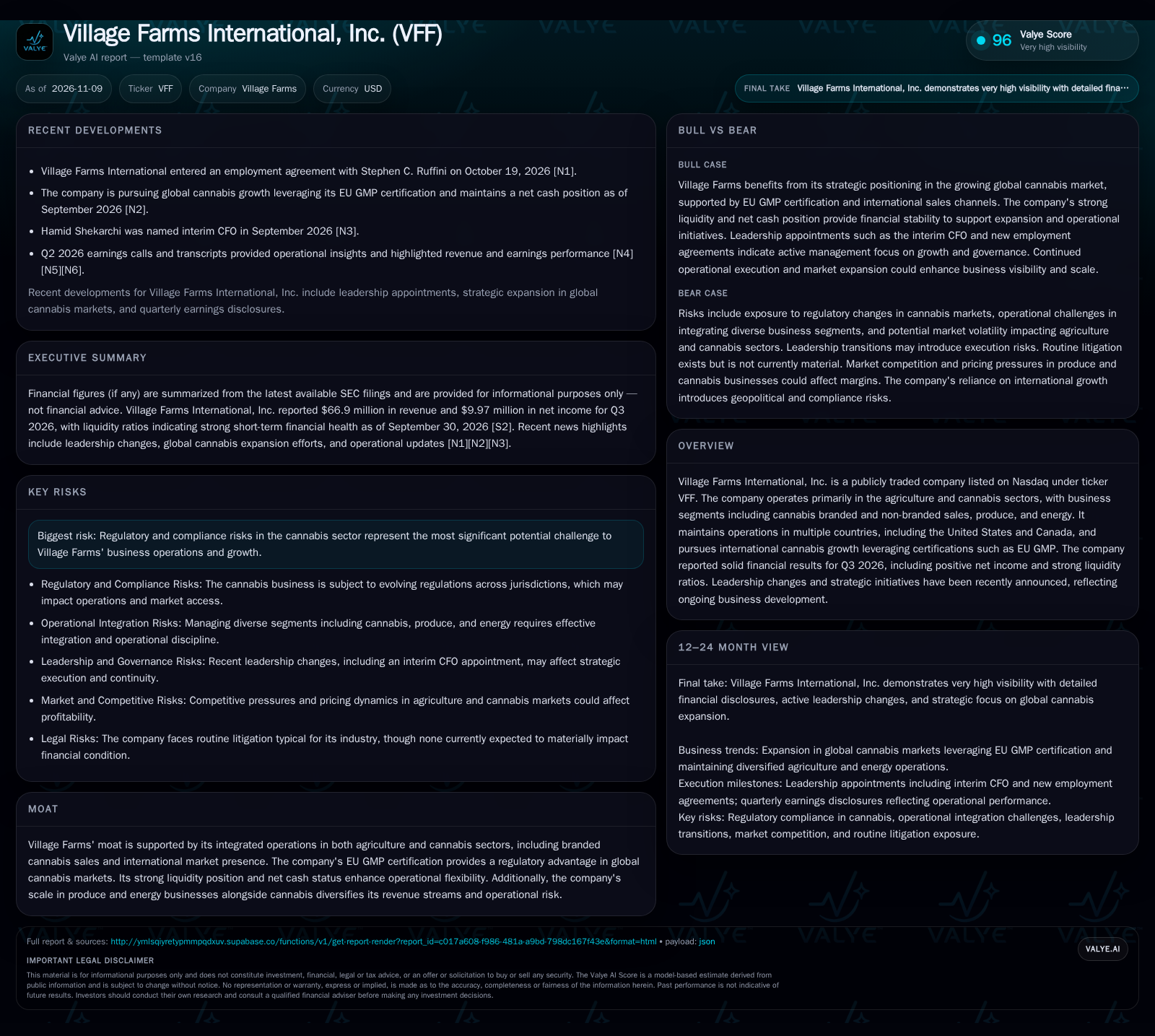
Village Farms International posted $66.9 million in Q3 2026 revenue and $9.97 million in net income, supported by a net cash position and reported liquidity position. The company is actively pursuing international cannabis growth, leveraging its EU GMP certification to target global markets. Leadership changes—including an interim CFO and a new employment agreement with Stephen C. Ruffini—signal a period of transition and possible strategic recalibration. The central challenge: can Village Farms translate its diversified platform and regulatory edge into durable margin expansion amid regulatory, competitive, and integration risks? [S2] [N1] [N2] [N3]
Village Farms International, Inc. enters late 2026 as a rare profitable operator straddling the cannabis and traditional agriculture sectors. Reporting nearly $10 million in quarterly net income and maintaining a strong net cash position, the company stands out for its regulatory credentials—most notably its EU GMP certification for cannabis. But as leadership transitions and international ambitions accelerate, the central question is whether Village Farms can sustain and scale margins in an industry fraught with regulatory flux, integration demands, and intensifying competition. The next phase will test the company’s ability to convert its breadth and financial stability into durable returns.
The company reported cash and liquidity metrics for the period; these figures do not by themselves establish operating runway, investment capacity, financial flexibility, or financ
Village Farms reported $66.9 million in revenue and $9.97 million in net income for Q3 2026, translating to basic and diluted EPS of $0.08 [S2]. This marks a period of profitability in a sector where many peers still struggle to generate consistent bottom-line results. The company’s financial footing is further supported by $79.3 million in cash and cash equivalents as of September 30, 2026, with a current ratio of 3.21 and a cash ratio of 1.44 [S2].
Recent leadership moves include naming Hamid Shekarchi as interim CFO in September 2026 and entering an employment agreement with Stephen C. Ruffini in October 2026 [N1] [N3]. These transitions suggest a period of strategic recalibration. Meanwhile, the company is actively pursuing international cannabis expansion, leveraging its EU GMP certification as a regulatory wedge into global markets while maintaining a net cash position [N2].
How Village Farms Could Unlock Margin Expansion Across Segments
Village Farms’ business model blends cannabis (both branded and non-branded), produce, and energy operations. In cannabis, regulatory credentials such as EU GMP certification may allow access to higher-value export markets, potentially supporting premium pricing compared to domestic-only peers. However, actual price realization depends on the company’s ability to negotiate volume contracts, maintain quality, and navigate evolving global regulations.
Agriculture and produce segments typically operate on thinner margins and are sensitive to commodity price swings, input costs, and weather disruptions. The cannabis segment could offer higher gross margins if Village Farms can maintain scale, manage regulatory compliance costs, and avoid price compression as more players enter export markets.
Operating leverage is plausible if fixed infrastructure—especially greenhouses and logistics—can be utilized across both produce and cannabis lines. However, integration costs and the need for specialized compliance in cannabis may limit the degree of margin expansion. Capital intensity remains a watchpoint, as growth in regulated cannabis markets often requires upfront investment in compliance, facilities, and supply chain adaptation.
Integrated Model and Regulatory Edge: Durable Advantage or Temporary Lead?
Village Farms’ integrated footprint across cannabis, produce, and energy provides operational flexibility and risk diversification not typical of pure-play cannabis companies. The company’s EU GMP certification is a potential moat in the context of international cannabis supply, as it enables access to regulated European markets that remain closed to uncertified rivals.
Nonetheless, regulatory barriers are dynamic. As more producers achieve similar certifications, the advantage may erode, shifting competition toward pricing, branding, and distribution efficiency. In produce, Village Farms faces entrenched competitors with established supply chains and pricing power. In cannabis, the competitive set includes domestic cultivators, international exporters, and vertically integrated brands.
The company’s diversified platform could blunt shocks in any one segment, but it also introduces complexity and potential dilution of focus. The question is whether Village Farms can maintain cost discipline and brand distinctiveness amid a crowded and rapidly evolving landscape.
Leveraging Regulatory Positioning to Capture High-Margin Global Cannabis Demand
The most favorable scenario sees Village Farms capitalizing on its EU GMP certification to secure lucrative export contracts in Europe and other regulated markets. If international cannabis demand accelerates and regulatory frameworks remain favorable, the company could achieve sustained premium pricing and higher margins relative to domestic-focused peers.
Upside would be confirmed by evidence such as increasing international cannabis sales as a share of total revenue, expansion of branded product lines in export markets, and disclosure of long-term supply agreements with major international buyers. Additional margin gains could come if the company demonstrates operating leverage—e.g., rising gross and operating margins despite stable or modestly increasing SG&A—while maintaining or growing its net cash position.
A durable upside would also require successful integration of leadership changes, as evidenced by smooth transitions and clear strategic communication from new executives.
Diversification Supports Stability, but Margin Gains Remain Elusive
The most plausible outcome is that Village Farms continues to generate modest profits and positive cash flow by balancing growth in global cannabis with steady, lower-margin produce and energy operations. The company maintains its net cash position and avoids major execution missteps, but competition and regulatory hurdles prevent outsized margin expansion.
Confirmation of this scenario would come from steady quarter-over-quarter revenue growth without a marked shift in gross or operating margins, continued references to diversified segment performance in earnings calls, and absence of large-scale international contract wins. Integration of leadership changes is smooth but not transformative, and the company remains exposed to the incremental risks of multi-segment management.
Falsification would occur if the company either breaks out of its current margin band—up or down—or if a segment (such as cannabis) dramatically outpaces the others in profitability or growth.
Margin Compression and Integration Risks Undermine Profitability
A negative scenario unfolds if Village Farms faces intensifying margin pressure in both cannabis and produce, either from regulatory changes, global oversupply, or aggressive price competition. If the EU GMP advantage is neutralized by broader certification among peers, the company could lose pricing power in export markets.
Operational complexity from managing disparate segments may lead to cost overruns, inefficiencies, or strategic drift—especially if leadership transitions are rocky. Adverse regulatory developments in key cannabis markets, or compliance missteps, could further erode profitability.
Indicators of this scenario would include sequential declines in gross and operating margins, rising SG&A without corresponding revenue growth, negative cash flow, or disclosure of operational disruptions tied to segment integration. Leadership turnover without clear strategic direction would further confirm downside risk.
Milestones That Will Clarify Village Farms’ Margin and Growth Trajectory
Quarterly revenue and net income trends, particularly the split between cannabis and produce/energy segments, if disclosed.
International cannabis sales growth as a percentage of total cannabis revenue—a useful metric would be explicit disclosure of export volumes and pricing.
Gross and operating margin progression, especially in the cannabis segment, to gauge whether scale and regulatory positioning are delivering durable economics.
SG&A trends relative to revenue, as a measure of integration efficiency and cost discipline.
Disclosure of new or renewed long-term international supply agreements, particularly tied to EU GMP-certified cannabis production.
Leadership stability and clarity of strategic direction, as reflected in executive communications and organizational announcements.
Changes to the regulatory environment in core and target export markets, and the company’s response to new compliance requirements.
Disclaimer: This is research-only, informational analysis and not investment advice. It may include AI-generated interpretation and general industry context. Always verify important details using primary sources.

Comments