
Immunovant’s FcRn Ambitions: Clinical Proof, Capital Endurance, and the High-Stakes Autoimmune Race
Immunovant’s bet on IMVT-1402—a next-generation FcRn inhibitor for autoimmune diseases—hinges on translating promising early clinical data into success across multiple large indications, while managing the risks of clinical failure, regulatory hurdles, and the long road to commercial revenues.
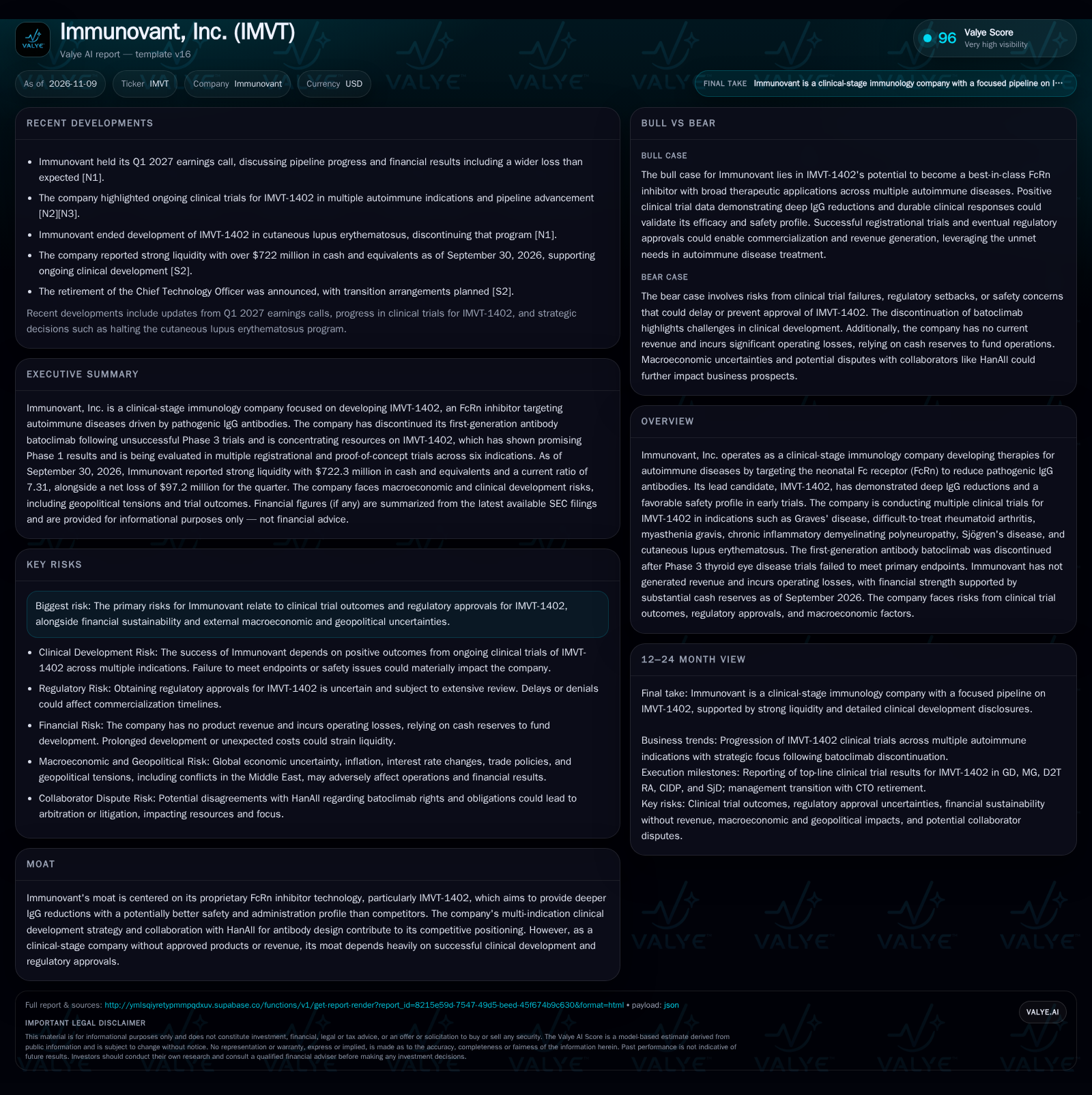
Immunovant is a clinical-stage biotech focused on IMVT-1402, a potentially best-in-class FcRn inhibitor for autoimmune diseases. The company has reported liquidity position ($722M cash) but no revenue, with ongoing registrational trials in several indications and recent discontinuation of its cutaneous lupus erythematosus program. The near-term outlook depends on clinical trial results, regulatory progress, and prudent cash management as Immunovant seeks to convert scientific promise into a viable commercial franchise. [S1] [S2] [N1]
Immunovant, Inc. is at a pivotal juncture as it channels its resources into IMVT-1402, a next-generation FcRn inhibitor targeting multiple autoimmune diseases. With deep IgG reductions and a promising safety profile in early trials, IMVT-1402 represents Immunovant’s best shot at establishing itself in a competitive, high-value therapeutic area. The company’s financial stability—anchored by $722 million in cash—buys time, but the absence of revenue and the recent discontinuation of its lupus program underscore the binary risk profile typical of clinical-stage biotechs. The next 12-24 months will reveal whether Immunovant’s scientific and financial bets can deliver durable differentiation and clear a path to commercialization. [S1] [S2] [N1]
IMVT-1402’s Clinical Progress and Portfolio Streamlining Define Immunovant’s 2026 Position
Immunovant’s strategic focus is now squarely on IMVT-1402 after discontinuing its cutaneous lupus erythematosus program. This decision narrows the pipeline but concentrates resources on other high-priority indications such as Graves’ disease (GD), myasthenia gravis (MG), difficult-to-treat rheumatoid arthritis (D2T RA), chronic inflammatory demyelinating polyneuropathy (CIDP), and Sjögren’s disease (SjD). IMVT-1402 has demonstrated dose-dependent, deep IgG reductions in Phase 1, with up to approximately 80% reduction and a safety profile that may be advantageous versus first-generation competitors. The business remains pre-commercial, reporting a $97.2 million net loss last quarter and holding $722.3 million in cash and equivalents as of September 30, 2026. The outcome of ongoing registrational trials and the durability of the company’s cash position are the most material facts shaping Immunovant’s near-term value proposition. [S1] [S2] [N1] [N2] [N3]
The Economics of FcRn Inhibition: High Upfront Investment, Long-Term Commercial Stakes
Immunovant’s business model is high-risk, high-reward: the company invests heavily in R&D to develop IMVT-1402, aiming for approval across multiple large autoimmune indications. If successful, the economics could be attractive due to the chronic nature of these diseases, the potential for premium pricing, and the ability to leverage a single biologic across several indications. However, the company currently generates no revenue and incurs significant operating losses, with quarterly net loss recently at $97.2 million. Fixed costs are dominated by clinical trial expenditures, while variable costs will only become relevant at scale if commercialization is achieved. Should IMVT-1402 secure approval, margins could be substantial, but commercialization would require substantial investment in sales infrastructure, market access, and post-marketing studies. The business is therefore highly sensitive to trial outcomes, regulatory timelines, and payer dynamics.
Competing in the FcRn Landscape: Differentiation and Barriers
The competitive environment for FcRn inhibitors is intensifying, with several companies pursuing similar strategies for IgG-mediated autoimmune diseases. Immunovant’s potential edge lies in the depth of IgG reduction and early signals of a favorable safety/tolerability profile, which could translate to best-in-class status if confirmed in larger trials. The breadth of indications in clinical development could allow for portfolio diversification and economies of scale in commercialization. However, the company faces counterforces: competitors may have head starts in certain indications, deeper commercial infrastructure, or broader portfolios. Biosimilars and non-FcRn immunomodulatory approaches may also emerge as substitutes. Switching costs for providers and patients could remain low in the absence of clear clinical superiority or payer-driven formulary preference. Immunovant’s moat is thus conditional on demonstrating both superior efficacy/safety and achieving timely regulatory milestones across multiple indications.
If IMVT-1402 Delivers Superior Efficacy and Safety, Platform Value Could Compound Rapidly
A favorable scenario would see IMVT-1402 demonstrate statistically significant and clinically meaningful efficacy with a differentiated safety profile in key registrational trials (e.g., Graves’ disease, MG, D2T RA). This could support rapid regulatory approvals and potentially enable Immunovant to pursue label expansions across additional autoimmune indications. The chronic nature and high unmet need in these diseases could allow for premium pricing and strong payer acceptance, especially if IMVT-1402 shows advantages over first-generation FcRn inhibitors or other immunosuppressive therapies. Early physician adoption, positive KOL commentary, and inclusion in treatment guidelines would reinforce commercial momentum. Evidence confirming this scenario would include positive top-line trial results, regulatory submissions/approvals, and early partnering or licensing interest. Falsification would come from underwhelming efficacy, safety signals, or delayed trial timelines.
Multiple Readouts, Mixed Outcomes: The Probable Near-Term Trajectory
The most plausible path is that Immunovant advances IMVT-1402 through its current suite of trials, with some indications yielding positive results and others producing equivocal or negative data. This would mirror the experience of many multi-indication biologics, where success is rarely uniform across all targeted diseases. Regulatory submissions could begin in select indications with the strongest data, while less promising programs are paused or discontinued. Commercialization remains several years away, and the company may seek partnerships for certain geographies or indications to defray launch costs. Confirmation of this scenario would come from staggered trial results, pipeline reprioritizations, and steady—but not explosive—cash burn. Falsification would be rapid, across-the-board clinical success or, conversely, wholesale failure in multiple programs.
Clinical Failure or Unfavorable Safety: The Fragility of a Single-Asset Strategy
Immunovant’s fortunes are tightly linked to IMVT-1402. Should critical registrational trials fail to meet primary endpoints, or if unexpected safety issues emerge, the company’s value would be severely impaired. The cutaneous lupus program discontinuation highlights the real possibility of attrition. In this scenario, the company’s substantial cash reserves would be consumed by wind-down costs, strategic reviews, or pivot attempts (e.g., seeking new in-licensing or M&A). Regulatory delays, negative trial headlines, or the emergence of more effective competitors could accelerate value erosion. Confirmation would include negative or inconclusive pivotal trial results, safety-related clinical holds, and sharp pipeline narrowing. Falsification would require steady clinical progress without major setbacks.
Milestones That Could Validate—or Undermine—Immunovant’s Multi-Indication FcRn Thesis
Top-line clinical trial results for IMVT-1402 in Graves’ disease, MG, D2T RA, CIDP, and Sjögren’s—especially the magnitude and durability of IgG reduction and clinical response. [S1]
Disclosure of safety/tolerability data in mid- and late-stage trials, including rates of infection and immunological adverse events, compared to first-generation FcRn inhibitors and standard of care. [S1]
Cash burn trajectory versus expectations—whether quarterly R&D and SG&A spending aligns with planned runway, and any signals of accelerated depletion. [S2]
Any announced partnerships, licensing deals, or co-development agreements, which could validate external confidence in IMVT-1402 and share commercialization risk.
Regulatory feedback, such as acceptance of submissions, fast-track or breakthrough designations, and the clarity of regulatory pathways in major markets.
Pipeline updates: decisions to advance, pause, or discontinue additional indications based on interim data or strategic reviews. [N1]
Management stability and execution, including the impact of the Chief Technology Officer’s retirement and succession planning. [S2]
If disclosed, early signals of payer or physician willingness to adopt FcRn inhibitors in targeted indications, or shifts in competitive landscape due to rival product launches.
Disclaimer: This is research-only, informational analysis and not investment advice. It may include AI-generated interpretation and general industry context. Always verify important details using primary sources.

Comments