
Orthofix Medical 2026: Reimbursement Recovery, Spine Segment Headwinds, and the Economics of Musculoskeletal Devices
Orthofix Medical’s 2026 performance reflects a complex interplay between improving reimbursement trends and persistent challenges in its spine product segment.
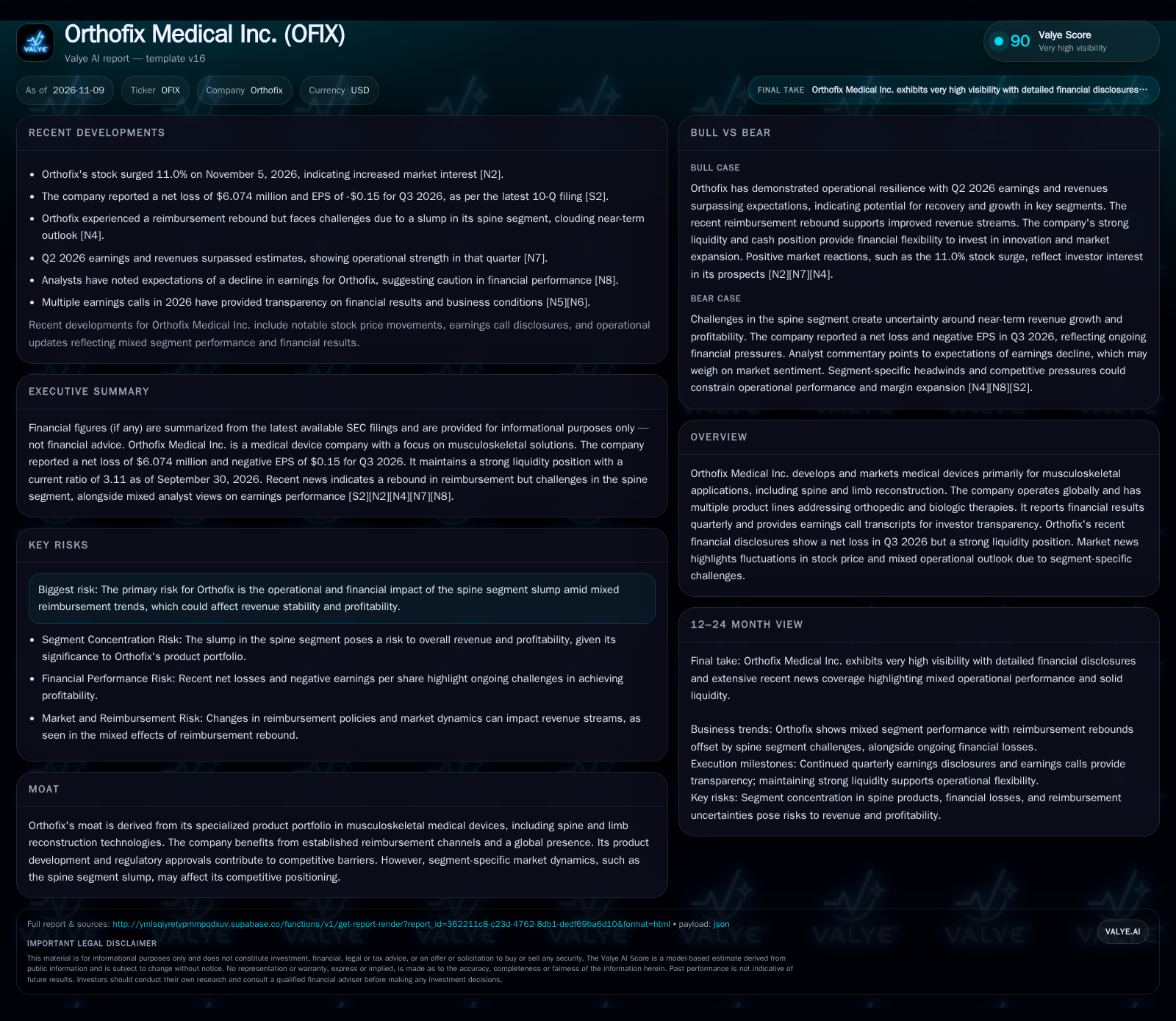
Orthofix reported a Q3 net loss and negative EPS despite operational strength earlier in 2026 and a recent stock surge. The company’s reported current ratio underscores short-term financial health, but headwinds in the spine segment and analyst expectations of earnings decline temper optimism. The outlook now depends on Orthofix’s ability to leverage reimbursement gains, manage product mix, and respond to competitive and market pressures in musculoskeletal devices. [S2] [N2] [N4] [N7] [N8]
A rebound in reimbursement channels and a notable Q2 outperformance offer reasons for optimism, but a slump in the critical spine segment and mixed analyst outlooks highlight the risks of product concentration and execution missteps. The next phase will test whether Orthofix can translate operational strengths and potential financial flexibility into sustained recovery—or whether competitive and segment-specific headwinds will dominate.
Recent Financials Signal Mixed Momentum Amid Segment-Specific Risks
Orthofix reported a net loss of $6.074 million and negative EPS of $0.15 for Q3 2026, highlighting ongoing challenges in reaching profitability [S2]. Despite these losses, the company maintains a reported liquidity position, with $86.3 million in cash and a current ratio of 3.11 as of September 30, 2026 [S2]. Notably, Orthofix’s stock surged 11.0% on November 5, 2026, reflecting episodic investor optimism [N2]. However, the company’s outlook is clouded by a slump in its spine segment, even as it benefits from a rebound in reimbursement channels [N4]. These dynamics illustrate a business at a crossroads—where operational wins and market sentiment are weighed against structural challenges in key product lines.
The interplay between liquidity strength and segment-specific challenges underscores the importance of capital allocation decisions moving forward. The company reported cash and liquidity metrics for the period; these figures do not by themselves establish operating runway, investment capacity, financial flexibility, or financing capacity. Hence, the company’s near-term financial health must be evaluated in conjunction with its strategic responses to evolving market dynamics and reimbursement environments.
How Orthofix’s Product Mix and Cost Structure Shape Its Financial Outcomes
Orthofix’s core business generates revenue through the sale of medical devices focused on musculoskeletal conditions, particularly spine and limb reconstruction. Revenue is driven by procedure volumes, product adoption among surgeons, and reimbursement rates from payors. The company’s economics are influenced by a mix of high-margin proprietary implants and biologics, and lower-margin commoditized hardware. Fixed costs—such as R&D, regulatory compliance, and a global salesforce—create operating leverage, but also magnify the impact of volume swings in major segments.
The rebound in reimbursement could improve realized prices and margins, but the spine segment’s underperformance may dilute overall profitability if it represents a substantial share of sales. High fixed costs mean that volume recovery in spine or acceleration in higher-margin products could rapidly improve operating leverage. Conversely, persistent segment weakness or adverse reimbursement changes could keep margins compressed.
The fixed cost structure inherent in Orthofix’s business model implies that operational gearing can work both ways: volume growth in higher-margin products can disproportionately enhance profitability, but volume declines in core segments like spine can exacerbate losses. This sensitivity to volume fluctuations necessitates a balanced product portfolio and nimble cost management. Additionally, the reimbursement environment's impact is not uniform across product lines; certain devices may benefit more from favorable payor policies, while others remain vulnerable to pricing pressures. Understanding the elasticity of demand relative to reimbursement changes and competitive pricing will help clarify how revenue gains translate into margin expansion or contraction.
Competitive Pressures and Market Dynamics in Musculoskeletal Devices
Orthofix operates in a highly competitive landscape, facing global device manufacturers and specialized orthopedic firms. Its moat derives from a specialized portfolio, established reimbursement channels, and regulatory approvals. However, the company’s exposure to the spine segment, where innovation cycles are rapid and larger players often hold scale advantages, increases vulnerability to both pricing pressure and share loss. Substitutes—from minimally invasive techniques to biologics and digital health interventions—add further pressure.
Switching frictions in orthopedic implants can be high due to surgeon preferences, hospital procurement cycles, and regulatory hurdles, but price-sensitive buyers and payor-driven standardization can erode these advantages. Orthofix’s ability to differentiate on clinical outcomes, procedural efficiency, or bundled service offerings could help defend share, but continued weakness in a major segment risks ceding ground to better-capitalized or more diversified competitors.
In addition to direct competition, Orthofix faces indirect threats from evolving clinical practices and emerging technologies that may alter the musculoskeletal treatment paradigm. For instance, shifts toward outpatient procedures or enhanced recovery protocols could reduce procedure volumes or change product utilization patterns. Furthermore, consolidation among hospital systems and payors can increase bargaining power, leading to more aggressive price negotiations and formulary restrictions. Orthofix’s strategic emphasis on clinical evidence generation, surgeon training, and integrated care solutions may help mitigate these pressures, but success depends on the company’s agility and investment in differentiating capabilities relative to larger, more diversified competitors.
If Reimbursement Gains and Product Innovation Drive a Turnaround
A favorable outcome would see Orthofix capitalizing on the recent reimbursement rebound, leading to improved realized prices and higher procedure volumes across its portfolio. If the company launches new or upgraded products in spine and limb reconstruction that gain rapid adoption among surgeons, this could accelerate revenue growth and shift the mix toward higher-margin offerings.
Operational leverage would amplify the impact of any volume recovery, quickly narrowing losses or restoring profitability. Confirmation of this scenario would come from sustained revenue growth in core segments, improved gross margins, and a return to positive EPS in upcoming quarters. Additional evidence would include new product launches, expansion of reimbursement approvals, and commentary from earnings calls indicating surgeon uptake and order book strength.
Realistic Trajectory: Reimbursement Helps, But Spine Challenges Persist
The most plausible path is one in which Orthofix benefits from improved reimbursement, stabilizing its limb reconstruction and biologics segments, while the spine segment remains a drag on overall performance. Revenue and margin trends may show modest improvement, but persistent competitive and innovation pressures in spine limit the pace of recovery.
Quarterly results would show incremental progress—narrowing losses or stabilizing EPS—but not a full turnaround. Confirmation would come from sequential improvements in operating metrics, flat-to-slightly growing revenues, and management commentary focused on portfolio optimization and targeted investments.
Prolonged Spine Segment Weakness and Margin Compression
A more adverse scenario would see spine segment weakness deepening, with volumes and pricing both deteriorating. If reimbursement tailwinds prove temporary or are offset by further payor cuts, Orthofix could face sustained revenue declines and margin compression across its portfolio.
Fixed cost leverage would work against the company, leading to widening losses, potential cash burn, and pressure on liquidity. Evidence of this scenario would include revenue contraction in spine and non-spine categories, declining gross margins, negative operating cash flow, and management signaling restructuring or cost-cutting measures. Analyst downgrades and share price volatility could further erode stakeholder confidence.
What Will Determine Orthofix’s Next Phase: Metrics and Milestones to Track
Quarterly spine segment revenue growth or decline—if disclosed—will clarify whether the segment’s slump is stabilizing or worsening.
Gross margin trends across the portfolio, especially in light of reimbursement changes, would help test the sustainability of recent operational gains.
New product launches or regulatory approvals in spine and limb reconstruction would indicate Orthofix’s progress on innovation and portfolio renewal.
Operating cash flow direction (positive or negative) will serve as a real-world check on the company’s ability to convert sales into liquidity.
Sequential EPS improvement or further deterioration will signal the trajectory of profitability and operational leverage.
Updates on reimbursement policy changes or payor mix shifts, as disclosed in earnings calls, would illuminate external revenue drivers.
Management commentary on competitive dynamics, portfolio strategy, or restructuring initiatives would provide context for near-term execution risks.
Market share trends in key geographies or product categories—if disclosed—would validate the effectiveness of commercial efforts and product positioning.
Disclaimer: This is research-only, informational analysis and not investment advice. It may include AI-generated interpretation and general industry context. Always verify important details using primary sources.

Comments