
Popular, Inc.: Puerto Rico’s Banking Leader Confronts Concentration Risk and Real Estate Exposure
As the largest financial institution in Puerto Rico, Popular, Inc. blends competitive position with vulnerability to regional and real estate cycles. Recent earnings outperformance and a stable dividend reflect resilience, but the company’s long-term trajectory will hinge on asset quality, regulatory shifts, and the evolution of competition in both Puerto Rico and selective U.S. markets.
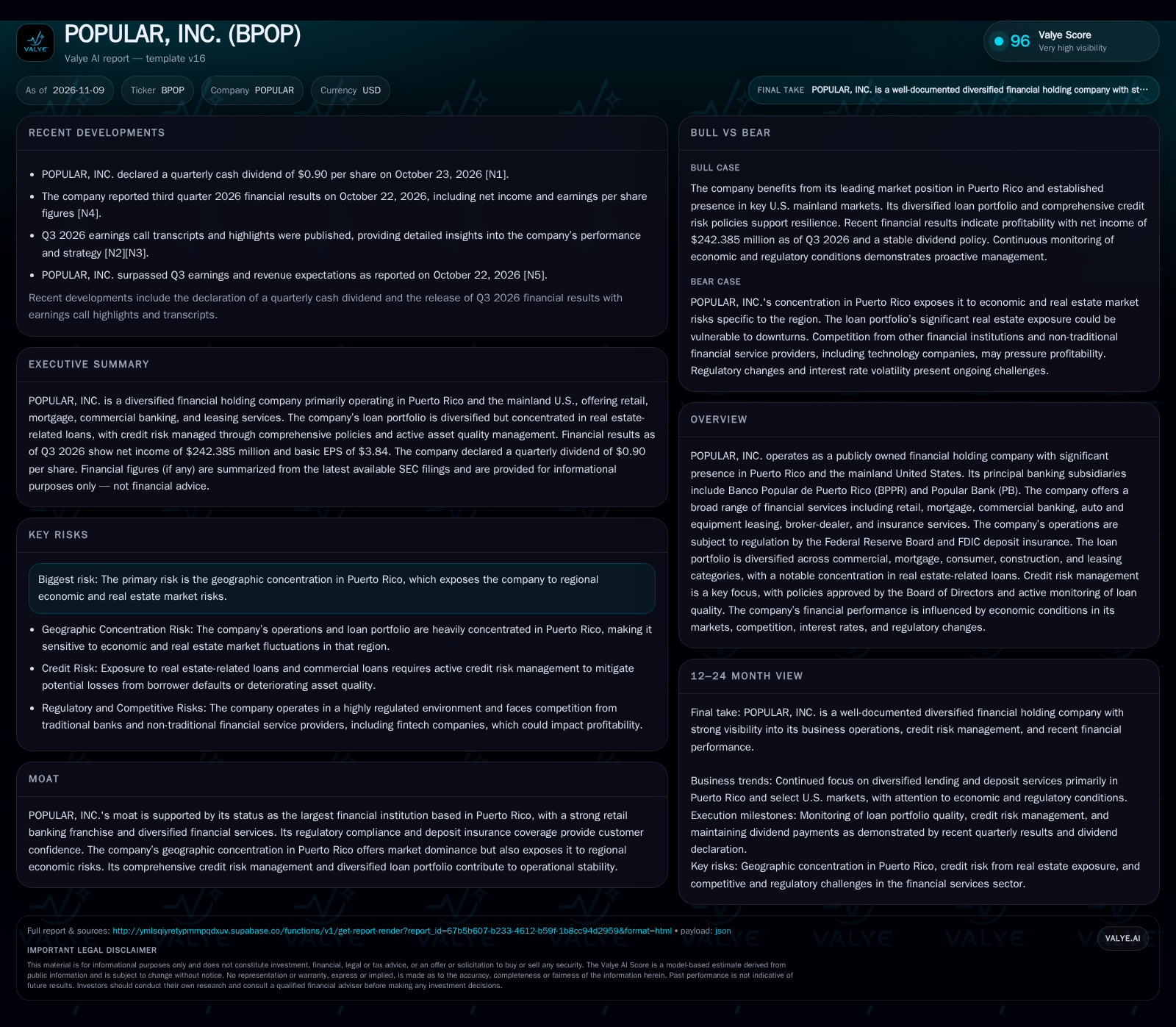
Popular, Inc. (BPOP) remains Puerto Rico’s dominant bank, reporting Q3 2026 net income of $242.4 million and maintaining a $0.90/share dividend. While its broad financial services and diversified loan book provide stability, over half of its loans are real estate-related and geographically concentrated in Puerto Rico, exposing it to local economic and housing cycles. The company’s performance will depend on credit quality management, competitive dynamics, and its ability to adapt to regulatory and market changes. [S1] [S2] [N1] [N4] [N5]
Popular, Inc. (BPOP) stands as the financial backbone of Puerto Rico, wielding differentiated scale and an extensive service portfolio across retail, commercial, and mortgage banking. Recent financial results highlight both profitability and operational discipline, but the company’s future is tightly bound to the fortunes of the Puerto Rican economy and real estate markets. Despite its diversified offerings and prudent credit management, Popular’s concentration in real estate lending and its home market raises questions about resilience in the face of potential regional downturns or competitive disruption. The next chapters for BPOP will be written not just by its financial outperformance, but by its ability to navigate structural risks and evolving industry dynamics.
Recent Outperformance Amid Structural Concentration
Popular, Inc. reported net income of $242.385 million for the third quarter of 2026, equivalent to basic earnings per share of $3.84, and declared a quarterly cash dividend of $0.90 per share in October 2026. These results not only surpassed market expectations but underscore the company’s ongoing profitability and shareholder return orientation. As of December 31, 2025, Popular managed $75.3 billion in consolidated assets and $66.2 billion in total deposits, reaffirming its status as Puerto Rico’s largest financial institution. However, 52% of its loan portfolio remains anchored in real estate-related lending, tying asset quality and future earnings tightly to regional economic and property market cycles. [S1] [S2] [N1] [N4] [N5]
How Popular Makes Money: Lending, Spreads, and Diversification Limits
Popular, Inc. generates the bulk of its revenue through net interest income—primarily the difference between yields on its diverse loan portfolio and interest paid on deposits. With a lending mix that includes commercial, residential mortgage, construction, leasing, and consumer loans, the company can modulate risk and pricing across cycles. However, more than half of the loan book is real estate-related, amplifying exposure to property values and local economic health. Fee-based income from broker-dealer, insurance, and leasing subsidiaries provides some diversification but remains secondary to core banking operations.
The company’s scale in Puerto Rico may afford some cost efficiencies and pricing power within its home market, particularly in deposit gathering and consumer lending. Yet, the capital intensity of banking—requiring robust equity buffers and regulatory compliance—limits excess returns, especially when regional concentration restricts true geographic diversification. Operating leverage is achievable if loan growth outpaces expense inflation, but credit costs can quickly erode margins in downturns, especially given the real estate tilt.
Dividend payments, such as the recent $0.90/share quarterly distribution, reflect a commitment to returning capital, but also constrain retained earnings available for expansion or risk absorption. The long-term economics hinge on asset quality trends, interest rate margins, and the ability to grow non-interest revenue in the face of shifting customer needs and digital disruption.
competitive position in Puerto Rico Meets U.S. Expansion and Digital Threats
Popular’s competitive strength stems from its entrenched market share in Puerto Rico, comprehensive retail and commercial offerings, and strong local brand recognition. In its core geography, it benefits from network density, deposit-gathering capacity, and regulatory familiarity, which collectively create switching frictions for customers and deter new entrants. Its U.S. mainland operations—via Popular Bank branches in New York, New Jersey, and Florida—provide some diversification, but are relatively small compared to its Puerto Rican footprint.
However, the very dominance that underpins Popular’s moat also exposes it to concentration risk: adverse shocks to Puerto Rico’s economy, migration trends, or real estate markets could disproportionately impact the company. Competition is intensifying not only from traditional banks but also from fintechs and non-bank lenders, which may target niches like consumer lending, payments, or small business credit—areas where digital convenience and lower overhead can erode legacy banks’ share.
Popular’s regulatory compliance, FDIC deposit insurance, and comprehensive credit risk framework are advantages, but they do not insulate the company from the fundamental need to innovate in product delivery, customer experience, and cost structure. The question is whether Popular can leverage its scale and relationships to maintain pricing power and defend profitability as technological and demographic changes reshape banking.
Resilient Asset Quality and Sustainable Lending Drive Long-Term Value
In a favorable scenario, Puerto Rico’s economy stabilizes or grows, supporting robust credit performance, low non-performing asset ratios, and healthy loan demand. Popular’s rigorous credit standards and active portfolio monitoring could limit losses even if isolated stresses emerge. If the company leverages its prominent position to expand fee-based services, deepen customer relationships, and selectively grow U.S. operations, it could achieve modest geographic diversification and incremental earnings growth.
Margin expansion may occur if interest rates remain favorable for banks, allowing Popular to widen the spread between loan yields and funding costs. Key confirming evidence would include improved or stable asset quality metrics, rising non-interest income, and market share gains in selected U.S. niches. If Popular can demonstrate digital leadership—by launching new platforms or partnerships that enhance customer retention and lower costs—its competitive position could be further strengthened.
Performance Anchored to Regional Trends and Prudent Credit Management
The most plausible path forward is steady, if unspectacular, performance, with Popular’s earnings and dividends largely tracking the health of Puerto Rico’s economy and real estate sector. Asset quality remains broadly under control thanks to comprehensive credit policies and active oversight, but periodic upticks in delinquencies or charge-offs are likely as the loan book ages and macro conditions fluctuate.
Interest margins may compress modestly if competition intensifies or if funding costs rise, but Popular’s scale advantage in Puerto Rico supports a stable deposit base and some pricing power. U.S. operations continue as a source of incremental growth and risk diversification, but remain proportionally small. Regulatory requirements and capital needs are met without major issues, and the dividend is maintained at current levels. Confirmation would come from stable non-performing asset ratios, consistent loan growth, and maintenance of the current dividend. Falsifying signals would include a sharp deterioration in local economic indicators or evidence of market share loss to digital competitors.
Local Economic Stress and Real Estate Weakness Threaten Capital and Earnings
In an adverse scenario, Puerto Rico experiences a significant economic downturn—driven by recession, government fiscal stress, population outflows, or a sharp correction in real estate values. Popular’s high exposure to local property-related loans could result in elevated delinquencies, higher provisions for credit losses, and downward pressure on earnings. If asset quality erodes rapidly, regulatory capital ratios could come under scrutiny, potentially forcing dividend cuts or capital raises.
Competitive threats could compound the challenge, as fintechs or aggressive mainland banks target profitable segments, eroding fee income and compressing lending margins. Regulatory changes, such as more stringent capital requirements or consumer protection rules, could further constrain profitability. Confirming evidence would include rising non-performing loans, declining loan origination, dividend reductions, or explicit regulatory concerns.
Benchmarks for Testing Popular’s Resilience and Growth Thesis
Net charge-off and non-performing asset ratios: Deterioration here would signal emerging credit stress, especially in the real estate loan book. If disclosed, quarterly trends in these ratios would help test asset quality.
Loan growth by geography and segment: A shift in loan origination mix—either toward more U.S. exposure or away from real estate—would indicate strategic risk management or pursuit of diversification.
Deposit market share in Puerto Rico: Retaining or expanding share would confirm continued franchise strength, while slippage could signal competitive or reputational challenges.
Net interest margin (NIM): Compression or expansion in this metric would provide an early read on profitability dynamics amid changing rate and competitive environments.
Non-interest income growth: Evidence of progress in wealth management, insurance, or digital services would support the case for business model evolution beyond traditional lending.
Customer retention and digital engagement: If disclosed, metrics on digital adoption, account openings, or churn rates would illuminate how well Popular is adapting to shifting customer preferences.
Disclaimer: This is research-only, informational analysis and not investment advice. It may include AI-generated interpretation and general industry context. Always verify important details using primary sources.

Comments