
Compass Therapeutics: Clinical Milestones, Bispecific Platform, and the Long Game in Oncology Innovation
Compass Therapeutics’ pipeline momentum is anchored by tovecimig’s statistically significant efficacy in biliary tract cancer and a portfolio of next-generation bispecific antibodies. As the company advances through pivotal trials and regulatory engagement, questions remain about commercial viability, competitive pressure, and the financial runway required to bridge from clinical proof to sustainable revenue.
Compass Therapeutics has achieved a major clinical milestone with tovecimig’s Phase 2/3 success in biliary tract cancer, supporting its bispecific antibody platform strategy. With multiple candidates in the clinic and reported balance sheet position liquidity, the company is positioned for further data readouts and regulatory steps. However, the transition from clinical-stage to commercial success in oncology is fraught with execution risk, capital needs, and intense competition.
Compass Therapeutics stands at a pivotal juncture, having delivered statistically significant efficacy for tovecimig in biliary tract cancer—a notoriously challenging indication with limited options. The company’s focus on bispecific antibodies and immune modulation positions it within one of oncology’s most competitive and innovation-driven segments. With a reported cash position, multiple candidates in clinical development, and active regulatory engagement, Compass must now convert clinical promise into a sustainable business model. The next 12–24 months will test the scalability of its platform, the durability of its clinical results, and its ability to carve out a differentiated position against entrenched and emerging rivals.
Tovecimig’s Phase 2/3 Success and Pipeline Progress Shape the Near-Term Landscape
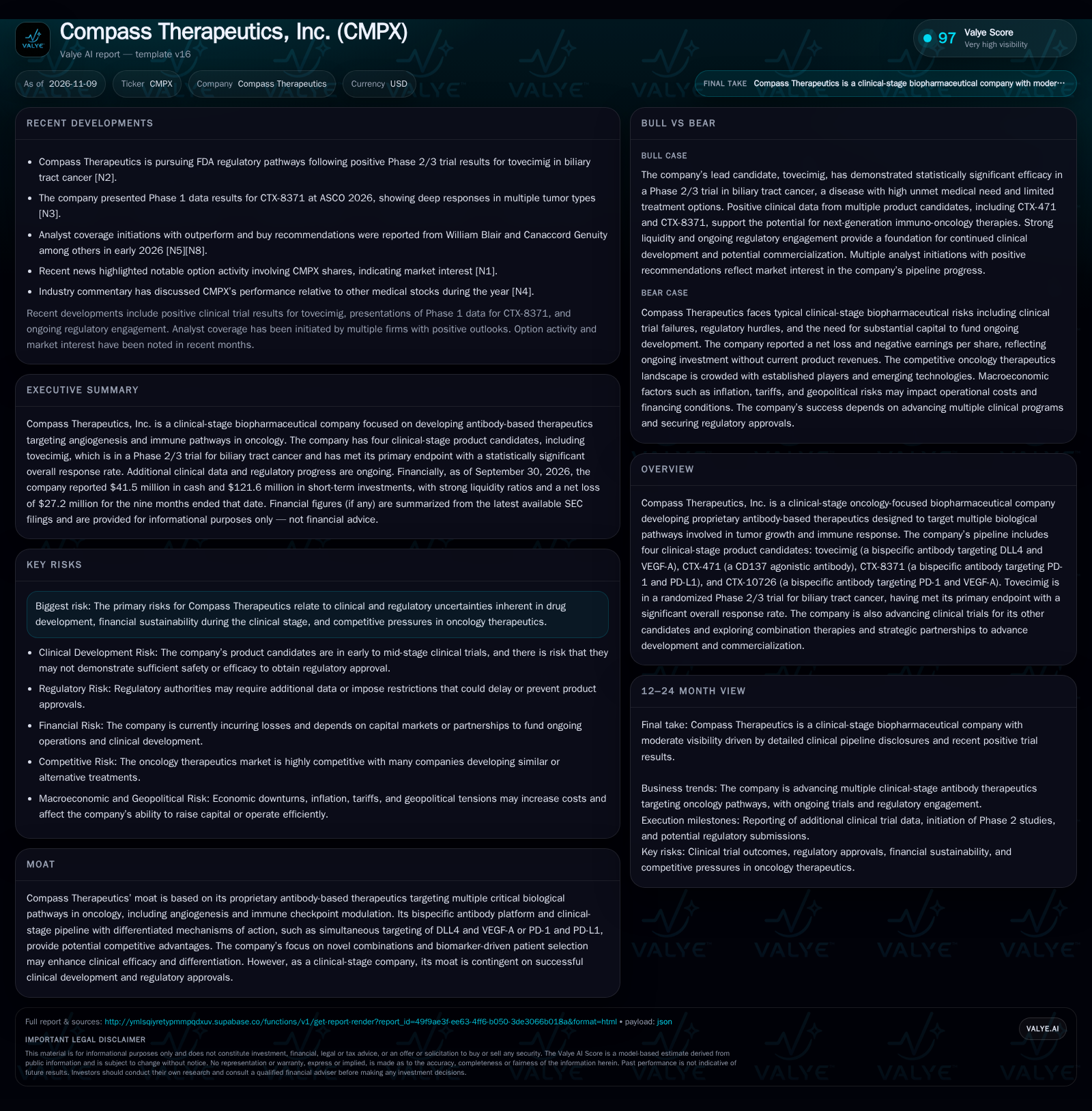
The most material recent development for Compass Therapeutics is the statistically significant result for tovecimig (CTX-009) in a randomized Phase 2/3 trial in biliary tract cancer (BTC): the combination therapy arm achieved an overall response rate (ORR) of 17.1% versus 5.3% for paclitaxel alone, with a p-value of 0.031 [S1]. This is a meaningful advance in a high-mortality cancer with limited innovation, providing clinical validation for Compass’s bispecific antibody approach.
The company has three additional clinical-stage candidates: CTX-471 (a CD137 agonist), CTX-8371 (a bispecific targeting PD-1 and PD-L1), and CTX-10726 (PD-1/VEGF-A). Notably, CTX-8371 demonstrated deep responses in early-phase trials across several tumor types without dose-limiting toxicities, and CTX-10726 entered Phase 1 following FDA clearance [S1]. These developments underscore both the breadth and early momentum of the platform.
As of September 30, 2026, Compass reported $41.5 million in cash and $121.6 million in short-term investments, with a current ratio of 6.79 and a net loss of $27.2 million for the prior nine months [S2]. The company reported cash and liquidity metrics for the period; these figures do not by themselves establish operating runway, investment capacity, financial flexibility, or financing capacity.
From Clinical Proof to Commercial Reality: Economic Stakes for a Bispecific Antibody Platform
Compass Therapeutics’ current economics are defined by R&D investment and a lack of product revenue, a standard profile for clinical-stage biopharma. The company’s ability to generate future value depends on transitioning successful clinical assets to regulatory approval and commercialization—either independently or via partnerships.
The economics of bispecific antibodies in oncology are characterized by high development costs, but the potential for premium pricing if clinical differentiation is demonstrated. Tovecimig’s statistically significant Phase 2/3 result in BTC could support an orphan or accelerated regulatory pathway, which may enable higher pricing and more rapid market entry if subsequent PFS/OS data are compelling. However, the ultimate addressable market size for BTC is modest compared to major solid tumors, so commercial success would likely require expansion into additional indications or combination regimens.
Fixed costs are dominated by R&D and clinical operations, but manufacturing complexity for bispecifics can also drive up variable costs, particularly pre-commercial scale. If Compass pursues a commercialization partnership, upfront and milestone payments could offset some late-stage development expenses, but would also dilute eventual revenue capture. Capital needs will remain significant until at least one candidate secures approval and launches, and further equity or partnership funding is likely if the company aims to commercialize without a major partner.
Competing in Oncology’s Front Line: Platform Differentiation and Market Headwinds
Compass operates in one of the most crowded and rapidly evolving segments of biopharma: oncology immunotherapy. Its core proposition is the use of proprietary bispecific antibodies to simultaneously target tumor angiogenesis and immune escape mechanisms. This platform approach may allow Compass to address resistance seen with single-pathway inhibitors and to pursue combination regimens.
The most direct competitors are established large-cap biopharma companies and well-funded biotechs with approved or late-stage immuno-oncology agents targeting VEGF, DLL4, PD-1, PD-L1, and costimulatory receptors. The competitive threat is twofold: established players have greater commercial reach, and a wave of next-generation modalities—such as cell therapies and antibody-drug conjugates—could reshape treatment paradigms. For Compass, differentiation will hinge on demonstrating superior efficacy, safety, or convenience in defined patient populations.
Switching costs in oncology are typically driven by clinical outcomes and guideline inclusion, not platform lock-in. If Compass’s candidates deliver superior or unique outcomes in indications with high unmet need, physician adoption can be rapid—but failure to show clear benefit will limit uptake regardless of mechanistic novelty. Biomarker-driven patient selection and successful combination strategies could support a niche or first-in-class positioning, but the moat is not yet established.
How Clinical Momentum Could Translate into a Commercial Inflection
The favorable scenario for Compass hinges on the continued success of tovecimig in pivotal BTC trials, followed by rapid regulatory approval and commercial launch. If the upcoming progression-free survival (PFS) and overall survival (OS) data confirm a compelling clinical benefit—especially in a population with few alternatives—Compass could secure expedited FDA review. This would open the door to orphan pricing and first-mover advantage in BTC.
The next lever is the successful advancement of the broader pipeline. If CTX-471 and CTX-8371 show durable responses in their respective Phase 2 programs, Compass could position itself as a platform innovator, attracting strategic partnerships or acquisition interest. Positive analyst sentiment and active option market activity suggest that investors are attuned to potential inflection points [N1] [N5] [N8].
Confirmation of this scenario would require: (a) robust PFS/OS data for tovecimig; (b) FDA acceptance of a streamlined approval pathway; (c) clear evidence of efficacy and tolerability for the next wave of candidates; and (d) the ability to secure non-dilutive funding or partnership economics to extend the financial runway.
Most Likely Course: Incremental Progress and Episodic Volatility
The most plausible outcome is that Compass continues to generate mixed but generally positive clinical data, advances additional candidates into mid-stage trials, and maintains regulatory engagement for its lead asset. While tovecimig’s Phase 2/3 ORR result is significant, subsequent survival data may be less dramatic, supporting a regulatory filing but not guaranteeing rapid uptake or breakout commercial success.
In this scenario, Compass would likely pursue a partnership for commercialization, especially outside the U.S., balancing dilution against the need for late-stage development capital and commercial infrastructure. The company would remain pre-revenue for several years, with periodic capital raises and milestone-driven volatility.
Evidence that would confirm this trajectory includes steady but not breakout clinical readouts, continued analyst coverage with cautious optimism, and a shift in focus to combination trials or additional indications to expand the addressable market.
If Clinical Setbacks or Funding Gaps Derail the Pipeline
The principal risk is that subsequent data for tovecimig or other candidates fail to show clinically meaningful improvement in survival or safety, undermining the value of the platform. Regulatory authorities could require larger or longer trials, delaying any potential approval and increasing burn.
Financial risk is acute: with no product revenue and a finite cash runway, Compass could face the need for dilutive financings under unfavorable terms if milestones are missed or delayed. In the worst case, a clinical hold or failed pivotal trial could force a strategic pivot or asset sale.
Milestones and Metrics That Will Shape Compass Therapeutics’ Trajectory
Top-line PFS and OS results from the pivotal tovecimig BTC trial, expected following the April 2026 data release, will be critical for regulatory and commercial prospects.
FDA regulatory feedback on tovecimig’s submission pathway—especially the potential for accelerated approval or additional trial requirements—will determine the timeline to market.
Clinical progress and safety/efficacy data from ongoing and planned Phase 2/3 trials for CTX-471, CTX-8371, and CTX-10726, especially in combination regimens.
Updates on strategic partnerships, co-development, or licensing agreements, which could provide non-dilutive funding or validate the platform’s commercial appeal.
Cash burn rate and projected runway, including any announced financing transactions or major capital raises.
Expansion into new indications for lead or pipeline assets, as this will impact long-term addressable market and commercial upside.
If disclosed, biomarker-driven patient selection or companion diagnostics adoption rates, as these could enhance efficacy signals and market positioning.
Analyst coverage changes or shifts in investor sentiment following major data releases or regulatory events.
Disclaimer: This is research-only, informational analysis and not investment advice. It may include AI-generated interpretation and general industry context. Always verify important details using primary sources.

Comments