
Heron Therapeutics’ Asset Sale Marks a Strategic Turning Point and Future Uncertainties
With a pending asset sale to CorMedix set to close in early 2027, Heron Therapeutics is poised to exit its core biotechnology operations. The company’s portfolio of FDA-approved acute care and oncology products—once underpinned by proprietary drug-delivery technology and reimbursement advantages—now faces a pivotal transition. The real test will be whether Heron’s post-sale strategy can convert asset-sale proceeds, royalty streams, and its public listing into sustainable new value creation.
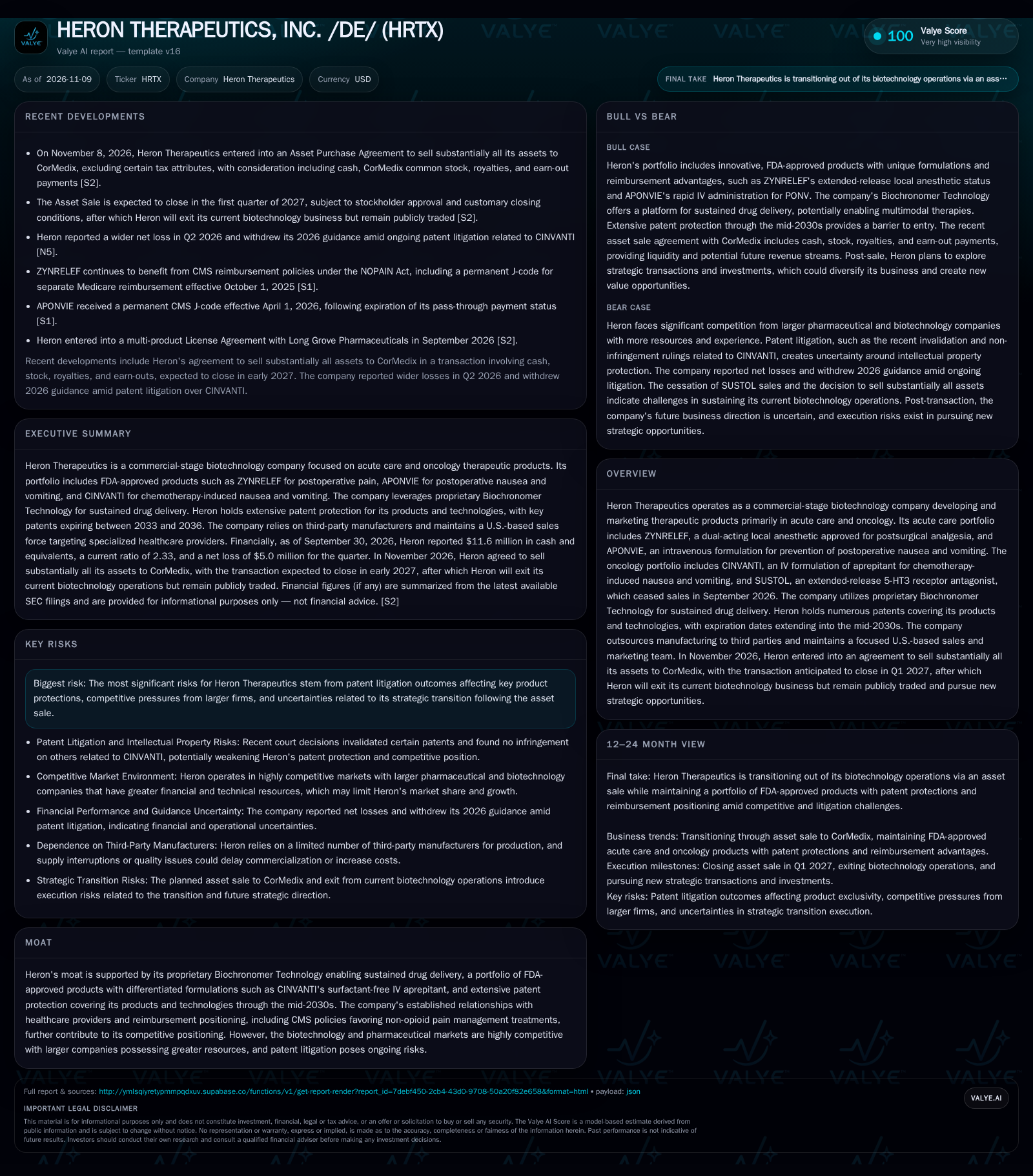
Heron Therapeutics has agreed to sell nearly all its assets to CorMedix, effectively ending its current biotech business. This transition follows years of commercialization efforts with products like ZYNRELEF and CINVANTI, both benefitting from differentiated technology and reimbursement positioning. Patent litigation and financial losses contributed to this strategic pivot. After the deal, Heron will remain publicly traded and seek new business directions, but its future value depends on its ability to redeploy capital and execute on a yet-to-be-defined strategy. [S2]
Heron Therapeutics stands at a strategic crossroads. Once a focused biotech with differentiated acute care and oncology products, the company has agreed to sell nearly all its operating assets to CorMedix, effectively ending its presence as a commercial-stage drug developer. While Heron’s innovations around sustained-release drug delivery and favorable reimbursement policies once offered competitive edges, mounting losses and patent litigation have forced a dramatic pivot. The company will soon be a cash-rich public shell, searching for its next act. The question now is whether Heron can translate this asset sale into a successful reinvention—or whether it faces the common fate of post-sale, non-operating biotechs.
Heron’s Near-Term Outlook Transformed by Asset Sale and Strategic Shift
The most consequential current fact is Heron's November 2026 agreement to sell substantially all of its assets—including its core acute care and oncology product lines—to CorMedix, with the deal expected to close in Q1 2027. The consideration includes cash, CorMedix stock, royalties, and earn-out payments, but excludes certain tax assets and other non-core holdings [S2]. This transaction marks a full exit from Heron’s legacy biotechnology operations, fundamentally altering its business model and value proposition.
Heron's lead products—ZYNRELEF (postsurgical analgesia), APONVIE (prevention of postoperative nausea and vomiting), and CINVANTI (chemotherapy-induced nausea and vomiting)—are all FDA-approved and have benefited from permanent CMS J-codes, supporting favorable reimbursement. However, competitive pressures and adverse outcomes in patent litigation, particularly around CINVANTI, have eroded the sustainability of the business [S1] [N5].
Financially, as of September 30, 2026, Heron reported only $11.6 million in cash and equivalents, with a quarterly net loss of $5.0 million. These figures reinforce the urgency of the asset sale and the company’s need to pivot away from a business model that was no longer generating self-sustaining cash flows [S2].
Value Creation from Heron’s Product Portfolio and Challenges to Its Business Model
Heron’s historical revenue streams were built on commercializing specialty pharmaceuticals for acute care and oncology settings, targeting hospital and ambulatory surgical centers with products offering clinical differentiation and reimbursement advantages. ZYNRELEF, for example, leveraged sustained-release technology to offer extended postsurgical pain relief, and its permanent J-code allowed for separate Medicare reimbursement—potentially driving hospital adoption by offsetting budgetary concerns. APONVIE and CINVANTI similarly benefited from differentiated formulations and reimbursement positioning.
The company’s economics were shaped by a mix of fixed costs—such as R&D, clinical trial investments, and a dedicated U.S. sales force—and variable costs tied to outsourced manufacturing and distribution. While Heron did not own manufacturing facilities, long-term supply agreements provided some cost predictability [S1].
Despite these advantages, Heron struggled to achieve the sales volumes and pricing power necessary for operating leverage. Competitive pressure from generics and larger pharmaceutical firms, combined with patent litigation setbacks, undermined both revenue growth and margin sustainability. As a result, Heron reported persistent net losses and ultimately withdrew its financial guidance in 2026 [N5]. The impending asset sale is thus a forced response to the company’s inability to generate durable positive cash flow from its existing portfolio.
Limits of Patent Protection and Reimbursement in Sustaining Heron’s Market Position
Heron’s competitive position was defined by its proprietary Biochronomer Technology, which enabled sustained drug delivery, and by its ability to secure favorable reimbursement status for its products. ZYNRELEF’s permanent J-code and support from the NOPAIN Act, for example, provided a reimbursement tailwind that could have driven market share gains in postsurgical pain management [S1]. CINVANTI’s surfactant-free formulation differentiated it from legacy competitors.
However, these advantages faced significant counterforces. Major pharmaceutical and biotech players, with far larger sales forces and deeper payer relationships, compete aggressively in both the acute care and oncology supportive care markets. The rise of generics, especially in the CINV segment, put further pressure on Heron’s pricing and volume. Most critically, adverse patent litigation outcomes weakened barriers to entry and undermined the exclusivity that is typically essential for specialty pharma economics [N5].
While Heron’s patent portfolio extends into the mid-2030s, the invalidation or non-infringement findings on key CINVANTI patents demonstrated the fragility of IP-based moats in highly contested therapeutic categories. The result: Heron’s differentiation was eroded faster than the company could scale or diversify its revenue base.
Leveraging Asset Sale Proceeds and Royalties to Build a New Strategic Platform
The most favorable scenario post-asset sale is that Heron successfully redeploys the cash, CorMedix stock, and future royalty/earn-out streams into a new business line or strategic acquisition that delivers long-term value to shareholders. The company's continued public listing provides a capital markets platform and the ability to move quickly on opportunities that may be out of reach for private buyers.
A successful outcome would likely depend on management’s ability to identify and execute on a compelling transaction—whether in healthcare, technology, or another sector—leveraging both the financial resources from the asset sale and any remaining tax attributes. Early evidence of a credible acquisition target, a well-defined investment thesis, or a partnership with an established operator would help confirm this scenario. If Heron can demonstrate disciplined capital allocation and attract top-tier deal partners or management talent, the post-sale entity could become a value-creation vehicle rather than a mere shell.
Conversely, the absence of a clear strategic direction or failure to close value-accretive deals would quickly falsify the upside case.
Heron’s Transition to a Public Shell Confronts Execution and Identity Challenges
The most plausible near-term scenario is that Heron completes the asset sale, returns as a public shell with a reported cash balance, and spends several quarters evaluating strategic options. This period is likely to be characterized by both opportunity and uncertainty: management will need to balance the pressure to deploy capital with the risk of overpaying or misallocating resources in unfamiliar sectors.
Typical outcomes for post-sale biotech shells range from reverse mergers with private companies seeking a public listing, to opportunistic acquisitions in adjacent or unrelated fields, to eventual liquidation if no viable deal emerges. The base case is that Heron will explore a broad set of industries, but execution risk will be high—especially given the loss of its operating team and sector expertise after the asset sale.
Confirmation of this scenario would come from prolonged periods with little or no operating activity, absence of major acquisition announcements, or continued net losses due to overhead. Falsification would require a rapid and credible pivot to a new business line or the announcement of a transformative transaction.
Risks of Value Decline from Strategic Missteps or Ineffective Redeployment
The adverse scenario is that Heron, post-asset sale, fails to identify or execute on any value-accretive transactions, leading to gradual value erosion through administrative overhead, deal search costs, or suboptimal capital deployment. Publicly traded shells often face shareholder impatience, activist intervention, or even delisting if no credible business plan emerges.
Further downside could materialize if expected royalty or earn-out payments from CorMedix underperform, either due to weak product uptake or adverse market conditions. If Heron becomes embroiled in legal disputes over asset-sale terms or faces unexpected tax liabilities, the value of the remaining entity could be further impaired.
Watchpoints for this scenario include shrinking cash balances, lack of strategic progress, and increasing governance friction—all of which would signal that Heron is trending toward dissolution or a value-destroying pivot.
Factors Influencing Heron’s Direction Following the Asset Sale
Closure of the asset sale to CorMedix on the announced timeline and receipt of all agreed-upon consideration [S2].
Disclosure of post-sale strategic plans, including acquisition targets, investment theses, or partnership frameworks—if disclosed.
Updates on the performance of royalty and earn-out streams tied to the divested product portfolio—would help test the thesis.
Changes in cash and equivalents during the quarters following the asset sale, signaling either capital preservation or deployment.
Board and management composition post-sale, including any changes in leadership or the addition of transaction-oriented executives.
Shareholder communications outlining the timeline for strategic alternatives and return-of-capital policies, if any.
Any activist shareholder activity or proxy contests that could influence the company’s direction or accelerate a deal process.
Regulatory or tax developments that could impact the net proceeds or restrict the flexibility of the post-sale entity.
Disclaimer: This is research-only, informational analysis and not investment advice. It may include AI-generated interpretation and general industry context. Always verify important details using primary sources.

Comments