
Spruce Biosciences 2026: Clinical Refocus, TA-ERT Milestones, and the Stakes of Pre-Revenue Neurology Innovation
Spruce Biosciences is betting its future on the late-stage advancement of TA-ERT for rare neurological disorders, following the spin-off of its CAH program and a substantial equity raise. With no current revenue and persistent losses, the company's prospects hinge on regulatory success, disciplined capital deployment, and the ability to navigate high-risk, high-reward drug development.
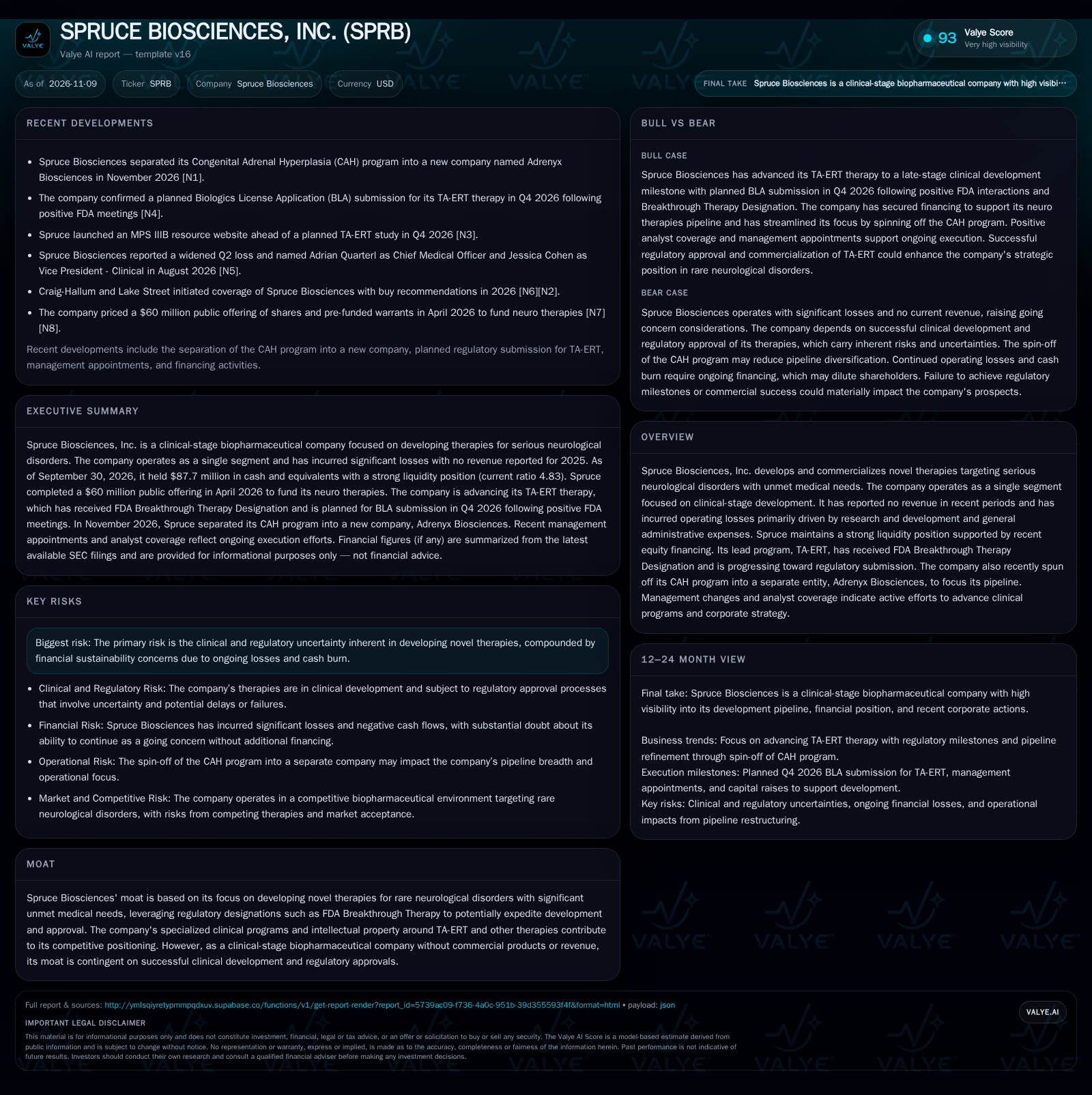
Spruce Biosciences has zero revenue and continues to incur substantial operating losses, but recently raised $60 million and holds $87.7 million in cash to progress its TA-ERT therapy—now approaching BLA submission with FDA Breakthrough Therapy Designation. The recent spin-off of its CAH program narrows the pipeline focus, increasing both clinical risk and reward concentration. The company's trajectory now depends on near-term regulatory outcomes and its capacity to manage cash burn while advancing late-stage neurology assets.
Spruce Biosciences finds itself at a pivotal moment as a clinical-stage biotech: flush with new capital, but still pre-revenue and reliant on the fate of its lead asset, TA-ERT, for MPS IIIB. The recent spin-off of its CAH program into a separate company reflects a decisive bet on rare neurology, sharpening both the risk and the strategic clarity of its pipeline. With FDA Breakthrough Therapy Designation and a planned BLA submission for TA-ERT in Q4 2026, Spruce must now convert scientific momentum into regulatory and, eventually, commercial progress—while managing ongoing losses and a finite cash runway. Success could transform the company’s value proposition; failure would leave little fallback.
TA-ERT Nears Regulatory Inflection While Pipeline Narrows
Spruce Biosciences is approaching a critical regulatory milestone with its lead therapy, TA-ERT, which targets MPS IIIB—a rare neurological disorder. The company has confirmed plans for a Biologics License Application (BLA) submission in Q4 2026, supported by positive FDA feedback and Breakthrough Therapy Designation [N4]. This places TA-ERT at the heart of Spruce’s near-term value proposition. As of September 30, 2026, Spruce held $87.7 million in cash and equivalents, bolstered by a $60 million public offering in April, which was earmarked to advance its neuro therapies [S2] [N7] [N8]. However, Spruce reported zero revenue for 2025, with a net loss of $39.0 million, and management does not expect positive cash flow from operations in the foreseeable future [S1]. The November 2026 spin-off of its CAH program into Adrenyx Biosciences further concentrates Spruce’s pipeline risk and opportunity squarely on TA-ERT and other neurology assets [N1].
Economics of a Pre-Revenue Biotech: Cash Burn, Leverage, and the Cost of Innovation
Spruce’s business model is typical of clinical-stage biotechs: heavy upfront investment in R&D, no commercial revenue, and ongoing operating losses. The company reported $19.5 million in R&D expenses and $17.0 million in G&A for 2025, resulting in a $39.0 million net loss [S1]. With $87.7 million in cash as of September 2026, Spruce’s runway is finite, especially since management has flagged substantial doubt about its ability to continue as a going concern absent future financing [S1] [S2].
If TA-ERT secures regulatory approval and launches commercially, the economics could shift dramatically. Rare disease therapies often command premium pricing due to orphan drug status and limited competition, potentially supporting high gross margins and rapid revenue ramp—if payer adoption is secured. However, commercialization would require new investments in medical affairs, market access, and potentially a specialty salesforce. The company’s cost base is currently dominated by fixed R&D and G&A, but would transition to include variable costs tied to launch, distribution, and post-marketing commitments. The absence of revenue means Spruce is highly sensitive to trial outcomes, regulatory timelines, and capital markets sentiment.
Spruce’s Moat: Orphan Indications, Regulatory Acceleration, and the Challenge of Differentiation
Spruce is pursuing a competitive edge through regulatory acceleration mechanisms (Breakthrough Therapy Designation) and a focus on rare neurological disorders with high unmet need. This strategy can create defensible market positions if the therapy demonstrates clear clinical benefit and first-mover advantage. Orphan drug exclusivity and intellectual property around TA-ERT could provide commercial protection, though this protection is contingent on approval and reimbursement.
The competitive environment for rare neurological disorders is dynamic, with both established pharmaceutical companies and emerging biotechs seeking to address similar indications. The spin-off of the CAH program removes pipeline breadth, increasing Spruce’s dependence on TA-ERT’s success. A key question is whether TA-ERT’s mechanism and clinical data will differentiate it meaningfully from emerging gene therapies, enzyme replacement therapies, or other novel modalities that may be in development for MPS IIIB and related disorders. If TA-ERT fails to show superior efficacy, safety, or patient convenience, payers and prescribers may favor alternative approaches.
How Regulatory Success Could Transform Spruce’s Economics and Strategic Options
If TA-ERT receives BLA approval in 2027, Spruce could transition from a clinical-stage to a commercial-stage company, unlocking orphan drug pricing and potential for rapid adoption in the MPS IIIB patient population. Early FDA approval, coupled with positive clinical outcomes, would likely drive payer coverage and enable premium pricing—common in rare disease markets. Spruce could then leverage its cash position and any early revenue to expand its pipeline, pursue partnerships, or even become an acquisition target for larger biopharma companies seeking rare disease assets.
Evidence that would confirm this scenario includes successful BLA acceptance and priority review by the FDA, favorable advisory committee outcomes, and early payer/formulary inclusions. Additional positive signs would be initial patient uptake, strong post-marketing data, and expansion of TA-ERT into additional indications or geographies. This scenario would be falsified by regulatory delays, significant safety signals, or inability to secure reimbursement at viable price points.
A Likely Course: Extended R&D Timeline and Continued Capital Dependence
The most plausible near-term path is that Spruce advances TA-ERT through the BLA process, but faces the typical uncertainties of regulatory review and pre-commercial launch. Even with Breakthrough Therapy Designation, approval is not guaranteed, and the FDA may request additional data or post-marketing commitments, extending timelines and increasing costs. The company continues to burn cash and may need to raise additional capital before any revenue is realized.
This scenario is confirmed by steady clinical progress, ongoing cash burn, and periodic capital raises to extend runway. Falsification would come from either a rapid approval and early commercial traction (moving into the upside case), or a clinical or regulatory setback that derails the program, tipping into the downside.
What Failure of TA-ERT Means for a Concentrated Pipeline
The principal risk for Spruce is that TA-ERT fails—either through negative clinical outcomes, regulatory rejection, or insurmountable commercial barriers. With the CAH program spun off, Spruce’s remaining pipeline is limited, making the company highly vulnerable to a single-asset outcome. Failure would likely trigger a rapid drawdown of cash reserves, forced restructuring, or a sale of remaining assets under distressed conditions.
This scenario would be confirmed by negative BLA news (complete response letter, safety issues), clinical trial setbacks, or inability to raise further capital on reasonable terms. Additional warning signs would include management turnover, cost-cutting beyond normal operational discipline, and a lack of new pipeline initiatives.
Milestones That Will Make or Break Spruce’s Neurology Bet
Progress and outcome of the BLA submission for TA-ERT in Q4 2026, including acceptance, review status, and any FDA feedback.
Updates on clinical data for TA-ERT, especially any new safety or efficacy disclosures during the regulatory review process.
Payer coverage decisions, formulary wins, or reimbursement agreements for TA-ERT if approved—key for revenue realization.
Cash burn trajectory and updated guidance on runway, particularly if disclosed in future SEC filings.
Any new capital raises, debt financings, or dilution events that affect potential financial flexibility and shareholder value.
Pipeline expansion efforts, such as new indications for TA-ERT or new neurology assets, if disclosed.
Management changes or board refreshes, which could signal strategic pivots or response to operational challenges.
Disclaimer: This is research-only, informational analysis and not investment advice. It may include AI-generated interpretation and general industry context. Always verify important details using primary sources.

Comments