
ContextLogic Holdings: From Marketplace Exit to Niche Asset Platform—The Stakes of US Salt Integration and Holding Company Execution
Following the divestiture of its marketplace business and the $908 million acquisition of US Salt, ContextLogic Holdings is repositioning itself as a platform for niche, defensible operating companies. The transition raises fundamental questions about integration, capital allocation, and the viability of its long-term holding company model.
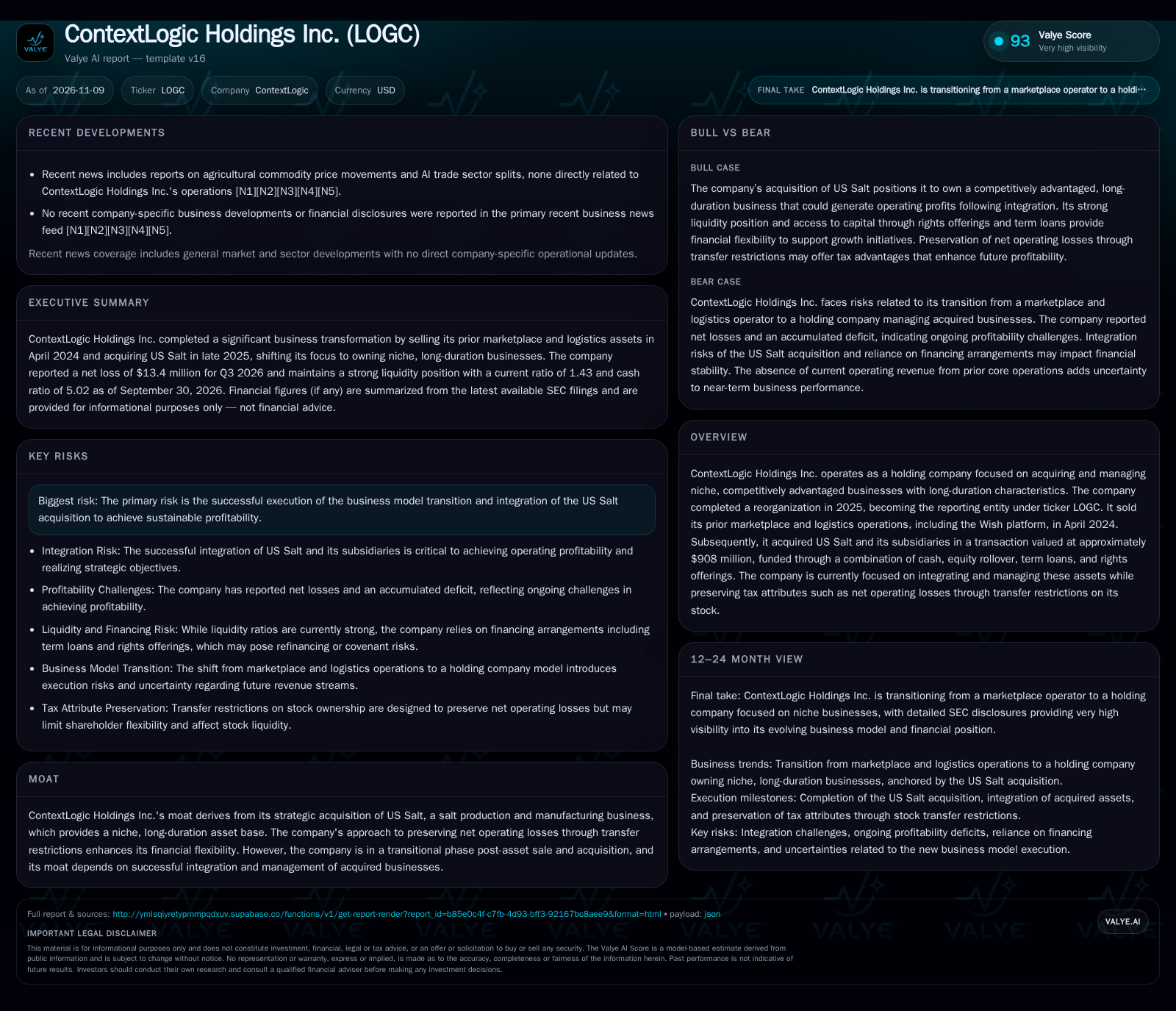
ContextLogic Holdings (LOGC) has exited its former marketplace business and acquired US Salt, shifting to a holding company model focused on niche, defensible assets. The company reported a Q3 2026 net loss of $13.4 million and holds $9.7 million in cash with a current ratio of 1.43. The success of this transformation will hinge on the integration of US Salt, future acquisition discipline, and the realization of operating profits from its new portfolio approach. [S1] [S2]
ContextLogic Holdings has undergone a radical transformation, evolving from a high-profile e-commerce marketplace operator into a holding company focused on acquiring and managing niche, defensible businesses. The recent $908 million purchase of US Salt—funded via cash, equity, term loans, and rights offerings—anchors this new strategy. With marketplace and logistics revenues now discontinued, LOGC’s fortunes rest on its ability to integrate US Salt as a stable, cash-generative asset while building a portfolio that can deliver durable, long-term value. The company’s decentralized governance and capital allocation model will be put to the test as it seeks to reverse ongoing losses and realize the promise of its new platform.
A New Corporate Identity Anchored by US Salt Acquisition
LOGC has fully exited its legacy e-commerce marketplace and logistics operations, selling these assets—including the Wish platform—to Qoo10 in April 2024. As of late 2025, the company’s identity is defined by its $908 million acquisition of US Salt, a long-established producer and distributor of specialty salt products. This transaction, funded through cash, equity rollover, term loans, and rights offerings, represents both a strategic pivot and a new foundation for future growth. Post-acquisition, ContextLogic Holdings no longer generates operating revenue from its prior marketplace business and instead seeks to generate profits from US Salt and future portfolio companies. The company reported a net loss of $13.4 million for Q3 2026, with $9.7 million in cash and a current ratio of 1.43 as of September 30, 2026. [S1] [S2]
How the Platform Model Could Drive Value Creation—and Its Constraints
In its new configuration, LOGC functions as a holding company with a decentralized structure. Each operating subsidiary is independently managed, with the parent providing capital allocation, public company reporting, and M&A execution. The economics of this model depend on acquiring businesses with durable cash flow, niche market positioning, and defensible competitive advantages—criteria exemplified by US Salt’s long history and specialized product focus.
US Salt itself operates in a mature, relatively stable industry where pricing power is typically modest but volume is predictable, especially in industrial, food, and de-icing markets. The economics of salt production are capital-intensive at the outset, but once infrastructure is in place, the business can generate healthy operating leverage and free cash flow—assuming steady demand and efficient operations. For LOGC, the challenge is realizing synergies and margin improvements without over-centralizing or disrupting subsidiary autonomy, while managing the debt and equity obligations incurred in the acquisition.
The holding company model can, in theory, achieve attractive returns on capital by reinvesting free cash flow from subsidiaries into new acquisitions or shareholder returns. However, LOGC’s ability to do so will depend on disciplined deal sourcing, prudent leverage, and the avoidance of capital misallocation—risks heightened by the company’s accumulated deficit and reliance on external financing for its first major acquisition. [S1] [S2]
Defensibility in Niche Markets: US Salt’s Moat and Broader Platform Ambitions
US Salt’s competitive position is rooted in its scale, established customer relationships, and the logistical barriers inherent in bulk commodity distribution. Entry barriers in specialty salt production include capital intensity, regulatory compliance, and the need for reliable, high-purity output. These factors help insulate US Salt from low-cost entrants and create modest but durable pricing power.
At the holding company level, LOGC aims to replicate this defensibility across a diversified set of niche businesses. The decentralized model is designed to keep decision-making close to the operating companies, allowing for industry-specific expertise and agility. However, LOGC competes for acquisition targets with private equity, family offices, and other permanent capital vehicles—all of which seek similar attributes in niche, cash-generative businesses. LOGC’s public listing may provide some capital-raising advantages, but it must demonstrate value as an owner and allocator to attract and retain high-quality assets.
The company’s preservation of net operating losses through stock transfer restrictions could provide a tax advantage, but also introduces some friction for existing and prospective shareholders. Ultimately, LOGC’s long-term moat will depend less on platform branding and more on its ability to consistently identify, acquire, and steward businesses with real structural advantages. [S1]
Integration Success and Disciplined Acquisitions Drive Sustainable Cash Flow
In a favorable scenario, LOGC successfully integrates US Salt, extracting efficiencies and maintaining or expanding margins. LOGC leverages its permanent public capital and tax attributes to outbid private competitors for similarly defensible, niche businesses, adding to its portfolio without overpaying or over-leveraging.
Operating leverage emerges as the platform scales, with holding company costs growing slower than subsidiary-level earnings. LOGC’s disciplined capital allocation and oversight—through business oversight and investment committees—help avoid the pitfalls of conglomerate sprawl or misaligned incentives. Over time, LOGC’s reported net losses reverse, and the company begins to post consistent operating profits, with free cash flow available for reinvestment or shareholder returns.
Evidence that would confirm this scenario includes: sustained operating profitability at US Salt, incremental accretive acquisitions, growing consolidated free cash flow, and a reduction in net losses or transition to net income. Improvements in return on invested capital and subsidiary performance metrics would further validate the thesis.
Gradual Transition to Platform Stability—But Profitability Remains Elusive
The most plausible outcome is a prolonged transition phase. LOGC integrates US Salt with moderate success—operational disruptions are limited, but margin expansion is incremental rather than dramatic. US Salt provides a stable earnings base, but its cash flow is largely consumed by platform expenses, interest obligations, and the need to preserve liquidity for future deals.
LOGC’s acquisition pipeline advances cautiously, with one or two additional niche businesses added over several years. While the holding company model demonstrates resilience, the company’s large accumulated deficit and initial losses persist, and operating profitability at the consolidated level takes time to materialize. External financing remains necessary for new deals, and LOGC’s ability to access low-cost capital will be periodically tested by market conditions and performance.
Evidence supporting this scenario would include: stable but unremarkable subsidiary results, continued net losses or only narrow operating profits, and measured acquisition activity with careful capital management. A lack of material improvement in return on equity or free cash flow conversion would suggest the platform is functional but not yet compounding value for shareholders.
Integration Missteps and Capital Constraints Stall Platform Growth
In an adverse scenario, LOGC encounters significant challenges integrating US Salt—operational setbacks, cost overruns, or loss of key customers erode the asset’s cash flow and profitability. High leverage and platform-level expenses outstrip subsidiary earnings, forcing LOGC to curtail acquisition ambitions or seek dilutive equity raises.
The company’s accumulated deficit and persistent net losses undermine investor confidence and restrict access to attractive financing. If future acquisition targets prove elusive or are acquired at unattractive prices, LOGC risks becoming a sub-scale holding company with limited pathways to value creation.
Confirmation of this scenario would come from deteriorating operating metrics at US Salt, widening consolidated losses, negative free cash flow, and difficulty in closing or financing new acquisitions. Any covenant breaches or forced asset sales would underscore the severity of execution and capital allocation risks.
Milestones and Metrics That Will Define LOGC’s Platform Evolution
US Salt’s quarterly and annual operating margins, cash flow, and customer retention rates—if disclosed—will be critical to assessing the anchor asset’s contribution.
Progress on integrating US Salt, including any disclosed synergies, cost savings, or operational disruptions, will provide early evidence of platform execution.
The pace, size, and terms of future acquisitions: Are new businesses accretive, competitively advantaged, and acquired without overpaying or over-leveraging?
Consolidated free cash flow generation and the trajectory of net losses or progression toward operating profitability will signal whether the platform can self-fund growth.
Changes in capital structure, such as additional term loans, rights offerings, or equity raises, and their impact on dilution and balance sheet risk.
Disclosure of return on invested capital (ROIC) at both the subsidiary and holding company level would help test LOGC’s ability to create value from acquisitions.
Any updates on the preservation or utilization of net operating losses and their realized tax benefits, as this could materially affect after-tax returns.
Management’s communication of acquisition pipeline, investment criteria, and governance effectiveness—especially the functioning of the oversight and investment committees.
Disclaimer: This is research-only, informational analysis and not investment advice. It may include AI-generated interpretation and general industry context. Always verify important details using primary sources.

Comments