
WhiteHorse Finance 2026: Navigating Yield Compression, Fee Adjustments, and the Stakes of Lower Middle Market Lending
WhiteHorse Finance, Inc. faces a challenging environment marked by lower yields, a shrinking portfolio, and heightened competition in lower middle market lending. As management responds with incentive fee reductions and cost controls, the company’s ability to source high-quality deals through its H.I.G. Capital affiliation—and maintain regulatory compliance—will determine its resilience and future earnings power.
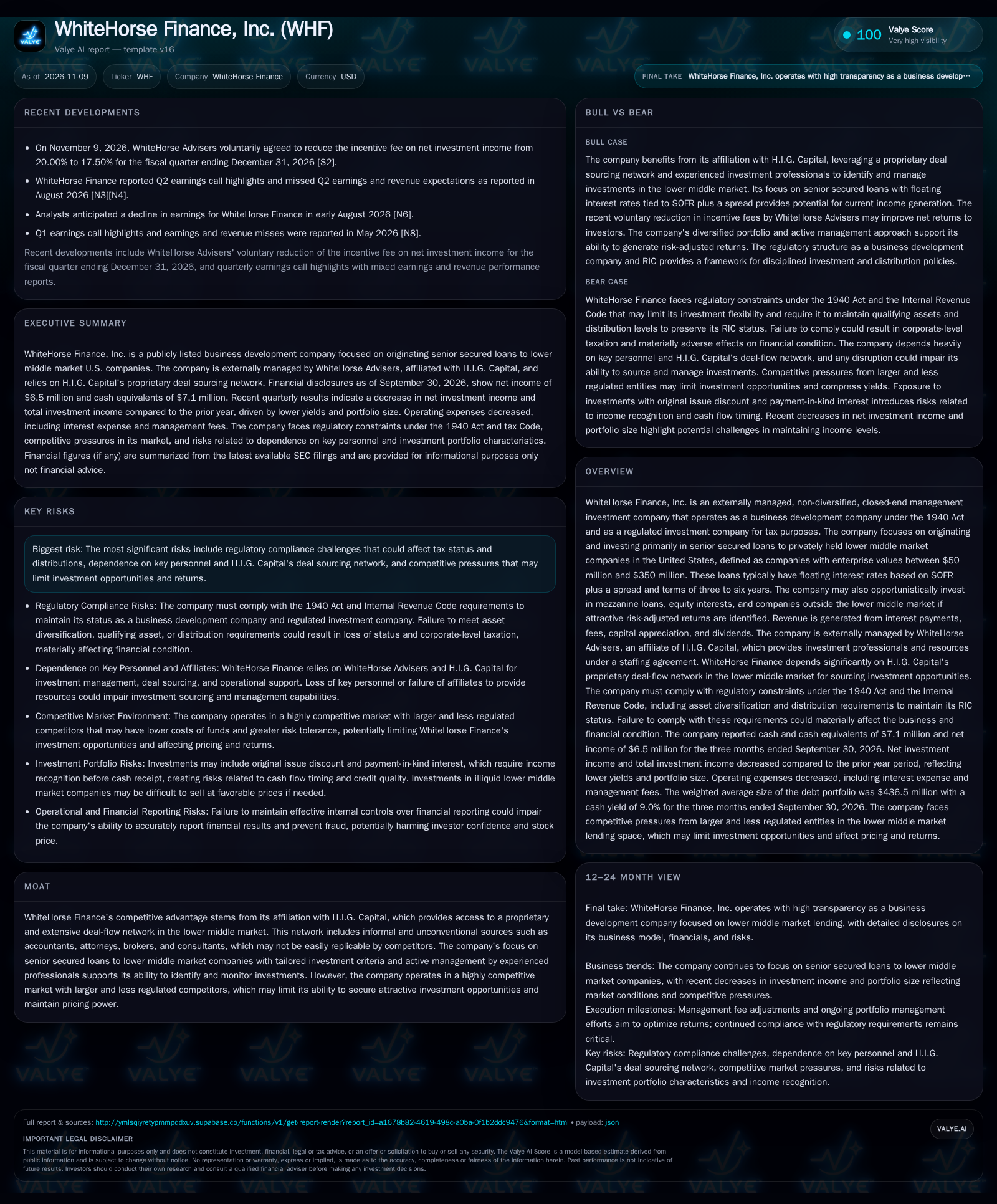
WhiteHorse Finance’s 2026 results reflect pressure on yields and portfolio size, driving lower investment income despite cost reductions and a voluntary incentive fee cut. The company’s externally managed model and reliance on H.I.G. Capital’s deal flow are central to its strategy, but competition and regulatory constraints create headwinds. Monitoring deal sourcing, portfolio growth, and regulatory compliance will be critical for evaluating its trajectory. [S2]
WhiteHorse Finance, Inc. exemplifies the challenges facing business development companies focused on the U.S. lower middle market: yield compression, shrinking asset bases, and heightened competition from larger or less regulated lenders. The company’s Q3 2026 results show declining net investment income and total investment income, despite cost controls and a temporary reduction in incentive fees by its external manager. As WhiteHorse leans on H.I.G. Capital’s deal sourcing network, its ability to navigate regulatory requirements and maintain portfolio quality will be pivotal for sustaining returns and dividend capacity in the coming quarters. [S2]
Recent Financial Results Reveal Yield and Portfolio Pressure
WhiteHorse Finance reported net investment income of $4.4 million for the three months ended September 30, 2026, down from $6.1 million in the prior year period, with total investment income also falling from $17.7 million to $14.8 million year-over-year. This decline was driven by both lower portfolio yields and a smaller average portfolio size. Interest income excluding payment-in-kind (PIK) fell by $2.8 million, highlighting the impact of competitive pricing and possibly reduced deal flow. Operating expenses decreased by $1.2 million, helped by lower interest expense and management fees. WhiteHorse Advisers voluntarily reduced its incentive fee from 20.00% to 17.50% for Q4 2026, a move that may cushion the impact of income pressure on shareholders. The weighted average debt portfolio stood at $436.5 million with a 9.0% cash yield, while weighted average borrowings were $328.5 million at a 5.25% rate. These figures point to a business in transition, grappling with industry-wide headwinds and adapting its cost structure accordingly. [S2]
Income Generation, Cost Structure, and Fee Dynamics in a Changing Lending Landscape
WhiteHorse Finance’s economic engine is built around originating senior secured loans—primarily first and second lien—to lower middle market companies, typically at floating rates tied to SOFR plus a spread. Revenue streams include contractual interest, origination and structuring fees, and opportunistic capital appreciation or dividends from equity investments. The company’s externally managed structure means a significant portion of its operating expenses are management and incentive fees paid to WhiteHorse Advisers, along with administrative fees and interest on borrowings.
As a regulated investment company (RIC), WhiteHorse must distribute the majority of its taxable income to avoid corporate-level taxation, structurally limiting its ability to retain earnings for growth. The company’s reliance on floating-rate loans can provide some protection in rising rate environments, but competitive pressures from larger or less regulated lenders have contributed to yield compression and a shrinking portfolio, as seen in the recent results. The voluntary reduction in the incentive fee from 20% to 17.5% for Q4 2026 slightly improves the net income available to common shareholders, but does not fundamentally alter the economics if portfolio yields and volumes continue to decline. Operating leverage is limited by the externally managed model, and the company’s ability to scale revenues is closely tied to its success in sourcing new, attractively priced deals while maintaining credit quality. [S1] [S2]
Deal Sourcing Edge Versus Structural Disadvantages in a Crowded Market
WhiteHorse’s core competitive advantage derives from its affiliation with H.I.G. Capital, which provides access to a proprietary deal sourcing network targeting lower middle market borrowers. This network may offer differentiated access to private companies, leveraging relationships with advisors, brokers, and intermediaries that are not easily replicated by larger, more transactional lenders. However, the lower middle market lending space has grown increasingly crowded, with larger business development companies, private credit funds, and less regulated lenders often able to accept lower returns, move faster, or underwrite larger deals.
This competitive dynamic has contributed to yield compression and could make it more difficult for WhiteHorse to deploy capital at attractive risk-adjusted returns, as reflected in the recent decrease in portfolio size and yields. The company’s focus on senior secured loans provides some downside protection, but its smaller scale and externally managed structure may constrain its flexibility in pricing, structuring, and servicing loans relative to larger or more vertically integrated platforms. The question is whether H.I.G. Capital’s sourcing network and underwriting discipline are sufficient to offset these disadvantages in a market where capital is abundant and spreads are tight. [S1]
If Sourcing Strength and Fee Adjustments Restore Income Growth
A favorable outcome for WhiteHorse would require stabilization or expansion of its portfolio—driven by improved deal flow from H.I.G. Capital’s network and successful origination of loans at higher spreads or more favorable terms. If competitive intensity moderates or market volatility leads to wider spreads, WhiteHorse could deploy capital at improved yields, reversing the recent income declines. The reduction in incentive fees, if extended or made permanent, would further enhance net returns to shareholders. Confirmation of this scenario would involve consecutive quarters of portfolio growth, rising weighted average yields, and higher net investment income per share, coupled with continued cost discipline.
Falsification would occur if portfolio size continues to contract, yields remain under pressure, or if credit costs rise due to deteriorating borrower quality, negating any benefit from lower management fees.
Maintaining Portfolio Stability Amid Competitive and Regulatory Constraints
The most plausible path forward is one in which WhiteHorse maintains a stable or modestly declining portfolio, with yields remaining pressured by ongoing competition. Management may continue to adjust fees and operating costs to partially offset income headwinds, but the company’s ability to materially grow earnings is limited unless market conditions shift or it gains access to a new source of higher-yielding assets. The business will likely remain focused on senior secured lending in the lower middle market, with H.I.G. Capital’s network providing deal flow but not necessarily enough to drive significant growth.
Evidence to the contrary would include significant changes in portfolio size, a notable shift in yield or credit quality, or regulatory non-compliance affecting tax status or capital deployment. [S1] [S2]
When Yield Compression, Deal Sourcing Weakness, or Regulatory Breaches Erode Earnings Power
A negative scenario could unfold if competitive pressures intensify further, with continued yield compression and shrinking portfolio volumes reducing investment income below sustainable levels. If H.I.G. Capital’s deal flow network fails to deliver enough high-quality opportunities, WhiteHorse may be forced to accept weaker credit or less attractive terms, raising the risk of credit losses or impaired income recognition (especially with OID and PIK-heavy investments).
Additional risk stems from the company’s need to comply with RIC and 1940 Act requirements—any breach could trigger corporate taxation and fundamentally alter the economics. Confirmation of this scenario would be persistent declines in net investment income, rising non-accruals or credit costs, dividend cuts (if disclosed), and/or regulatory findings or warnings regarding compliance.
What Will Determine WhiteHorse’s Resilience in Lower Middle Market Lending?
Quarterly changes in weighted average portfolio size and composition—an inflection would signal a shift in deal sourcing or deployment capacity.
Trends in weighted average cash yield on the debt portfolio, as sustained yield compression would further pressure investment income.
Net investment income per share and dividend coverage (if disclosed), to assess the sustainability of shareholder returns.
Level and trend of non-accruals, credit losses, or impairments, which would indicate underlying borrower stress or underwriting weakness.
Updates regarding the permanence or extension of the incentive fee reduction, as a lasting cut could improve net returns if portfolio economics stabilize.
Any regulatory disclosures or 1940 Act/RIC compliance updates, since a breach would have outsized effects on tax efficiency and capital structure.
Evidence of shifts in competitive intensity or market spreads in the lower middle market, which could affect the company’s ability to originate at attractive terms.
Portfolio allocation to OID and PIK instruments—a useful metric would be the proportion of total income from non-cash sources, as this affects cash flow timing and risk.
Disclaimer: This is research-only, informational analysis and not investment advice. It may include AI-generated interpretation and general industry context. Always verify important details using primary sources.

Comments