
Superior Group of Companies: Segment Diversification, Margin Pressures, and the Challenge of Sustained Earnings Quality
Superior Group of Companies operates across branded products, healthcare apparel, and contact centers—providing revenue diversity but facing renewed earnings volatility and near-term margin pressure. Recent profit declines and a reported cash balance highlight the company’s exposure to operational swings and the need for improved segment execution.
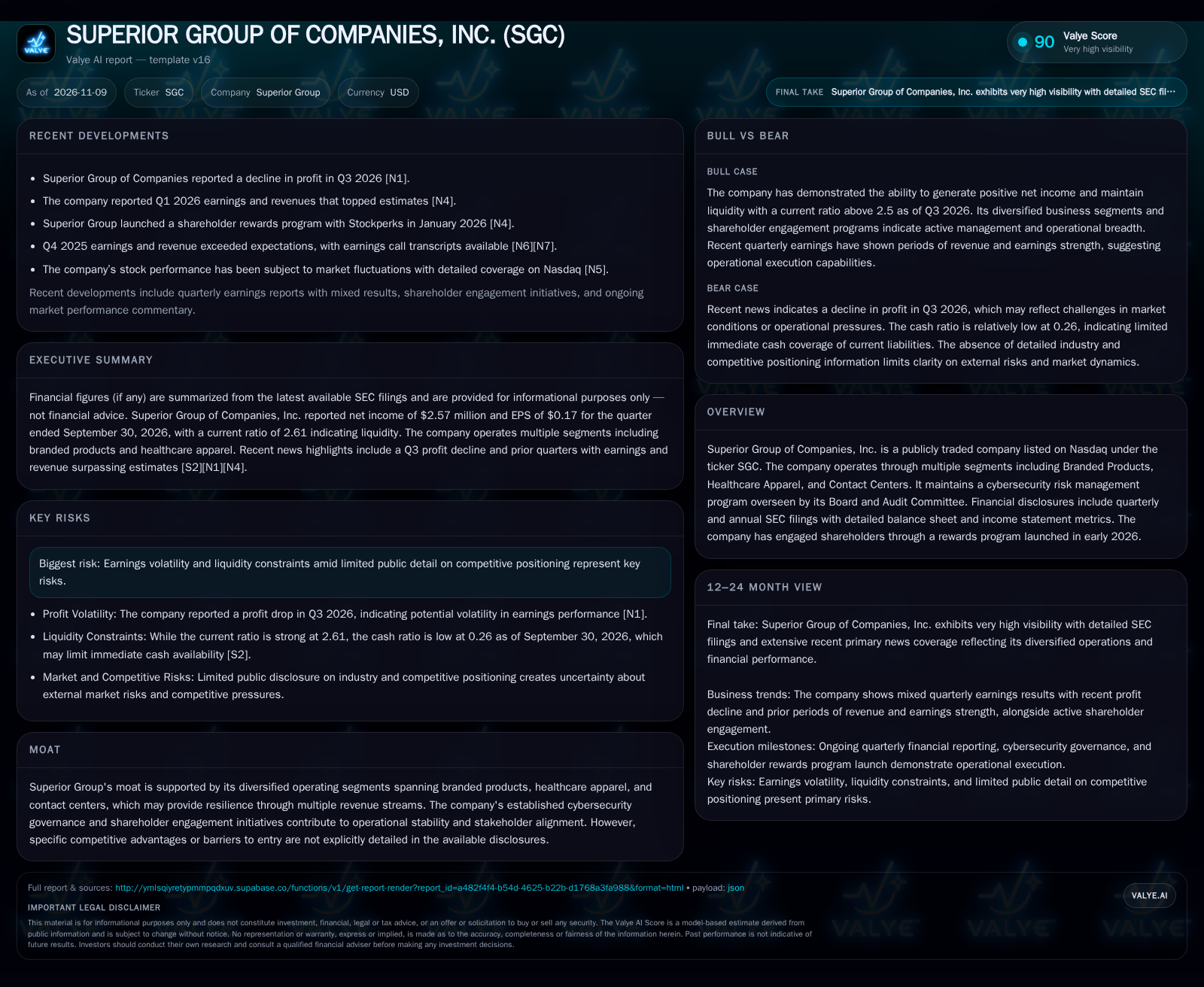
Superior Group of Companies reported a Q3 2026 profit decline despite maintaining a diversified segment structure and a reported current ratio. [S2] [N1]
Superior Group of Companies (SGC) stands at a crossroads: its diversified business segments—branded products, healthcare apparel, and contact centers—offer resilience against demand shocks, yet recent financials reveal renewed earnings volatility and margin pressure. The next phase will test Superior’s segment execution and ability to buffer margin swings in a competitive, cost-sensitive landscape. [S2] [N1] [N4]
Recent Profit Decline and Liquidity Snapshot Define the 2026 Operating Landscape
Superior Group of Companies reported net income of $2.57 million for Q3 2026, with basic and diluted EPS of $0.17 per share—a notable drop in profit compared to prior quarters that had topped estimates [S2] [N1] [N4]. This shift signals renewed margin pressure or volume headwinds across its operating segments. As of September 30, 2026, the company’s current assets stood at $281.7 million against current liabilities of $108.0 million, yielding a current ratio of 2.61. However, cash and cash equivalents were $27.9 million, translating to a cash ratio of just 0.26 [S2]. The launch of a shareholder rewards program in early 2026 reflects management’s focus on investor engagement, but its tangible impact on shareholder loyalty and capital structure is not yet clear [N4].
Segment Economics: Revenue Diversity Versus Margin Volatility
Superior Group’s business model spans three operational segments: Branded Products, Healthcare Apparel, and Contact Centers [S1]. Each segment likely operates with distinct revenue drivers and margin profiles. Branded Products may depend on contract manufacturing, licensing, or direct sales—where gross margins hinge on sourcing, brand equity, and sales channel mix. Healthcare Apparel is typically characterized by recurring institutional and retail demand, but is exposed to margin compression from procurement cycles and competitive pricing. Contact Centers are service-intensive, with revenue tied to seat utilization and labor efficiency—offering operational leverage but also subject to wage inflation and client contract churn.
The company’s overall operating leverage is mixed: high fixed costs in apparel manufacturing and branded goods could amplify profitability in demand upswings but also risk losses in downturns. The service orientation of the contact center segment may allow for more variable cost structures, but scale is essential for margin expansion. Recent profit declines suggest that Superior is currently absorbing cost or volume shocks, perhaps from input price pressure or demand softness in one or more segments. The ability to flex expenses, adjust pricing, or mix higher-margin products and services will determine the pace of margin recovery.
The interplay between fixed and variable costs across Superior Group’s segments critically affects its margin sensitivity to volume fluctuations. For instance, branded products with higher fixed manufacturing overhead may benefit disproportionately from incremental sales, enhancing operating leverage during growth phases. Conversely, during demand contractions, these fixed costs become burdensome, compressing margins more severely than in segments with more flexible cost structures. Healthcare apparel, while somewhat recurring in demand, may face cyclical procurement budgets from institutional buyers, creating episodic revenue dips that challenge margin stability. Contact centers, reliant on labor costs, are vulnerable to wage inflation and the difficulty of rapidly scaling staffing levels, which can lead to underutilized capacity or overtime expenses. Understanding the cost elasticity within each segment would help clarify the company’s overall margin volatility and its capacity to adjust expense profiles in response to market conditions.
How Diversification Shapes Competitive Exposure and Resilience
Superior Group’s multi-segment footprint creates both opportunity and complexity. In Branded Products, the company likely competes with specialty manufacturers, contract apparel firms, and branded merchandisers. Healthcare Apparel pits it against large-scale uniform providers and niche medical suppliers, where procurement cycles, brand preference, and compliance standards drive differentiation. Contact Centers compete in a fragmented, often commoditized market, where scale, technology adoption, and client retention are key.
Diversification theoretically buffers Superior against sector-specific downturns, but also means management must execute across markets with different competitive dynamics and cost structures. There is no explicit evidence of sustainable competitive advantages—such as proprietary technology, exclusive contracts, or brand leadership—that would create high switching costs or defend margins. In apparel, barriers to entry are moderate and price competition is persistent; in contact centers, automation and labor cost pressures are ongoing threats. The company’s established cybersecurity risk management framework may be a differentiator for enterprise clients, but is unlikely to be a primary moat. Without clear evidence of scale or unique capabilities, Superior’s competitive position is best described as operationally diversified but not deeply defensible.
Superior Group’s diversified operations also imply a complex resource allocation challenge for management. Capital and managerial attention must be distributed across segments with differing growth trajectories and competitive pressures, potentially diluting focus and slowing strategic responses. The absence of a clear competitive moat in any segment suggests that achieving scale advantages or differentiation through innovation or branding is critical. However, scale economies may be uneven; for example, contact centers often require significant technology investment to automate routine tasks and improve efficiency, while branded products may depend more on supply chain optimization and brand marketing. The company’s ability to prioritize investments that enhance segment-specific competitive positioning, while leveraging cross-segment operational synergies such as shared procurement or administrative functions, would be a key determinant of its resilience and profitability over time.
Operating Discipline and Segment Execution Drive a Return to Earnings Growth
If Superior Group leverages cross-segment synergies and improves cost discipline, it could restore earnings momentum. For example, enhanced procurement, leaner manufacturing, or better labor management in contact centers could lift margins even in a tepid demand environment. Upside could also come from successful cross-selling between branded and healthcare apparel channels, or from new client wins in contact centers that improve seat utilization and contract visibility.
Evidence that would confirm this scenario includes a return to quarter-over-quarter profit growth, margin expansion disclosed in segment reporting, or management commentary pointing to successful cost initiatives and new business wins. Improved cash flow from operations and a reported liquidity-ratio trends would further validate operational recovery. Conversely, persistent margin compression or lack of improvement in segment profitability would falsify the upside scenario.
Operational improvements could also arise from digital transformation initiatives, particularly in the contact center segment where automation and AI tools can reduce reliance on labor and improve service consistency. If Superior Group successfully integrates such technologies, it could lower variable costs and enhance scalability, which in turn would mitigate wage inflation pressures and client churn risks. Similarly, in branded products and healthcare apparel, adopting advanced analytics for demand forecasting and inventory management could reduce excess stock and improve working capital efficiency. These initiatives would require upfront investment but could yield sustainable margin expansion if executed effectively. The degree to which management articulates a clear roadmap for such modernization efforts, along with measurable milestones, would provide important signals about the feasibility of realizing this upside.
Mixed Segment Performance and Limited Pricing Power Constrain Margin Expansion
The most plausible outlook is that Superior Group achieves modest revenue growth or stabilization, but continues to face margin pressures from input costs, wage inflation, and competitive pricing. Branded Products and Healthcare Apparel may each contribute steady but unspectacular sales, while Contact Centers remain exposed to labor cost volatility and client churn.
Confirmation of this scenario would include ongoing earnings volatility, with occasional quarters of outperformance offset by periods of profit decline, as seen in 2026. Reporting that shows little change in gross or operating margins, or persistent commentary on challenging pricing conditions and cost headwinds, would reinforce this middle path. Any material improvement or deterioration in segment-specific profitability would tip the balance toward the upside or downside cases, respectively.
Sustained Margin Compression and Cash Flow Weakness Erode Operating Flexibility
Should margin pressures persist or worsen—due to rising input costs, labor inflation, or competitive price cuts—Superior Group could see further profit declines and cash flow tightening.
Additional red flags would be management disclosures of restructuring charges, cost-cutting initiatives, or commentary on tight liquidity. If the company is forced to seek external financing or divest assets to cover obligations, it would confirm a stressed scenario.
Milestones That Will Shape Superior Group’s Margin Recovery and Strategic Optionality
Quarterly segment-level revenue and margin disclosures—if available—would clarify which business lines are driving or lagging profitability.
Cash flow from operations trends will indicate whether the company is converting reported earnings into sustainable liquidity.
Management commentary on input cost pressures, pricing actions, or labor conditions will reveal the company’s ability to manage margin volatility.
Evidence of new large customer wins, contract renewals, or cross-segment synergies would suggest progress on organic growth and margin lift.
Updates on the effectiveness or uptake of the shareholder rewards program could inform the impact on investor engagement and capital structure.
Disclosures of restructuring, asset sales, or new financing arrangements would flag stress or strategic pivots.
Tracking broader industry trends in healthcare apparel procurement, branded product demand, and contact center outsourcing will contextualize Superior’s performance relative to peers.
Disclaimer: This is research-only, informational analysis and not investment advice. It may include AI-generated interpretation and general industry context. Always verify important details using primary sources.

Comments