
AiXin Life International: Integrated Health Platform in China, But Liquidity and Market Position Remain Unproven
AiXin Life International’s vertically integrated health and wellness business in China combines R&D, manufacturing, and omni-channel distribution, but persistent net losses and severe working capital deficits cast doubt on its ability to scale or defend share in a fragmented and highly competitive market.
AiXin Life International leverages in-house R&D, manufacturing, and omni-channel sales to pursue growth in China’s health and wellness sector.
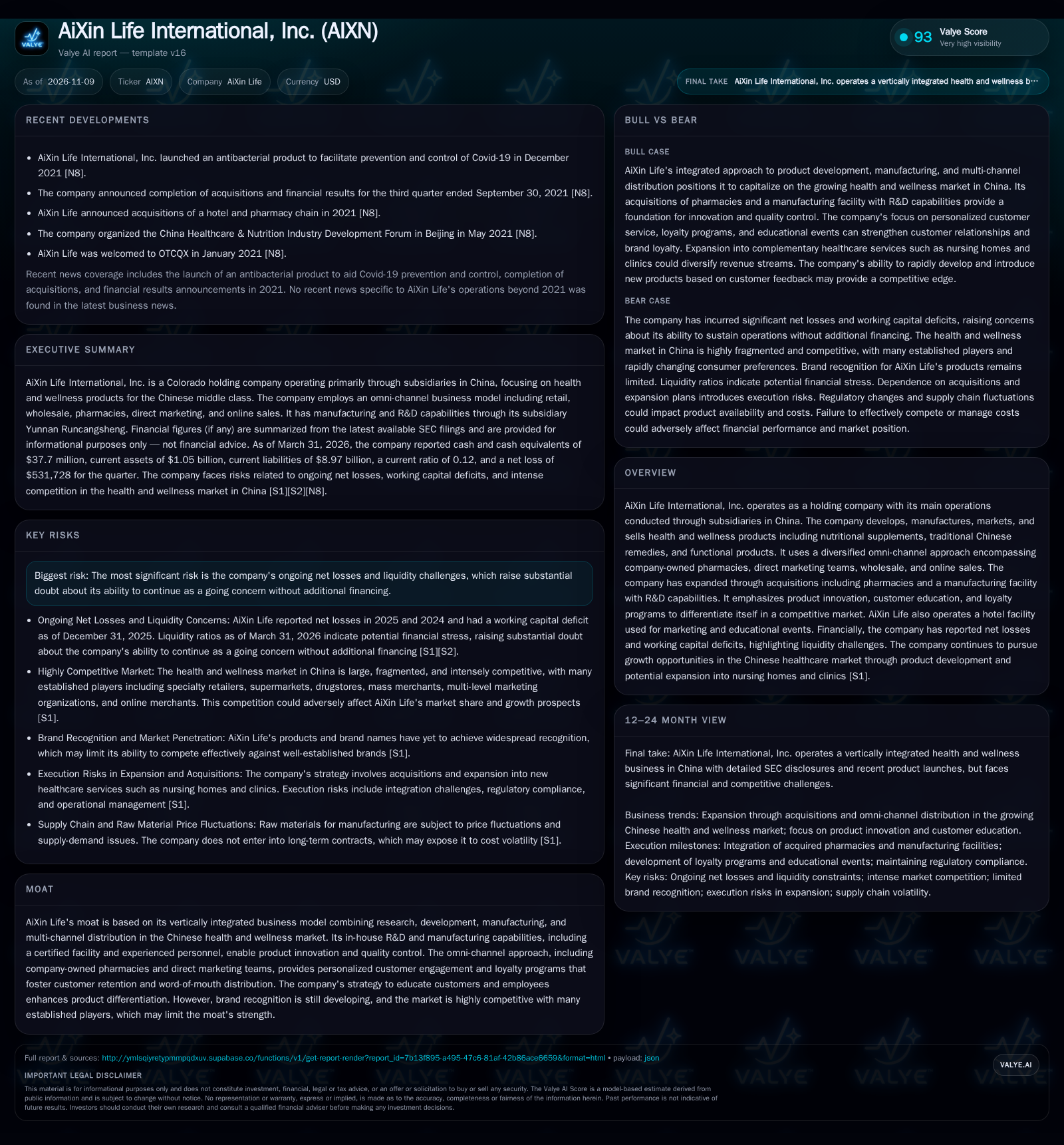
AiXin Life International, Inc. operates a vertically integrated platform in China’s vast health and wellness market, combining proprietary product development, in-house manufacturing, and a multi-pronged distribution network that includes pharmacies, direct marketing, and online channels. While this structure aims to capture rising demand from China’s middle class, the company’s persistent net losses, severe working capital deficit, and nascent brand presence underscore the steep hurdles to achieving sustainable scale and profitability. In a sector marked by fragmentation and rapid consumer shifts, AiXin Life’s ability to convert operational breadth into defensible market share remains an open question [S1] [S2].
Persistent Losses and Liquidity Strain Define Current Reality
As of March 31, 2026, AiXin Life reported cash and cash equivalents of $37,677 with current assets of $1,054,805 and current liabilities of $8,965,264, resulting in a current ratio of just 0.12 and a cash ratio of 0. The company has posted consecutive net losses—$2.04 million in 2025 and $2.77 million in 2024—and used net cash in operating activities of over $2 million in 2025 [S1] [S2]. These figures highlight severe liquidity pressure and ongoing operating losses, raising substantial doubt about the company’s ability to continue as a going concern without external financing.
Operationally, AiXin Life’s business spans company-owned pharmacies (eight as of the latest report), direct marketing, online channels, and a recently acquired manufacturing facility with R&D capability. Despite these assets, brand recognition is still developing and the company faces intense competition from a wide array of retail and online players [S1].
How AiXin Life’s Integrated Model Could Create Value—and Where It May Fall Short
AiXin Life’s economics rely on leveraging vertical integration to capture margins across product development, manufacturing, and distribution. In theory, this structure enables faster product innovation, quality control, and the ability to respond quickly to changing consumer preferences. The company sells both proprietary and third-party products through a mix of pharmacies, direct marketers, wholesale, and e-commerce, aiming for broad reach and recurring engagement.
However, the business is capital-intensive: acquisitions, R&D, manufacturing, and physical retail all require ongoing investment. Fixed costs—such as operating a 2,946-square-meter production facility and maintaining multiple retail locations—create high operating leverage, meaning revenue growth must be strong and sustained to cover losses. The company reported cash and liquidity metrics for the period; these figures do not by themselves establish operating runway, investment capacity, financial flexibility, or financing capacity. [S1] [S2]
Customer loyalty programs and educational events are designed to drive repeat purchases and word-of-mouth marketing, but the effectiveness of these initiatives has not yet translated into profitability. The company’s ability to scale direct marketing and online sales, which generally carry higher margins and lower fixed costs than physical retail, could be a future lever if executed well.
Fragmented Market and Undeveloped Brand Limit Defensibility
AiXin Life operates in one of China’s most fragmented and competitive consumer sectors. The health and wellness market features specialty retailers, supermarkets, drugstores, mass merchants, multi-level marketing organizations, and a growing base of digital-native brands. Many of these competitors have deeper resources, established brand recognition, and scale advantages.
While AiXin Life’s vertical integration and omni-channel approach create the potential for product differentiation and customer engagement, these advantages are not yet entrenched. Brand awareness remains low, and customer switching costs are minimal in a market where consumers are inundated with alternative options. The company’s product portfolio includes traditional Chinese remedies and modern supplements, but without strong brand attachment or unique intellectual property, AiXin Life risks being outcompeted on price, distribution, or marketing spend.
The company’s strategy to use physical pharmacies as learning centers and loyalty hubs is a plausible differentiator, but this model requires high ongoing investment and does not guarantee scale in a digital-first consumer environment.
If Omni-Channel Integration and Innovation Pay Off
In a favorable scenario, AiXin Life’s investment in vertical integration and customer engagement could yield a virtuous cycle: proprietary R&D and manufacturing allow for rapid product launches tailored to Chinese consumer trends, while omni-channel distribution maximizes reach and loyalty programs drive retention. If the company can achieve operational efficiencies, increase pharmacy traffic, and grow its direct marketing network, it could convert fixed costs into operating leverage and move toward breakeven.
Evidence supporting this outcome would include: a reversal of net losses, sustained revenue growth exceeding fixed-cost escalation, improved working capital ratios, and signs of growing brand awareness (such as repeat customer rates or digital engagement, if disclosed). Expansion into adjacent services—like nursing homes or clinics—could further diversify revenue if executed without overwhelming management bandwidth or capital reserves.
Most Likely Trajectory: Incremental Growth, Ongoing Strain
The most plausible outcome is that AiXin Life achieves modest revenue growth from new product introductions and incremental gains in pharmacy or online channel sales, but continues to struggle with profitability and liquidity. Competitive intensity and low brand recognition limit pricing power and customer loyalty, while fixed costs from physical operations and manufacturing keep the break-even point high.
Confirming evidence would be continued net losses, persistent working capital deficits, and lackluster improvement in key operating metrics such as same-store sales, online conversion rates, or direct marketing effectiveness (if disclosed). The company might pursue additional financing, asset sales, or restructuring to sustain operations, but with execution and dilution risks.
When Liquidity Dries Up Before Scale Is Achieved
In the adverse scenario, AiXin Life’s liquidity position deteriorates further before the business reaches scale or profitability. Inability to raise additional capital, combined with ongoing net cash outflows, could force the company to close pharmacies, divest assets, or even pursue bankruptcy protection. Brand momentum stalls as competitors outspend and out-innovate AiXin Life, and customer loyalty programs fail to offset churn.
Evidence confirming this scenario would include further declines in cash and working capital, default on obligations, significant layoffs or asset sales, or auditor commentary on going-concern risks. Regulatory, supply chain, or macroeconomic shocks could accelerate this outcome given the company’s thin financial cushion.
Signals That Will Determine Whether AiXin Life’s Model Can Scale
Sustained improvement in net cash from operating activities, not just revenue growth, would be a primary signal of business model viability.
A useful metric would be same-store sales growth in company-owned pharmacies, indicating whether physical retail expansion is generating returns.
Trends in customer retention or repeat purchase rates (if disclosed) would help assess the effectiveness of loyalty programs and educational initiatives.
Disclosure of online sales growth and digital channel profitability would clarify whether the omni-channel model is shifting toward higher-margin, scalable segments.
Evidence of improved working capital or successful external financing would be critical to alleviating immediate liquidity risks.
Expansion into adjacent services (such as nursing homes or clinics) should be monitored for early signs of operational and financial contribution versus distraction or drain.
Gross margin trends, particularly in proprietary product lines, would indicate whether vertical integration is translating into real economic advantage.
Any regulatory, supply chain, or macroeconomic disruptions impacting health and wellness consumption in China could have outsized effects given the company’s financial fragility.
Disclaimer: This is research-only, informational analysis and not investment advice. It may include AI-generated interpretation and general industry context. Always verify important details using primary sources.

Comments