
Tonix Pharmaceuticals: TONMYA’s Commercial Inflection, Pipeline Leverage, and the Stakes of Patent Defense
Tonix Pharmaceuticals’ recent surge in TONMYA sales and a robust late-stage pipeline signal a commercial inflection, but the company’s future hinges on defending its intellectual property and executing on clinical milestones—especially as generic threats and clinical uncertainties loom.
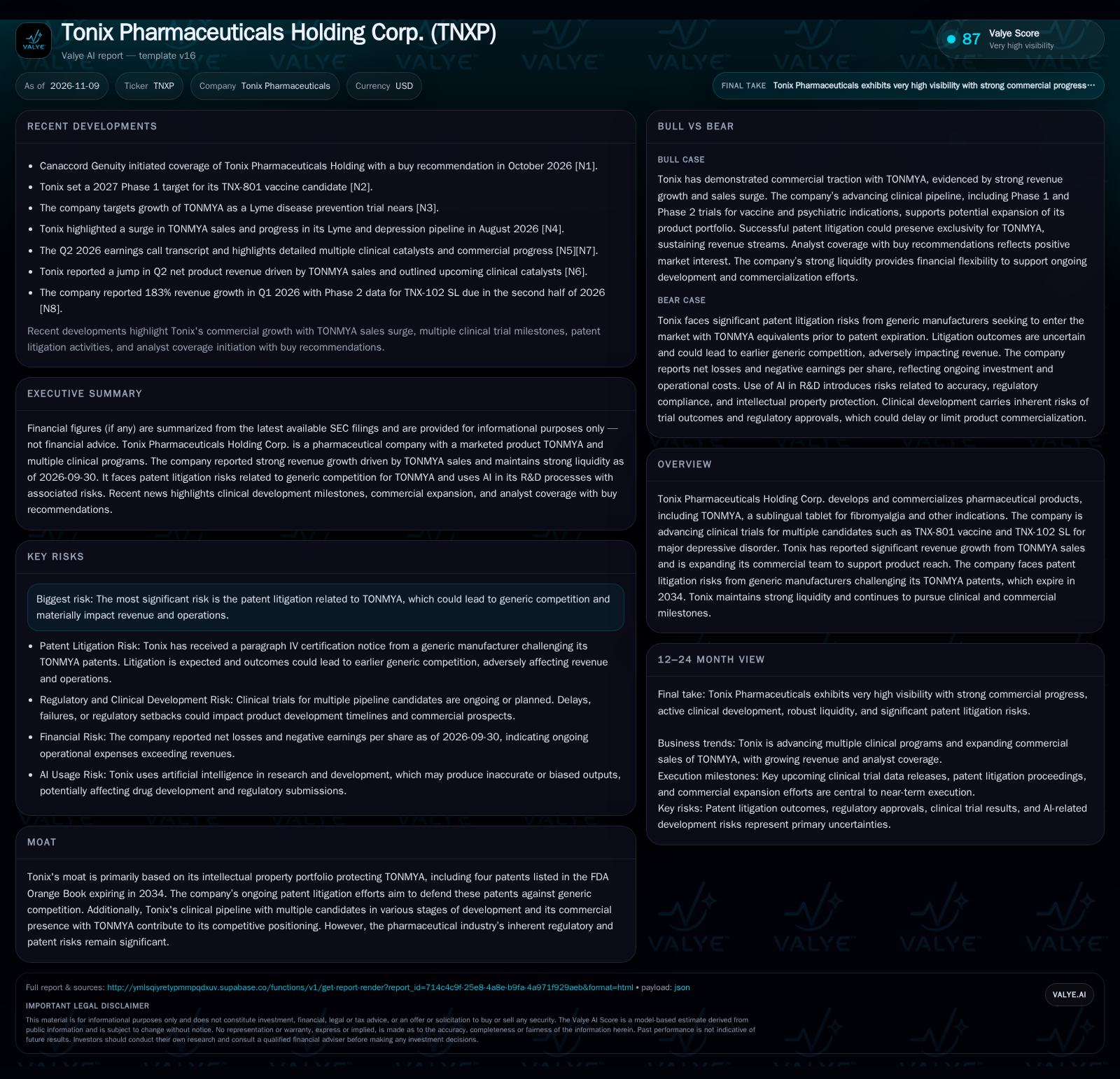
Tonix Pharmaceuticals is experiencing a step-change in revenue, driven by the commercial launch of TONMYA for fibromyalgia, while advancing a pipeline in depression and infectious disease. [S2] [N3] [N4] [N8]
Tonix Pharmaceuticals finds itself at a critical juncture: its first marketed product, TONMYA, is delivering rapid commercial growth and transforming the firm’s financial profile. Yet, the durability of this momentum depends on defending its intellectual property against generic challengers and successfully advancing a suite of late-stage clinical assets. The coming 12-24 months will test whether Tonix can translate its cash reserves and pipeline into sustainable market positions—or if legal, clinical, and competitive headwinds will erode its recent gains.
Recent Revenue Acceleration, Patent Litigation, and a reported cash balance: Where Tonix Stands Now
Tonix Pharmaceuticals has posted a 183% increase in revenue in Q1 2026, attributed to the commercial launch and sales surge of TONMYA (cyclobenzaprine hydrochloride) for fibromyalgia. This marks the company’s shift from a pure development entity to one with tangible commercial traction. [N8]
The company’s financials as of September 2026 show $162.8 million in cash and equivalents, a current ratio of 4.57, and a cash ratio of 3.93, reflecting a reported liquidity position for a small-cap biotech. However, Tonix also reported a net loss of $53.3 million for the period, indicating that operational expenses continue to outpace revenue. [S2]
Tonix faces a material patent litigation risk after receiving a paragraph IV certification from a generic manufacturer seeking to bring a TONMYA equivalent to market before its patents expire in 2034. The company plans to pursue litigation, which could trigger a 30-month stay but introduces uncertainty around revenue durability. [S2]
Beyond fibromyalgia, Tonix is advancing clinical programs in major depressive disorder (Phase 2 trial initiation approved), Lyme disease prevention (trial nearing), and a TNX-801 vaccine candidate (Phase 1 targeted for 2027), all of which could diversify and expand future revenue streams. [N2] [N3] [N4]
How TONMYA Drives Economics—and the Leverage and Risks in Tonix’s Model
Tonix’s current revenue base is dominated by TONMYA, a branded product for fibromyalgia with FDA-listed patents. The economics of branded pharmaceuticals typically feature high gross margins due to premium pricing and low variable production costs, but require significant upfront R&D and regulatory investment. If TONMYA can achieve meaningful market penetration, operating leverage should improve as fixed costs are spread over a larger revenue base.
The path to profitability is complicated by ongoing R&D spending, commercial build-out, and legal costs associated with patent defense.
Future economics hinge on two levers: 1) sustained exclusivity for TONMYA, which enables premium pricing and delays generic erosion, and 2) pipeline success, particularly in major depressive disorder and infectious disease, which could open new, larger markets. The economics would shift dramatically if generics enter the market early, potentially compressing margins and forcing strategic pivots.
Tonix’s use of AI in R&D could, if effective, accelerate drug discovery and reduce development costs, but also introduces regulatory and reliability risks that could offset potential efficiencies.
IP Protection, Pipeline Breadth, and the Threat of Substitution
Tonix’s primary competitive moat is its intellectual property around TONMYA, with four patents listed in the FDA Orange Book expiring in 2034. This IP, if successfully defended, provides a window of exclusivity and could support premium pricing. However, the paragraph IV challenge from a generic manufacturer exemplifies the constant threat of patent cliffs in the pharmaceutical sector. [S2]
Beyond IP, Tonix’s competitive position depends on its ability to generate compelling clinical data and secure regulatory approvals for pipeline candidates. The company’s efforts in major depressive disorder, Lyme disease prevention, and vaccine development pit it against both large pharma incumbents and a crowded field of clinical-stage biotechs.
Substitution risk is significant: if generics enter the market or new therapies outperform TONMYA in efficacy, safety, or convenience, Tonix could rapidly lose share and pricing power. Furthermore, the fibromyalgia market includes alternative therapies, both branded and generic, making differentiation through clinical outcomes or patient experience critical.
Tonix’s commercial expansion—evidenced by recent management additions and sales force build-out—could help capture share, but ultimate success depends on payer coverage, physician adoption, and patient retention, none of which are guaranteed.
If Patent Defense Holds and the Pipeline Delivers: Roadmap to a Multi-Asset Franchise
The favorable scenario for Tonix rests on three reinforcing outcomes: 1) successful defense of TONMYA’s patents, resulting in at least several years of exclusivity; 2) strong uptake and sustained sales growth for TONMYA in fibromyalgia and, potentially, in new indications such as Lyme disease prevention; and 3) positive readouts from pipeline programs, particularly TNX-102 SL in major depressive disorder and TNX-801 in infectious disease.
If the company can extend TONMYA’s revenue tail while layering in new products, it could achieve operating leverage and move toward profitability as fixed costs are amortized over a larger base. Successful clinical data in depression or Lyme could open larger or less crowded markets, providing additional growth vectors.
Evidence that would confirm this scenario includes: court rulings upholding TONMYA’s patents and granting a 30-month stay against generic entry; accelerating product revenue in subsequent quarters; positive Phase 2/3 data readouts and regulatory milestones for pipeline assets; and expanding analyst coverage or strategic partnerships.
Falsification would come from adverse patent rulings, disappointing clinical trial results, or stalled revenue growth despite exclusivity.
Navigating Growth, Litigation, and Pipeline Risk: The Most Likely Outcome
The most plausible scenario is a mixed outcome: Tonix sustains moderate growth in TONMYA sales while managing ongoing legal and R&D spending. The company likely secures at least an initial stay on generic entry, but faces continuing uncertainty around IP litigation that weighs on market valuation and strategic planning.
Pipeline progress is incremental: TNX-102 SL advances in major depressive disorder, but commercialization timelines remain uncertain until late-stage data are available. Other programs, such as TNX-801, may progress to early clinical stages but are unlikely to contribute revenue near-term.
This scenario would be confirmed by continued quarter-over-quarter sales growth for TONMYA, timely clinical trial enrollment and data releases, and ongoing legal proceedings without early generic entry. Falsification would occur if TONMYA sales plateau, pipeline trials are delayed or fail, or adverse legal outcomes accelerate generic competition.
Early Generic Entry or Clinical Setbacks: Erosion of Exclusivity and Strategic Options
The adverse scenario unfolds if Tonix loses its patent litigation, allowing a generic version of TONMYA to enter the market well before the 2034 patent expiry. In this case, the company would likely see a rapid decline in TONMYA revenue as payers and patients shift to lower-cost alternatives, compressing margins and undermining funding for pipeline development.
Simultaneously, if clinical trials for TNX-102 SL or other pipeline assets deliver negative or equivocal results, Tonix could find itself with shrinking revenue, persistent losses, and a diminished ability to raise additional capital or attract partners.
In this scenario, Tonix could be forced to retrench, cut costs, or pursue strategic alternatives such as asset sales or partnerships at suboptimal terms. The company’s liquidity buffer would provide only temporary relief unless new revenue streams materialize quickly.
This outcome would be confirmed by court decisions against Tonix’s patents, generic entry announcements, declining TONMYA sales, missed clinical milestones, or negative Phase 2/3 data.
What Will Determine Tonix’s Staying Power and Value Creation?
Quarterly TONMYA sales growth and market share trends—evidence of commercial traction and pricing resilience.
Legal filings, court decisions, and updates on the paragraph IV patent litigation—confirmation of exclusivity or risk of generic entry.
Progress and timelines for key clinical trials: Phase 2 readouts for TNX-102 SL in major depressive disorder and Phase 1 for TNX-801—would help test pipeline value.
R&D expense levels and cash burn rates relative to liquidity—indicators of potential financial flexibility and potential need for future capital raises.
Expansion of commercial infrastructure and payer coverage for TONMYA—evidence that Tonix can scale sales efficiently (if disclosed).
Regulatory milestones and FDA interactions for new indications—signals for future market expansion or delays.
Partnership activity or licensing deals, particularly for pipeline assets or ex-US markets—could extend runway or validate platform value.
Disclaimer: This is research-only, informational analysis and not investment advice. It may include AI-generated interpretation and general industry context. Always verify important details using primary sources.

Comments