
Ionis Pharmaceuticals 2026: Commercial Expansion, RNA Platform Leverage, and the Stakes of Pipeline Maturation
Ionis Pharmaceuticals has transformed into a fully integrated commercial-stage biotech, now marketing seven RNA-targeted therapies and advancing a late-stage pipeline. Recent FDA approval of HIBSAGO and positive Phase 3 data for Sefaxersen highlight the company’s growing revenue streams and partnership leverage, even as persistent net losses and execution risks underscore the challenges of scaling rare-disease drug portfolios.
Ionis Pharmaceuticals stands at a commercial inflection point, with new approvals and late-stage pipeline progress strengthening its rare disease franchise. While royalty income from HIBSAGO and milestone-driven partnerships with major pharmas support future revenue, the company’s ongoing net losses and reliance on successful launches keep financial sustainability in question. Execution in independent commercialization and pipeline advancement will determine whether Ionis can transition from platform innovator to durable rare-disease leader.
Ionis Pharmaceuticals has reached a pivotal stage in its evolution, having built a diversified portfolio of RNA-targeted therapies now commercialized both independently and via partnerships with pharmaceutical majors. The recent FDA approval of HIBSAGO and strong Phase 3 data for Sefaxersen mark significant milestones that could broaden revenue sources and validate Ionis’s unique antisense technology platform. However, persistent net losses and the complexity of launching rare disease drugs—especially in competitive global markets—raise important questions about the company’s ability to achieve sustained profitability and operational scale. The coming quarters will be shaped by Ionis’s execution on product launches, partnership leverage, and the maturation of its late-stage pipeline.
Recent Approvals and Pipeline Progress Reshape Ionis’s Commercial Outlook
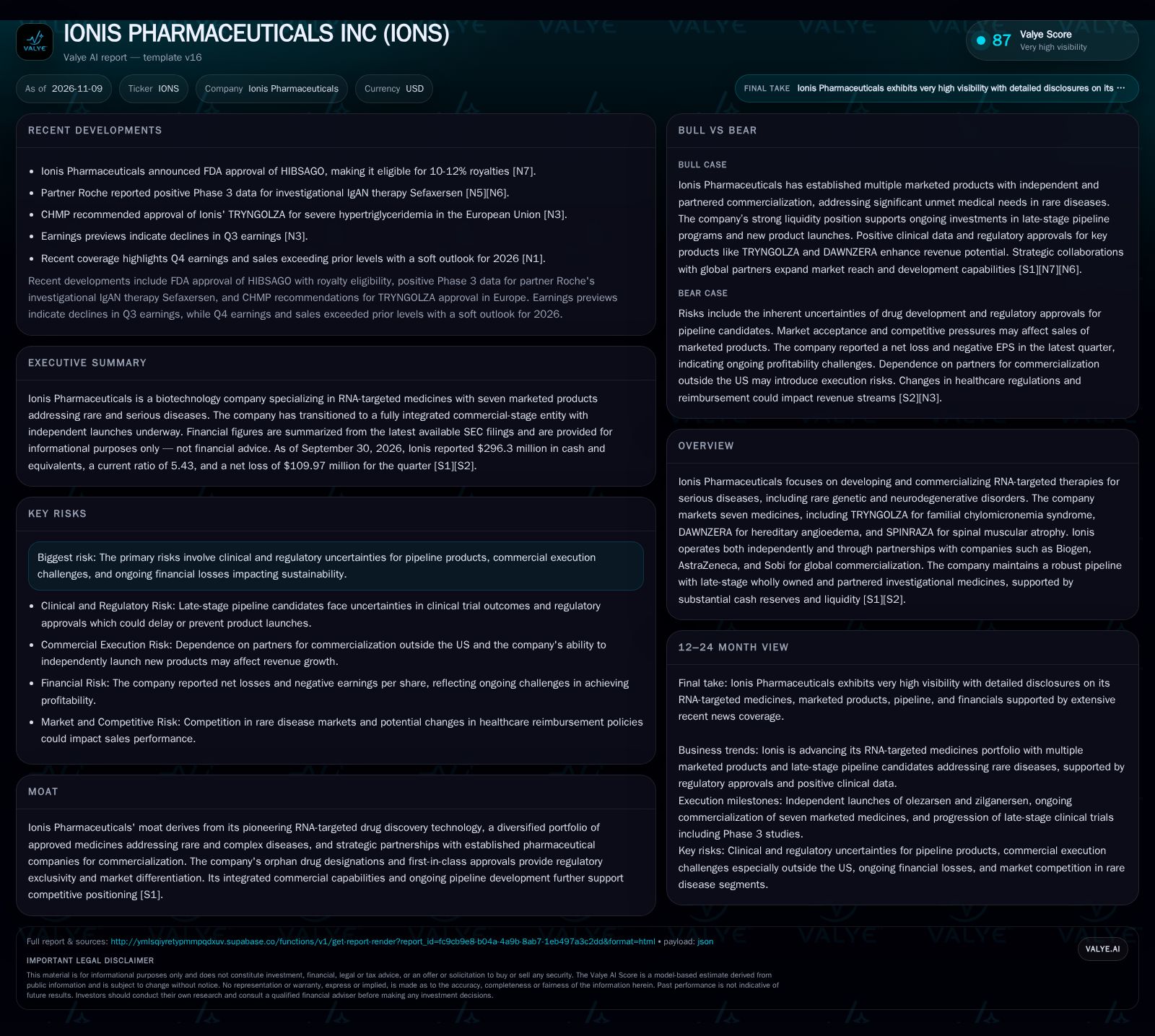
The most material recent developments for Ionis Pharmaceuticals include the FDA approval of HIBSAGO, which makes the company eligible for 10-12% royalties, and positive Phase 3 results for Sefaxersen, an investigational therapy for IgA nephropathy partnered with Roche [N7] [N6]. These events add new potential revenue streams beyond Ionis’s existing seven marketed RNA-targeted medicines. As of September 30, 2026, Ionis reported $296.3 million in cash and equivalents, a current ratio of 5.43, and a net loss of $109.97 million for the quarter [S2]. The company’s continued net losses highlight the tension between pipeline investment and the challenge of achieving commercial self-sufficiency. The question for investors is whether new launches and royalty/milestone income can offset ongoing R&D and commercialization costs quickly enough to alter the company’s financial trajectory.
RNA Platform Economics and the Royalty/Milestone Model
Ionis’s economics are defined by a hybrid of direct product sales and leveraged royalty/milestone streams from partnered programs. The company’s RNA-targeted drug platform is capital-intensive, requiring significant upfront R&D and clinical investment, especially for rare and ultra-rare diseases where patient populations are small but pricing can be high. Commercial-stage launches, like those for TRYNGOLZA, DAWNZERA, and HIBSAGO, may command premium pricing but face high fixed costs in manufacturing, regulatory compliance, and specialized sales infrastructure.
Royalty income—such as the 10-12% rate from HIBSAGO—offers high-margin, low-operational-burden revenue, but is contingent on partner execution and market uptake. Milestone payments from partners like Roche (Sefaxersen) and established relationships with Biogen, AstraZeneca, and Sobi diversify funding and smooth out cash flow volatility, but also reduce Ionis’s share of overall economics compared to wholly owned products. The economics will pivot on the pace of new launches, royalty stream scaling, and the ability to manage fixed costs as the commercial portfolio grows.
Orphan Drug Strategy, Platform Differentiation, and Competitive Threats
Ionis competes in the rare disease and RNA therapeutics space, where first-mover advantage, regulatory exclusivity, and deep platform expertise can confer durable advantages. Its orphan drug designations and first-in-class approvals provide periods of market protection, while the breadth of its RNA platform enables targeting of previously intractable diseases. Partnerships with large pharmas extend global reach and validate Ionis’s technology, but also create exposure to partner execution risk and potential loss of strategic control.
Counterforces include the growing number of RNA and gene therapy competitors, some with larger commercial footprints or differentiated delivery technologies. The transition to independent commercialization increases exposure to the high cost and complexity of rare disease drug launches, including reimbursement hurdles and the need to educate fragmented specialist prescriber bases. As more competitors enter the rare disease and RNA space, pricing pressure and the need for continuous innovation may intensify. Ionis’s competitive position will depend on its ability to sustain a pipeline of best-in-class or first-in-class therapies and to execute on both partnered and independent launches.
Pipeline Maturation and Royalty Leverage Drive a Breakout Revenue Inflection
A favorable scenario for Ionis would see rapid uptake of newly approved HIBSAGO, strong commercial execution by partners (notably Roche with Sefaxersen in IgA nephropathy), and successful independent launches of late-stage candidates. This would drive a step-change in royalty and milestone income, supplementing direct product sales and potentially pushing the company toward operating profitability. Additional upside could come from further pipeline readouts, new regulatory approvals, or expansion of label indications for existing drugs.
Evidence confirming this scenario would include sequential growth in royalty and milestone revenues, successful independent launches with robust initial sales, and announcements of new or expanded partnerships. A visible reduction in quarterly net losses or a shift to sustained profitability as product revenues scale would further validate the inflection. Conversely, delays in launches, weak partner sales, or disappointing pipeline data would falsify the breakout thesis.
Mixed Launch Execution and Gradual Pipeline Progress Sustain the Status Quo
The most plausible scenario is that Ionis achieves moderate growth through a combination of incremental product launches and steady royalty/milestone flows from partnered programs. Commercial execution for new launches may face friction—such as reimbursement delays or slow physician adoption—while some pipeline programs advance, but others encounter the typical attrition of late-stage biotech development.
Financially, Ionis may continue to report net losses as R&D and commercial expenses remain high relative to revenue. Evidence for this scenario would be stable or slowly improving revenue, continued but narrowing net losses, and a pipeline with both progress and setbacks. Confirmation would come from updates showing sequential growth in marketed product sales but no dramatic inflection in overall profitability.
Pipeline Setbacks and Commercial Friction Undermine the Transition to Profitability
An adverse scenario would involve pipeline setbacks—such as negative trial outcomes, regulatory delays, or safety issues—combined with disappointing uptake of newly launched or partnered products. This could result in stagnant or declining royalty and sales revenues, while fixed R&D and commercial costs remain high. Negative surprises from partner execution, such as Roche failing to convert positive Sefaxersen data into timely approval or strong sales, would further pressure the business model.
Confirmation would come from missed clinical milestones, lack of new approvals, or weak sales ramp for recently launched products. Persistently widening net losses and the need to raise additional capital would signal that Ionis is struggling to achieve operational leverage. In this scenario, market confidence in the platform and management’s ability to execute would likely erode, increasing the risk of dilution or strategic retrenchment.
Milestones and Metrics That Will Shape Ionis’s Rare Disease Trajectory
Quarterly revenue growth from direct product sales, especially for newly launched or independently commercialized medicines, would help assess commercial execution.
Royalty and milestone income trends—particularly from HIBSAGO and Sefaxersen—will indicate the strength and scalability of the partnered revenue model.
Clinical trial progression and regulatory milestones for late-stage pipeline candidates (if disclosed) are critical to future revenue potential and platform validation.
Partner performance, especially Roche’s commercialization of Sefaxersen, will be an indicator of the reliability and upside of Ionis’s partnership strategy.
Market uptake and reimbursement access for newly launched orphan drugs, as measured by sales ramp or payer coverage (if disclosed), would clarify pricing power and demand.
New partnership announcements or expansion of existing deals could signal external validation and provide additional non-dilutive capital.
Disclaimer: This is research-only, informational analysis and not investment advice. It may include AI-generated interpretation and general industry context. Always verify important details using primary sources.

Comments