
SHF Holdings: Cannabis Banking at a Crossroads—Compliance Platform Scale, Financial Strain, and the High Stakes of Industry Evolution
SHF Holdings’ Safe Harbor Program delivers much-needed compliant banking infrastructure for cannabis businesses, but recurring losses, indemnification risk, and a pending business combination with Opifex Media threaten both its financial stability and strategic focus. The company’s future hinges on its ability to stabilize revenue, manage unlimited loss exposure, and adapt to a rapidly evolving regulatory and industry landscape.
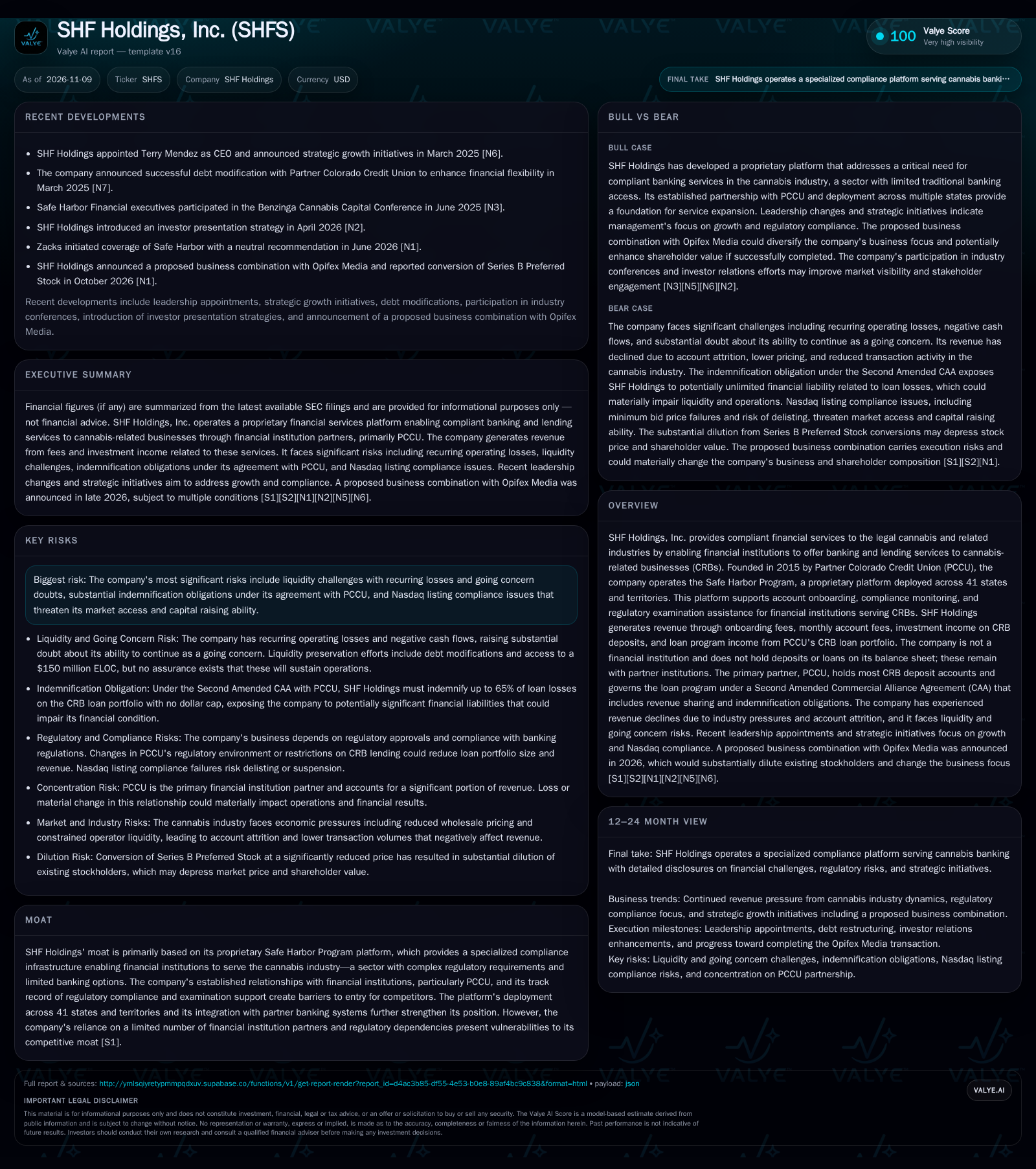
SHF Holdings operates a compliance-driven banking services platform for cannabis-related businesses, leveraging partnerships with financial institutions like PCCU. The company faces mounting economic and regulatory pressures, including recurring operating losses, a potentially unlimited indemnification burden, stockholder dilution, and Nasdaq compliance risk. Its proposed merger with Opifex Media could alter the company’s trajectory, but ongoing revenue decline and industry headwinds make execution and stability a major challenge [S1] [S2].
SHF Holdings, Inc. is a specialized provider of compliance-focused banking services to the cannabis sector—a segment historically underserved by traditional financial institutions due to regulatory complexity. Operating its Safe Harbor Program platform across 41 states and territories, SHF Holdings partners primarily with PCCU to facilitate business accounts, cash management, and lending for cannabis-related businesses. However, as the legal cannabis market faces pricing pressure and operator distress, SHF’s own financials have deteriorated, with recurring losses, increased indemnification risk, and a shrinking revenue base. The company’s survival now hinges on stabilizing operations, managing open-ended risk, and navigating the implications of a transformative merger proposal with Opifex Media [S1] [S2].
Deteriorating Revenue, Unlimited Indemnification Risk, and Strategic Uncertainty Define 2026
As of September 30, 2026, SHF Holdings reported $4.4 million in cash and equivalents, $1.4 million in short-term investments, and a current ratio of 1.59, but continues to face recurring operating losses and negative cash flows—conditions that raise substantial doubt about its ability to continue as a going concern [S2].
Revenue has declined due to account attrition, lower pricing, a shift to money market accounts that share interest with depositors, and overall reduced transaction activity in the cannabis industry [S2].
SHF Holdings’ Second Amended Commercial Alliance Agreement with PCCU exposes the company to indemnification of up to 65% of CRB loan losses with no dollar cap, a risk that could outstrip its available liquidity should portfolio performance deteriorate [S1] [S2].
In October 2026, SHF announced a proposed business combination with Opifex Media, subject to multiple approvals. This deal would substantially dilute existing shareholders and potentially pivot the business beyond its current focus [S2].
Fee-Based Platform Model Faces Revenue Compression and Open-Ended Liability
SHF Holdings’ economics are driven by a platform model: revenue streams include onboarding fees, monthly account and transaction fees, and a share of investment income from CRB deposits. The company also receives up to 65% of loan program income from PCCU’s CRB lending portfolio, but must indemnify up to 65% of loan losses with no dollar cap [S1] [S2].
SHF’s model is asset-light in that it does not hold deposits or loans on its own balance sheet, with partner institutions assuming direct regulatory and credit risk. However, the indemnification mechanism transforms the company’s liability profile by exposing it to potentially unlimited claims if the underlying CRB loan portfolio experiences significant losses.
Revenue compression has been driven by industry-wide declines in cannabis pricing, operator distress, and competitive pressures forcing lower fees and higher interest-sharing arrangements. The introduction of money market accounts—where SHF shares more interest with depositors—has further eroded net fee income [S2].
Operating leverage is limited by recurring fixed costs for compliance, technology maintenance, and regulatory support, while variable costs may rise if indemnification claims increase. The company’s negative cash flows and lack of direct deposit/lending relationships constrain its ability to scale profitably without new capital or a fundamental industry rebound.
Specialized Cannabis Compliance Creates Barriers—But Reliance on PCCU and Regulatory Headwinds Erode Moat
SHF Holdings’ Safe Harbor Program addresses a real pain point for cannabis-related businesses, which struggle to access compliant banking services due to federal restrictions. The company’s integration with 41 states and territories and its regulatory compliance infrastructure create moderate barriers to entry for new fintech or banking competitors [S1].
However, the moat is eroded by two factors: first, the heavy reliance on PCCU as the primary partner and revenue source, which creates concentration risk; second, the indemnification obligation, which may deter other institutions from similar arrangements or limit SHF’s ability to diversify.
Competitors include other compliance-focused banking platforms, regional credit unions, and larger fintechs exploring cannabis banking as regulations evolve. Should federal reform occur or mainstream banks enter the market, SHF’s specialized position could face significant margin and retention pressure.
Switching costs for institutional partners are moderate, based on compliance integration and regulatory familiarity, but not insurmountable if alternative platforms or direct banking access become available.
If Cannabis Banking Demand Rebounds and Risk Is Contained, SHF Could Leverage Its Platform Footprint
A favorable scenario for SHF Holdings would involve stabilization and recovery in the legal cannabis industry—driven by improved wholesale pricing, operator liquidity, or regulatory reform that increases transaction volumes and reduces account attrition.
If SHF can successfully renegotiate the indemnification terms or limit its liability exposure, the company could retain more of its fee income and reduce the risk of catastrophic loss. Expansion of its platform to new institutional partners beyond PCCU, or increased penetration in states with growing cannabis markets, would support revenue growth and margin stabilization.
Progress on the Opifex Media merger could provide new capital and strategic optionality if the transaction is structured to preserve or enhance the core compliance platform.
Confirmation would come from sequential revenue stabilization, new partner announcements, improved net fee income, and evidence of reduced indemnification payouts. Falsification would be indicated by continued account attrition, further revenue declines, or major indemnification charges.
Most Probable Course: Ongoing Revenue Drag, High Risk Exposure, and Uncertain Strategic Pivot
The most plausible path for SHF Holdings is continued revenue pressure as cannabis operators face margin compression and liquidity stress, causing further account attrition and lower transaction volumes. The company’s fee-based model will likely remain under strain as long as industry pricing and operator health remain weak.
PCCU will continue as the dominant partner, but the indemnification obligation will weigh on SHF’s risk profile and may limit its ability to attract additional institutional partners or negotiate more favorable terms.
Nasdaq compliance challenges and the potential for delisting will make capital raising more difficult, while the pending Opifex Media merger introduces uncertainty regarding business direction and shareholder value.
Evidence confirming this scenario would include flat or declining revenue, persistent operating losses, and ongoing dilution or strategic uncertainty. Falsification would require a marked recovery in cannabis industry financial health, successful liability renegotiation, or a value-enhancing completion of the merger.
Major Loan Losses, Delisting, and Failed Pivot Could Trigger Financial Distress or Restructuring
The adverse scenario centers on SHF Holdings being forced to honor large indemnification claims due to credit deterioration in the PCCU CRB loan portfolio. Given the unlimited nature of this liability and the company’s reported liquidity position, a major loss event could quickly exhaust available resources and force debt restructuring or insolvency.
If the proposed business combination with Opifex Media fails to close or does not deliver sufficient capital or business diversification, SHF would remain exposed to ongoing losses with limited avenues for recapitalization, especially if delisted from Nasdaq.
Further dilution from preferred stock conversions could depress the market price, erode investor confidence, and hamper the company’s ability to attract new capital or partners.
Confirmation of this scenario would be large indemnification payouts, breach of Nasdaq listing requirements, failed merger execution, and rapid balance sheet deterioration. Falsification would require avoidance of major losses, successful capital infusion, and a credible business transition.
Milestones That Will Reveal SHF Holdings’ Resilience—or Fragility—in Cannabis Banking
Sequential revenue growth or stabilization following recent declines would indicate whether the company’s core platform is regaining traction or continuing to lose ground.
Disclosure of new institutional banking partners beyond PCCU would signal diversification and reduced concentration risk.
Actual dollar amount of indemnification claims paid or reserved, if disclosed, would help gauge the scale of contingent liability and its impact on liquidity.
Progress milestones or material updates on the Opifex Media merger—including regulatory approvals, shareholder votes, and terms affecting dilution and business direction.
Nasdaq listing compliance status—specifically, whether the company regains and maintains minimum bid price and other requirements, or faces delisting.
Cash burn rate and changes in working capital, especially in relation to potential indemnification events or merger transaction costs.
Retention rates for CRB accounts and net new account onboarding, if disclosed, would clarify customer momentum versus attrition.
Fee income margin trends, especially the impact of interest-sharing on money market accounts versus traditional deposit products, would help test the thesis.
Disclaimer: This is research-only, informational analysis and not investment advice. It may include AI-generated interpretation and general industry context. Always verify important details using primary sources.

Comments