
Quanterix 2026: Biomarker Platform Scale, IP Defensibility, and the Stakes of Sustained Losses
Quanterix’s advanced biomarker detection technologies anchor its growth ambitions, but ongoing net losses and persistent intellectual property risks highlight a business model where scientific leadership must be matched by commercial and legal execution.
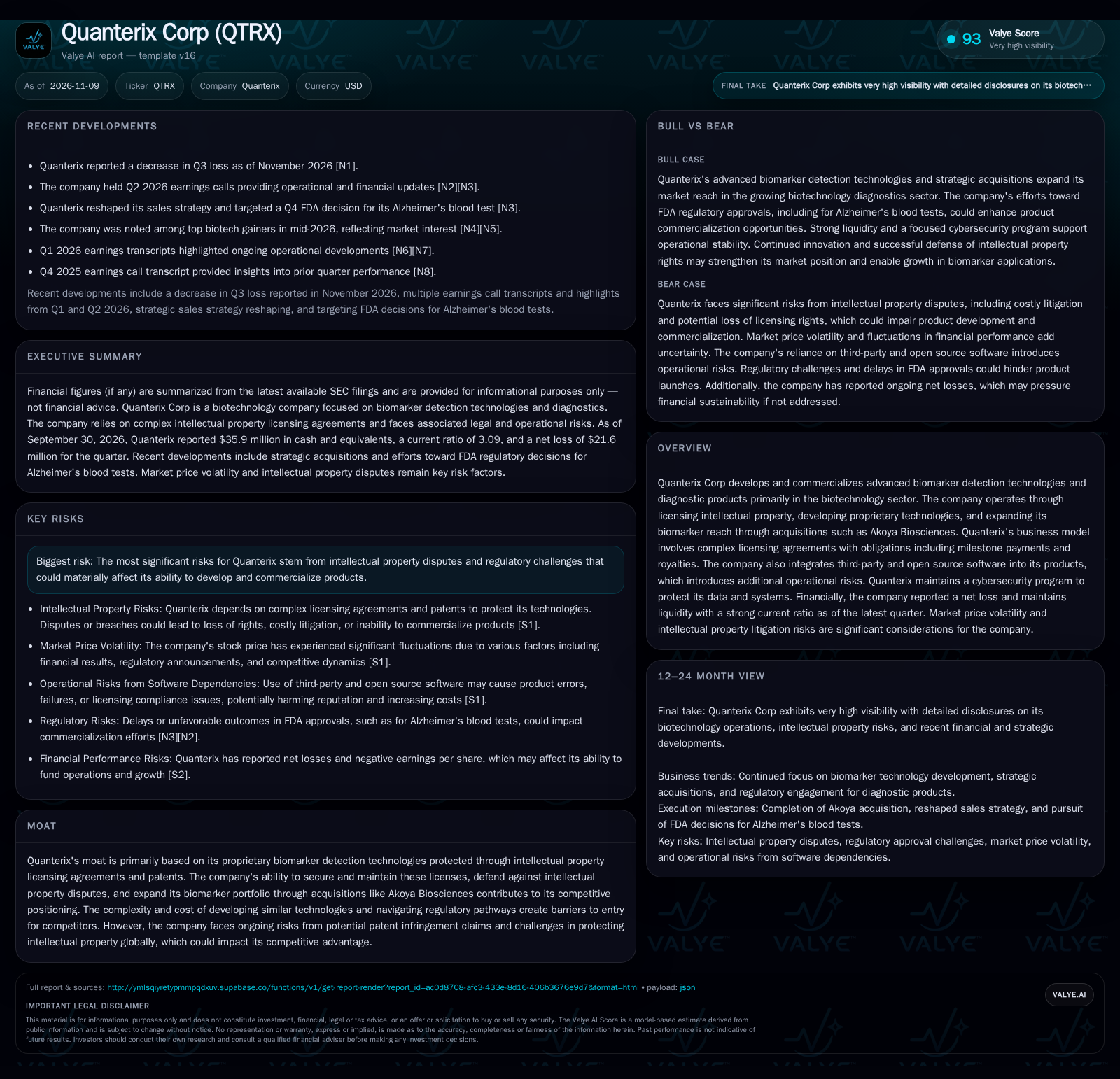
Quanterix develops advanced biomarker detection platforms and diagnostics, leveraging proprietary technologies and complex licensing agreements. As of September 2026, the company posted a net loss of $21.6 million but reported liquidity-ratio trends above 3.0 and $35.9 million in cash [S2]. While its technology and IP portfolio could support long-term growth, ongoing losses and legal risks around intellectual property enforcement and software dependencies remain material. The company’s future will depend on its ability to defend its IP, achieve commercial adoption, and control operational risks.
Quanterix Corp sits at the intersection of advanced diagnostics and biotechnology, offering proprietary biomarker detection platforms with applications across research and clinical markets. While the company’s technology base and intellectual property portfolio provide a potential competitive edge, its financial profile remains challenged by sustained net losses and a reliance on complex licensing and software arrangements.
Recent Financials and Risk Landscape Define the Near-Term Outlook
As of September 30, 2026, Quanterix reported a net loss of $21.6 million for the quarter, with basic and diluted EPS at -$0.46. The company reported cash and liquidity metrics for the period; these figures do not by themselves establish operating runway, investment capacity, financial flexibility, or financing capacity. [S2] These figures underscore the company’s ongoing challenge in achieving profitability despite a reported balance sheet position. Beyond the numbers, Quanterix’s business remains deeply exposed to intellectual property disputes, particularly around its core biomarker detection technologies and complex licensing agreements [S1]. The use of third-party and open source software further exposes the company to operational and compliance risks, adding another layer of uncertainty to the business model [S1].
How Quanterix’s Platform Could Translate Innovation into Earnings
Quanterix’s core economic engine is its suite of proprietary biomarker detection technologies—likely delivered through a mix of hardware platforms, consumables, and potentially recurring software or service revenue. The company’s reliance on intellectual property licensing introduces both recurring and milestone-dependent cash flows, but also creates obligations such as royalty payments and legal diligence requirements [S1]. The economics of this model can be attractive if adoption scales: consumables and software typically carry high gross margins, while installed hardware platforms can establish a base for recurring revenue. However, fixed costs associated with R&D, regulatory compliance, and litigation are significant, and the need to continually defend and enforce IP rights can create unpredictable legal expenses.
Capital requirements are moderate for a platform diagnostics company relative to drug developers, but Quanterix’s ongoing net losses suggest that current revenues are insufficient to cover fixed costs. [S2] If Quanterix can increase installed platform count and drive up consumable pull-through, operating leverage could improve, but this is not yet evident in the latest financials.
Defending a Niche: Technology, IP, and the Realities of Diagnostic Competition
Quanterix’s primary competitive advantage lies in its proprietary biomarker detection technologies, which are protected by a web of patents and licensing agreements [S1]. The moat is reinforced by the technical complexity and regulatory hurdles required to develop and commercialize similar platforms—barriers that can deter new entrants or slow fast followers. However, this competitive position is not absolute. The risk of IP disputes, especially in international markets where enforcement can be inconsistent, remains high [S1].
Competitor categories include established life science toolmakers, diagnostics giants, and emerging biotech firms with alternative detection modalities (e.g., next-generation sequencing, multiplex immunoassays, or digital PCR). While Quanterix may have a lead in sensitivity or multiplexing capability, technology substitution is an ongoing threat if rivals develop platforms that deliver comparable results with lower cost or greater ease of use. Switching costs for end-users are typically moderate in research settings but could be higher in clinical labs if workflow integration is deep. Ultimately, the company’s long-term edge will depend on the defensibility of its IP, continued technical differentiation, and the ability to convert scientific leadership into sticky customer relationships.
If Platform Adoption and IP Defense Accelerate, a Path to Profitable Scale Emerges
A favorable scenario for Quanterix would see rapid adoption of its biomarker platforms across both research and clinical markets, leading to a growing installed base and increasing pull-through of high-margin consumables and software. This could be catalyzed by successful expansion into new biomarker applications, validation in high-profile studies, or regulatory approvals that open clinical reimbursement pathways. If the company is able to defend its intellectual property portfolio—winning or avoiding costly litigation—it could limit competitive encroachment and sustain premium pricing.
Confirming evidence would include a material uptick in platform placements, growth in recurring consumables revenue, announcements of new licensing deals or major partnerships, and resolution or favorable outcomes in major IP disputes. Falsification would come from stagnant or declining adoption rates, ongoing or escalating legal challenges, or margin compression due to pricing pressure from rivals.
Scientific Progress Continues, but Commercial and Legal Frictions Persist
The most plausible near-term trajectory is one where Quanterix continues to advance its biomarker technology and expands its application footprint, but faces persistent operational and legal headwinds. Revenues may grow as platform adoption expands incrementally, yet high fixed costs, ongoing net losses, and the need for active IP defense prevent a clean inflection to profitability.
Confirming evidence for this scenario would be continued reporting of net losses despite modest revenue growth, periodic legal expenses tied to IP enforcement, and a stable or slightly improving liquidity position. Failure to break out of this cycle could eventually force strategic decisions around cost structure, capital raising, or portfolio focus.
Legal Setbacks or Stalled Adoption Could Trigger a Strategic Reset
Adverse outcomes for Quanterix could be driven by major legal defeats that undermine its IP portfolio, leading to loss of licensing revenue, erosion of competitive differentiation, or costly settlement obligations. Alternatively, if new or existing competitors offer superior or cheaper biomarker platforms, or if regulatory changes slow clinical adoption, Quanterix could see platform placements stall and consumable revenues plateau or decline.
Downside confirmation would come from material adverse legal rulings, public loss of key patents, significant customer churn, or a dramatic sequential decline in cash reserves with no clear path to profitability. In this scenario, the company might be forced to seek strategic alternatives, divest assets, or raise dilutive capital.
What Will Determine Whether Quanterix Converts Innovation into Defensible Growth?
Quarterly trends in platform placements and installed base growth, if disclosed, would provide leading indicators for future consumable and service revenue.
Consumables and software revenue as a percentage of total sales—higher ratios would suggest recurring revenue scale and improved gross margins.
Resolution and frequency of intellectual property disputes, including both litigation outcomes and new licensing agreements, will test the durability of Quanterix’s moat.
Operating expense levels relative to revenue growth: persistent negative leverage would pressure the company’s path to profitability.
Adoption rates of new biomarker applications or clinical use cases, as evidenced by regulatory approvals or major customer wins.
Incidents or disruptions related to third-party or open source software, as these could lead to product recalls, customer dissatisfaction, or increased compliance costs.
Disclaimer: This is research-only, informational analysis and not investment advice. It may include AI-generated interpretation and general industry context. Always verify important details using primary sources.

Comments