
Delcath Systems 2026: Commercial Inflection, Supply Chain Stakes, and the Challenge of Niche Oncology Expansion
Delcath Systems has transitioned to commercial-stage operations, reporting Q3 2026 profitability and building out its infrastructure on the back of HEPZATO’s US launch. The company’s path forward hinges on expanding market adoption, managing supply risk for critical components, and navigating the reimbursement and competitive complexities of the metastatic uveal melanoma market.
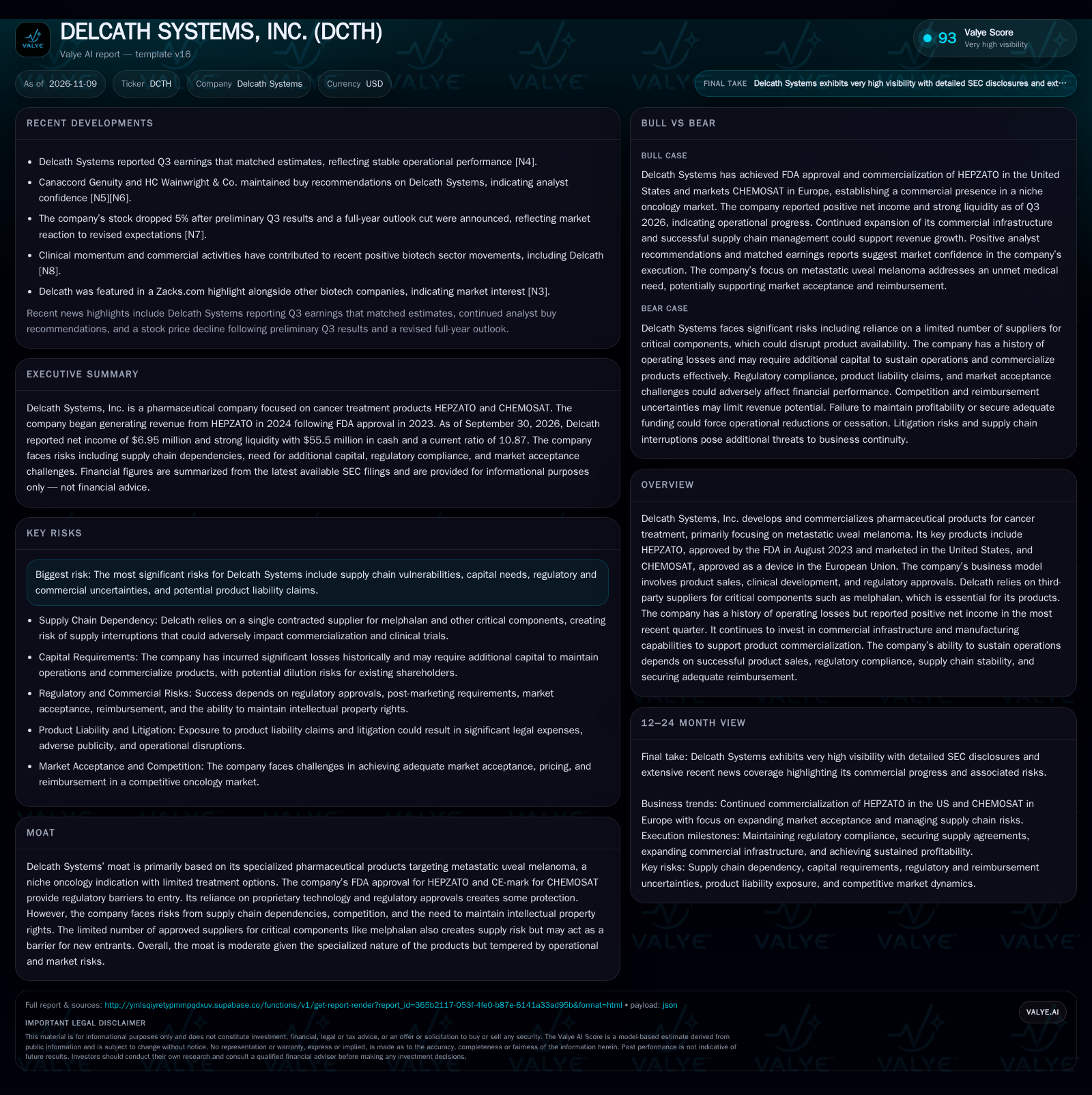
Delcath Systems reported positive net income in Q3 2026 as HEPZATO sales ramp in the US, supported by reported liquidity position and ongoing investment in commercial infrastructure. The company’s long-term trajectory will be shaped by its ability to drive adoption in the niche mUM segment, secure reliable supply of melphalan, and address reimbursement and competition risks in both the US and EU markets. Execution risk remains high given the company’s limited commercial track record and supply chain dependencies. [S2]
Delcath Systems stands at a crucial inflection point in late 2026. With HEPZATO now FDA-approved and generating revenue in the US and CHEMOSAT marketed in Europe, the company has posted its first profitable quarter after a long history of losses. Yet, this progress comes with significant caveats: Delcath’s future depends on deepening market penetration for its niche oncology platforms, managing acute supply chain vulnerabilities, and overcoming the structural hurdles of reimbursement and competition in cancer care. The next phase will test whether Delcath can translate this early commercial momentum into durable growth and sustained profitability.
From Approval to Profitability: The 2026 Operating Landscape
Delcath Systems reported a net income of approximately $6.95 million for Q3 2026, a notable milestone for a company with a history of operating losses. This result coincides with the commercial launch of HEPZATO in the US, following FDA approval in August 2023, and ongoing CHEMOSAT sales in Europe. The company reported cash and liquidity metrics for the period; these figures do not by themselves establish operating runway, investment capacity, financial flexibility, or financing capacity. However, this financial progress is counterbalanced by operational risks: the company remains heavily dependent on a single supplier for melphalan—a critical component for both HEPZATO and CHEMOSAT—and faces the challenge of scaling its commercial infrastructure while maintaining compliance and supply continuity. Analyst buy recommendations and recent news coverage reflect both confidence in management’s execution and market apprehension following a downward revision of full-year outlooks. [S2] [N4] [N5] [N6] [N7]
Revenue Drivers, Cost Structure, and the Economics of Niche Oncology
Delcath’s core revenue streams are derived from sales of HEPZATO in the US and CHEMOSAT in the EU. HEPZATO’s FDA approval allows the company to sell a bundled pharmaceutical-device solution directly to US healthcare providers, while CHEMOSAT is marketed as a device in Europe, with physicians sourcing melphalan separately. This distinction implies different pricing and margin structures—US sales may benefit from higher per-procedure pricing and pharmaceutical margins, while EU sales are likely more device-centric with lower bundled economics.
The company’s cost base includes manufacturing, licensing, and ongoing investments in commercial infrastructure and regulatory compliance. Given the specialized nature of mUM treatment and the need for clinical support, Delcath’s model likely involves high-touch sales and medical education, which may limit near-term operating leverage. Over time, increased procedure volumes could drive margin expansion if fixed costs are leveraged and supply chain risks are mitigated. However, the reliance on a single melphalan supplier constrains negotiating leverage and exposes Delcath to potential cost spikes or supply disruptions, which could erode gross margins.
Capital requirements remain substantial: Delcath funds operations through a mix of product revenue, private placements, public offerings, and debt. The sustainability of profitability will depend on balancing growth investments with the ability to manage variable and fixed costs as market adoption scales. [S2]
Specialization as Differentiator—But Not Moat: Competitive Forces in Oncology Delivery
Delcath’s strategic focus on metastatic uveal melanoma (mUM)—a challenging and relatively underserved oncology segment—affords it some competitive insulation, as few alternatives exist for liver-directed therapy. The FDA approval of HEPZATO and CE-marking for CHEMOSAT offer regulatory barriers for new entrants. However, these advantages are inherently limited: the company’s moat is moderate, relying on proprietary technology, regulatory exclusivity, and first-mover status in a niche market.
Competition is not absent. Broader oncology players, interventional device manufacturers, and pharmaceutical firms developing systemic therapies or alternative liver-targeted approaches could encroach on Delcath’s addressable market. Additionally, the company’s dependence on a limited supplier base for melphalan—rather than vertical integration or diversified sourcing—weakens its bargaining position and operational resilience. Pricing power is constrained by hospital budget pressures and the need to demonstrate cost-effectiveness in a value-driven healthcare environment, especially as payers increasingly scrutinize new oncology treatments.
Switching costs for clinicians are moderate: while adoption of a new interventional platform requires training and workflow adaptation, the ultimate driver of retention will be clinical efficacy, safety, and reimbursement. If competitors offer simpler, less resource-intensive, or more widely reimbursed alternatives, Delcath’s position could erode. The company’s ongoing investment in physician engagement and real-world evidence generation may help bolster its standing but does not eliminate these structural risks.
What Could Unlock Durable Growth: Expanding Adoption and Mitigating Supply Risk
A favorable scenario for Delcath would see accelerated adoption of HEPZATO in the US as oncologists and interventional radiologists become more comfortable with the procedure and reimbursement stabilizes. If the company secures multi-source, long-term supply agreements for melphalan, it could reduce operational risk and improve margin visibility, enabling more aggressive commercial investments. Expansion of CHEMOSAT indications or new geographies in Europe could further diversify revenue.
Key confirming signals would include consistently increasing quarterly procedure volumes, expansion into additional cancer indications, successful renegotiation or expansion of supplier contracts, publication of positive real-world outcomes, and improved reimbursement coverage. Sustained profitability over multiple quarters, coupled with rising analyst price targets or new partnerships, would further validate the upside thesis.
Potential falsifiers would be stagnant or declining US HEPZATO procedure counts, persistent supply bottlenecks, or negative trends in gross margins due to supplier leverage. If new competitors with superior outcomes or lower procedural burden gain traction, Delcath’s growth could stall despite existing approvals.
Commercializing in a Niche: Moderate Growth Tempered by Execution and Supply Constraints
The most plausible near-term outlook for Delcath is steady but measured growth in HEPZATO adoption within the US mUM segment, accompanied by ongoing but limited CHEMOSAT sales in Europe. Revenue expansion is likely to be gradual as the company builds commercial infrastructure, educates clinicians, and navigates payer dynamics. Supply chain risk—especially the reliance on a single melphalan supplier—remains a persistent constraint, with the company needing to secure additional agreements to de-risk operations.
Profitability may fluctuate as Delcath invests in salesforce expansion, medical education, and post-marketing studies required for reimbursement and label expansion. Gross margins could remain under pressure if supplier costs rise or if the company is forced to accept less favorable terms to secure melphalan. A confirming sign for this scenario would be a pattern of modest quarter-over-quarter revenue growth, stable gross margins, incremental expansion in procedure volumes, and periodic capital raises to fund continued commercialization.
Evidence against this scenario would include a sharp inflection in adoption, rapid international expansion, or breakthrough reimbursement wins, which would tilt the outlook toward the upside case. Conversely, a major supply disruption, regulatory setback, or unanticipated competitive challenge could force a reassessment toward the downside.
How Disruption Could Derail Progress: Supply, Adoption, and Funding Risks
The principal risk to Delcath’s thesis is a supply chain interruption—if the single contracted melphalan supplier faces regulatory action or contract disputes, both US and EU sales could halt abruptly, leading to revenue loss and reputational damage. Additionally, if market adoption of HEPZATO stalls due to reimbursement pushback, adverse clinical outcomes, or slow physician uptake, the company’s revenue base could shrink below breakeven.
On the financial side, persistent operating losses driven by higher-than-expected commercialization costs or litigation could force Delcath to access dilutive capital or restructure operations. A negative feedback loop may emerge if product recalls, adverse events, or litigation erode clinician and patient trust, making recovery difficult.
Concrete evidence for this scenario would include an announced supply disruption, significant revenue shortfall, withdrawal of analyst buy ratings, or a publicized product safety issue. Conversely, the absence of such events—combined with ongoing commercial execution—would refute the immediate downside case.
What Will Test Delcath’s Commercial Trajectory in the Next 12–24 Months
Quarterly HEPZATO procedure volumes and year-over-year growth rates, if disclosed, would be critical to gauge market penetration and adoption momentum.
Status and terms of any new or expanded melphalan supply agreements, including supplier diversification or vertical integration efforts.
Gross margin trends and cost of goods sold per procedure, as evidence of pricing power and supply chain resilience.
Updates on reimbursement coverage and payer acceptance for HEPZATO in the US and CHEMOSAT in EU markets.
Progress on commercial infrastructure buildout—such as salesforce expansion, physician training, and new hospital accounts onboarded.
Announcements of new clinical data, label expansions, or regulatory submissions that could broaden the addressable market.
Incidence and resolution of product recalls, adverse events, or litigation, as these could materially impact commercial momentum and brand reputation.
Capital raises, debt refinancing, or changes in liquidity position that signal evolving funding requirements or financial stress.
Disclaimer: This is research-only, informational analysis and not investment advice. It may include AI-generated interpretation and general industry context. Always verify important details using primary sources.

Comments