
ICF International’s Strategic Shifts and Financial Trajectory in 2025
A detailed examination of ICF International’s financial progress, evolving client profile, and technology integration shaping its outlook for coming years.
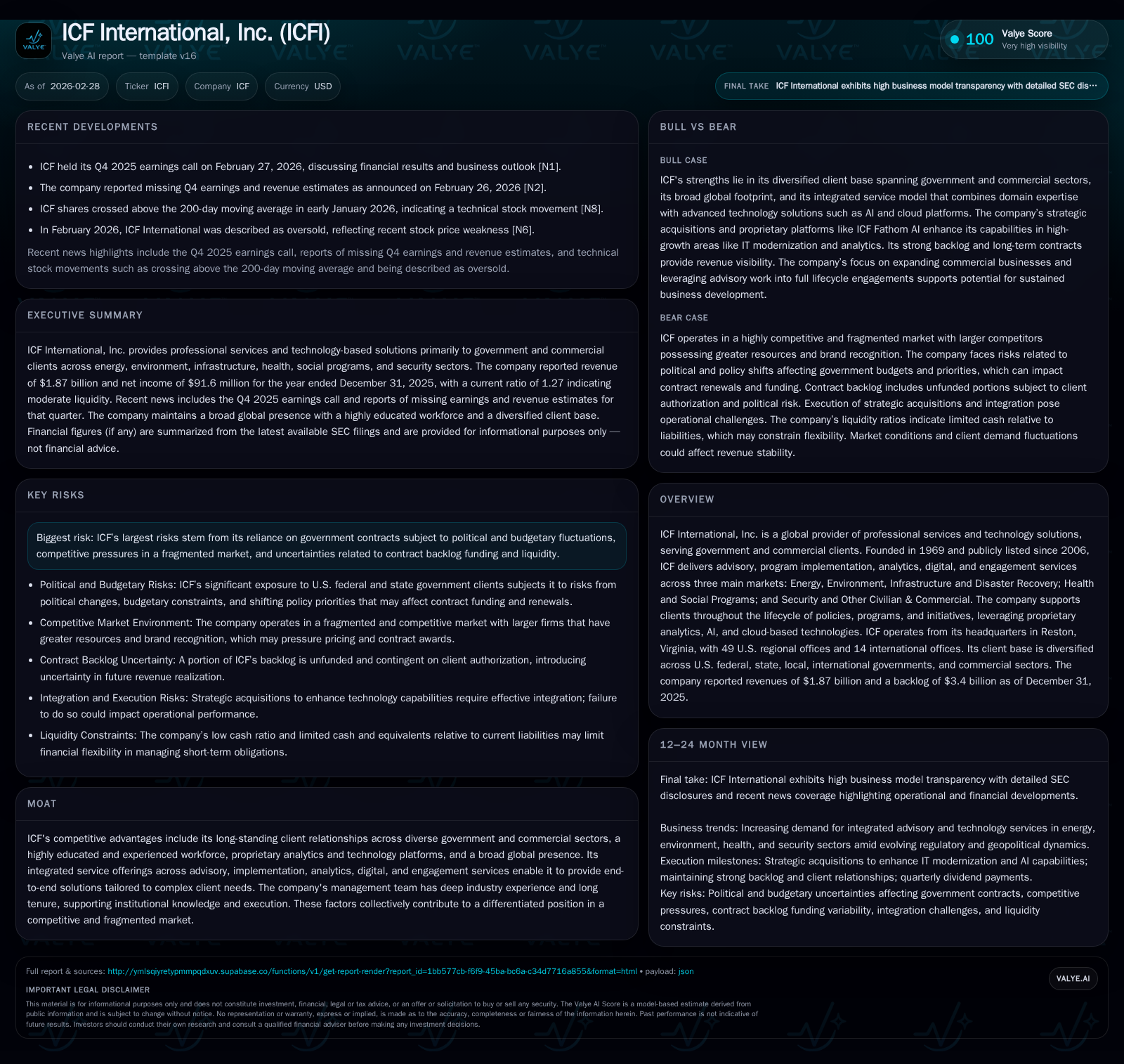
ICF International closed 2025 with a robust top-line growth of 10.9%, reaching $1.87 billion in revenue, driven by a strategic pivot toward commercial clients and technology-enabled services across energy, health, and security markets. Despite this revenue expansion, operating income and net income declined by 12.3% and 16.9%, respectively, reflecting margin pressures from cost dynamics and contract mix shifts. The company’s backlog slipped modestly to $3.4 billion, highlighting cautious demand in government-funded projects amid political budget uncertainties. Proprietary AI platforms and integrated digital offerings remain critical to ICF’s competitive positioning as it pursues life-cycle solutions and broader market penetration while rigorously managing cybersecurity risks under seasoned governance.
Historic Revenue Dynamics and Profitability Patterns
ICF International demonstrated steady top-line growth into fiscal year 2025, reporting revenues of approximately $1.87 billion—a 10.9% increase over the prior year—reflecting successful market expansion efforts [F1][S5].
Despite this growth, profitability metrics contracted during the same period: operating income declined by about 12.3% to $145 million while net income dropped nearly 17% to approximately $92 million [F1]. This divergence suggests margin pressures potentially linked to shifts toward lower-margin contracts or increased operational costs associated with expanding technology capabilities [S6].
Historical performance (annual)
| FY | Net ($mm) | CFO ($mm) | OpInc ($mm) | Capex ($mm) | Net YoY |
|---|---|---|---|---|---|
| 2025 | 92 | 142 | 145 | 22 | -16.9% |
| 2024 | 110 | 172 | 166 | 21 | +33.4% |
| 2023 | 83 | 152 | 132 | 22 | +28.6% |
| 2022 | 64 | 162 | 109 | 24 |
Source: SEC companyfacts cache [F1].
Capital returns and efficiency (annual)
| FY | Div ($mm) | FCF ($mm) | ROE% |
|---|---|---|---|
| 2025 | 10 | 120 | 8.9 |
| 2024 | 11 | 150 | 11.2 |
| 2023 | 11 | 130 | 9.0 |
| 2022 | 11 | 138 | 7.5 |
Source: SEC companyfacts cache [F1].
Note: Data sourced from annual filings illustrating recent financial trends [F1].
Client Mix Evolution and Contract Backlog Trends
A key dynamic influencing ICF’s revenue is the shift in client composition between government and commercial sectors. The U.S federal government’s share of revenue decreased from approximately 54% in fiscal year 2024 to about 43% in fiscal year 2025, reflecting tighter federal budgets and changing contract renewals [S7].
Conversely, commercial client revenue rose notably from roughly a quarter (24%) of total revenues in FY24 to about a third (33%) in FY25, indicating effective diversification through expanded advisory and technology-enabled services [S7].
Backlog—the contracted but unrecognized revenue—declined moderately from $3.79 billion at the end of FY24 to approximately $3.41 billion entering FY26 [S5][S13], primarily due to uncertainties around funded backlog tied to government programs amid volatile appropriations.
Technology-Driven Offerings: AI, Analytics, and Digital Integration
ICF’s investment in technology platforms underpins its competitive positioning across Energy & Environment, Health & Social Programs, and Security markets [S6][S12]. The launch of the proprietary ICF Fathom AI platform in 2025 exemplifies its focus on advanced analytics integration for policy lifecycle management.
This platform complements cloud modernization initiatives aligned with federal IT transformation priorities emphasizing scalability and security via zero-trust frameworks [S6]. These digital capabilities integrate with advisory expertise enabling comprehensive program lifecycle solutions.
Near-Term Financial Performance Challenges and Outlook
Q4 fiscal year-end results missed consensus estimates due partly to margin pressures from increased personnel investments supporting new technologies and backlog funding uncertainties amid political budget volatility affecting government contracts [N1][N2][S13].
Management notes that while commercial growth supports revenue expansion, careful cost control is essential given fluctuating funded work authorizations within federal programs.
Capital Allocation: Returns, Cash Flow, and Shareholder Distributions
ICF’s return on equity stands near an estimated 8.9%, based on net income relative to approximately $1.03 billion equity as of December 31, 2025 [F1]. Operating cash flow declined by about 17% year-over-year but free cash flow remained positive at roughly $120 million after capital expenditures totaling around $21.7 million focused on sustaining technology investments [F1].
Dividend payments have been stable near $10 million annually without recent share repurchases reported—reflecting a cautious approach balancing shareholder returns against reinvestment needs amid profit pressures [F1].
Cybersecurity Governance Supporting Operational Resilience
Robust cybersecurity risk management is embedded within ICF’s enterprise risk framework vital for maintaining trust with sensitive governmental clients [S1][S27]. The company adheres to NIST cybersecurity frameworks and ISO27001 standards utilizing multi-layered controls including next-generation firewalls, endpoint detection systems, encryption protocols, ongoing vulnerability assessments, and annual third-party penetration testing.
Board-level oversight is conducted primarily via the Audit Committee while senior management led by seasoned CIO/CISO roles manages operational response capabilities enhancing resilience against cyber threats.
No material cybersecurity incidents affecting operations or financial conditions have been reported to date.
Investor Considerations: Catalysts and Risks Ahead
Key factors influencing ICF’s future trajectory include:
- Backlog renewal rates amid federally funded project uncertainties driven by political appropriations cycles [N1][N2][S13];
- Continued commercial sector penetration leveraging AI/digital platform adoption;
- Execution risks managing cost structures alongside growth initiatives;
- Competitive pressures within a fragmented consulting marketplace;
- Regulatory scrutiny including audit risks related to disaster recovery contracts [S27];
- Ongoing cybersecurity risk management imperative given infrastructure protection mandates;
- Upcoming quarterly disclosures expected to provide clarity beyond recent Q4 softness.
This comprehensive perspective aids investors assessing ICF International's position within professional services addressing complex public-private missions based on disclosed financials and strategic narratives.[N1][N2][S17]
Disclaimer: This report is prepared solely for informational purposes emphasizing analytic perspectives on historical performance trends and documented company disclosures without providing investment advice or recommendations.
Disclaimer: This is research-only, informational analysis and not investment advice. It may include AI-generated interpretation and general industry context. Always verify important details using primary sources.

Comments