
Comprehensive Analysis of IES Holdings Inc: Engineering Electrical Infrastructure Across Diverse Markets
IES Holdings operates as a multi-segment electrical and technology infrastructure service provider, leveraging its technical expertise and acquisition strategy to navigate competitive and cyclical industrial landscapes.
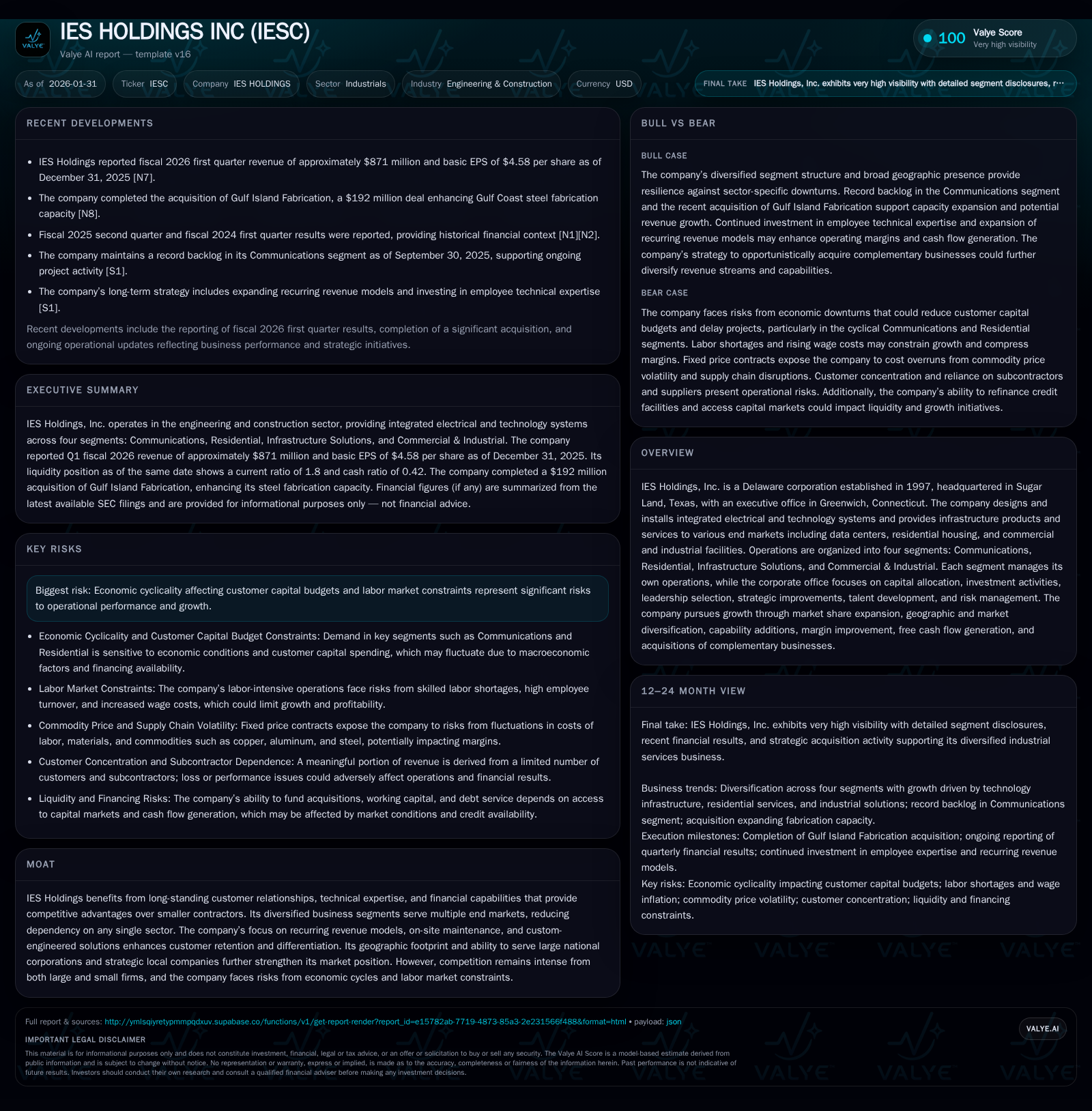
IES Holdings, Inc. is a diversified provider of integrated electrical and technology infrastructure services across communications, residential, infrastructure solutions, and commercial & industrial segments. Recent acquisitions like Gulf Island Fabrication bolster its industrial services footprint amid steady quarterly revenues. The company’s decentralized operational model allows segment-specific management while the corporate office drives capital allocation and strategic improvements. IES faces typical industry cyclicality and labor market constraints but differentiates via technical expertise, long-term customer relationships, and a recurring revenue model. Key risks include economic volatility, regulatory compliance, and maintaining liquidity in a capital-intensive environment.
What Changed Recently
In January 2026, IES Holdings reported its fiscal 2026 first quarter results, posting revenues of approximately $871 million, slightly below consensus estimates of $876 million [N3][N6]. The quarter reflects steady performance across its diversified business lines despite ongoing macroeconomic headwinds. Concurrently, IES completed a $192 million acquisition of Gulf Island Fabrication, a move that significantly enhances its Gulf Coast steel fabrication and electro-mechanical capacity, particularly benefiting its Infrastructure Solutions segment [N8][N9]. This acquisition aligns with IES’s corporate strategy of expanding capabilities and geographic reach through targeted acquisitions.
Additionally, quarterly results continue to reflect the cyclicality inherent in IES’s end markets, especially in communications infrastructure spending and residential construction, though the company’s recurring revenue streams in maintenance services provide some earnings stability [N1][N2][N3]. The firm announced ongoing strategic initiatives focusing on operational improvements, talent development, and risk management to bolster margins and cash flow generation [N3][S1].
Business Model as a System
IES Holdings operates through four autonomous yet complementary segments:
Communications: Nationwide provider of design, construction, and maintenance of data center communications infrastructure supporting co-location and managed hosting clients. This segment benefits from long-term contracts with large corporate clients and repeat customers, providing a recurring revenue base [S1][S3].
Residential: Regional electrical installation services for single-family homes and multi-family complexes, supplemented by HVAC and plumbing in select markets. The business scales with housing cycle dynamics and is driven by a mixture of national/regional builder relationships and localized sales efforts [S1][S8].
Infrastructure Solutions: Focused on electro-mechanical industrial services including apparatus repair, and custom-engineered products such as metal enclosed bus systems and generator enclosures for data centers and industrial applications. This segment is sensitive to capital investments in heavy industry and infrastructure, with customers distributed across numerous industrial verticals [S1][S4][S6].
Commercial & Industrial: Provides electrical and mechanical design, construction, maintenance, and emergency services for commercial buildings and industrial facilities. Projects range from data centers and office buildings to power infrastructure and renewable energy installations. This segment leverages regional expertise and long-term client relationships [S1][S7].
Each segment manages its own operational execution, including sales, project management, and service delivery. The corporate office concentrates on capital allocation, acquisitions, strategic initiatives, leadership appointments, and risk management oversight [S1][S2]. This decentralized model allows flexibility tailored to the distinct demand drivers and operational characteristics of each segment.
Acquisitions form a core part of IES’s growth strategy, with targets selected for proven management teams, low technological obsolescence, established market positions, and strong cash flow profiles [S2]. The recent Gulf Island Fabrication deal exemplifies this, enhancing scale and technical capability in industrial electro-mechanical services [N9].
Industry Map & Competitive Battlefield
IES operates in the highly competitive, fragmented U.S. electrical contracting and technology infrastructure market. Competitors vary from small, privately held local contractors to large, multi-national firms. Barriers to entry are generally low in residential and some commercial markets, leading to intense price and service competition [S3][S7][S8].
However, IES leverages several competitive advantages:
Technical Expertise: Advanced engineering and custom design capabilities differentiate it in complex industrial and data center projects.
Financial Strength: Access to capital allows bidding on large, multi-year projects and strategic acquisitions.
Customer Relationships: Longstanding, repeat customers and preference as a provider enhance project pipeline visibility.
Geographic Footprint: Operations across 28 states with 174 locations enable proximity to customers and rapid service response.
Recurring Revenue Models: On-site maintenance and emergency services create more stable cash flows amid project-driven volatility.
Industry trends influencing IES include accelerating data center buildouts, aging U.S. infrastructure requiring upgrades, and growing demand for renewable energy installations [S4][S7]. Conversely, labor shortages and commodity cost inflation impose operational pressures.
Where the Economics Become Real
IES’s unit economics are heavily influenced by project size, geographic location, labor availability, and commodity costs. Large, complex projects like data centers and industrial infrastructure yield higher margins but carry greater bidding and execution risks due to long duration and cost uncertainties [S3][S7].
Residential segment economics depend on housing starts and builder relationships, with the ability to scale up or down due to a relatively variable cost structure [S8]. Infrastructure Solutions and Commercial & Industrial segments have a mix of custom-engineered product sales, service contracts, and project-based revenue. The custom products side benefits from higher margin and limited competition due to technical specificity [S6].
Margin drivers include:
Labor Efficiency: Skilled workforce productivity directly impacts cost control.
Project Management: Accurate bidding and execution mitigate overruns.
Commodity Price Risk Management: Early procurement and contract escalation clauses help offset raw material cost volatility, though not all contracts provide full protection [S13].
Recurrence of Service Revenues: Maintenance and emergency service contracts provide steadier cash flow and margin stability.
Financially, as of December 2025, IES reported a current ratio of roughly 1.8, with $88.8 million in cash and equivalents against $616 million in current liabilities, reflecting an adequate liquidity buffer to support working capital and acquisitions [Sourced XBRL].
Capital allocation balances organic investment with opportunistic acquisitions to enhance capabilities and geographic reach. Debt levels and credit facility covenants require ongoing monitoring to maintain financial flexibility [S9][S10].
Diligence Questions / Disconfirming Signals
How will integration risks from the Gulf Island Fabrication acquisition affect near-term operational performance and margins?
To what extent does IES’s bidding process and project management mitigate risks of cost overruns and margin erosion on long-term projects?
How sensitive is the business to fluctuations in labor availability and wage inflation across its diverse geographic footprint?
What is the proportion of contracts that include commodity escalation clauses, and how has recent raw material inflation impacted unprotected projects?
How diversified and sticky are the recurring revenue streams, particularly in maintenance and on-site services, in cushioning economic downturns?
Are there any pending litigation, latent defect claims, or regulatory compliance issues that could materially affect financial results or reputation?
How exposed is the company to cybersecurity threats, given its role in critical data center infrastructure, and what mitigation efforts are in place?
How does the company balance the competing demands of geographic diversification with maintaining local market expertise and relationships?
What are the company’s strategies to manage potential environmental liabilities or remediation costs in its Infrastructure Solutions segment?
How might shifts in tax laws or credit market conditions impact capital access and cash flow generation?
IES Holdings occupies a complex position as a diversified electrical and technology infrastructure services provider with a multi-segment operational model designed to capture growth across a range of end markets. Its recent acquisition activity and ongoing strategic initiatives underscore a commitment to scale, technical differentiation, and operational rigor. Nonetheless, the company must navigate cyclical demand, competitive pressures, and operational risks inherent to large-scale construction and maintenance services. Close attention to project execution, integration of acquired businesses, and managing labor and commodity cost dynamics will remain critical to sustaining profitability and cash flow. This analysis is grounded in publicly available information as of early 2026 and does not constitute investment advice.
This report is prepared for informational purposes only and does not constitute a recommendation to buy or sell securities.
Disclaimer: This is research-only, informational analysis and not investment advice. It may include AI-generated interpretation and general industry context. Always verify important details using primary sources.

Comments