
Integrated Electrical & Tech Systems Provider Navigates Cyclicality and Expansion Challenges
IES Holdings Inc. delivers diversified electrical and technology infrastructure services across multiple segments, balancing organic growth with strategic acquisitions amid economic and labor market headwinds.
IES Holdings operates through four distinct segments serving data centers, residential, industrial, and commercial markets, leveraging long-term customer relationships and technical expertise to maintain competitive positioning. Recent results show stable revenue generation and margin resilience, supported by acquisitions such as Gulf Island Fabrication to expand capabilities. The firm’s decentralized operational model and capital allocation focus underpin its expansion, but faces margin pressure from cyclicality, commodity costs, and labor constraints. Careful monitoring of project mix, integration success, and regulatory risks is essential to understanding near-term performance dynamics.
What Changed Recently
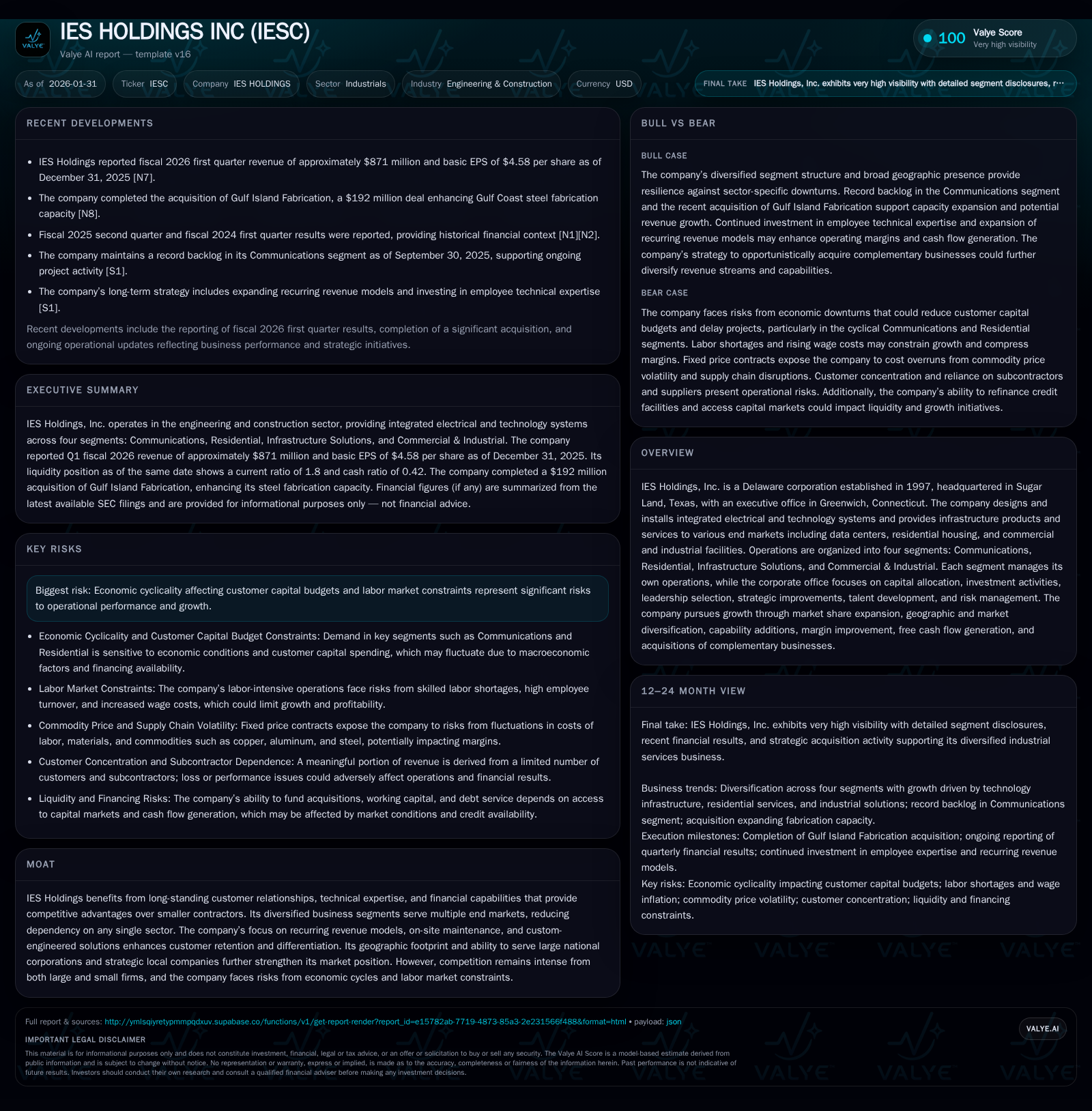
IES Holdings reported its fiscal 2026 first quarter results with revenues of approximately $871 million, slightly below the FactSet consensus estimate of $876 million, reflecting a modest shortfall primarily due to timing differences in project completions [N3][N6]. The quarter underscored ongoing tightness in the macro environment impacting customer capital spending, particularly in the Communications segment, which is sensitive to data center infrastructure cycles. Margins held steady, supported by disciplined cost management and a steady stream of maintenance and service contracts [N3].
Notably, IES completed the acquisition of Gulf Island Fabrication, a $192 million deal that enhances its steel fabrication capacity along the Gulf Coast, significantly expanding Infrastructure Solutions’ capabilities and geographic reach [N8][N9]. This acquisition aligns with the company's long-term strategy of strategic bolt-ons that complement existing segments and broaden service offerings.
Market commentary highlights IES as a 'silent beneficiary' of ongoing digitalization trends, particularly through its Communications segment servicing data center infrastructure, which remains a growth vector despite cyclicality in capital expenditures [N11].
Business Model as a System
IES Holdings operates as a decentralized conglomerate of electrical and technology services organized into four reportable segments: Communications, Residential, Infrastructure Solutions, and Commercial & Industrial. Each segment operates with operational autonomy, managing day-to-day activities, while the corporate office focuses on capital allocation, strategic investments, leadership development, and risk management [S1].
Communications: Provides design, build, and maintenance of data center communications infrastructure nationwide. This segment serves large corporations and independent businesses, relying on long-term contracts and repeat customers, with relatively low seasonality but exposed to cyclical capital spending in data center markets [S1][S3].
Residential: Focuses on electrical installation and increasingly HVAC and plumbing services for single and multi-family homes, primarily in Texas, Florida, and the Midwest. The segment benefits from long-standing relationships with national and regional homebuilders, though it faces seasonal and weather-related fluctuations [S1][S8].
Infrastructure Solutions: Offers engineered electro-mechanical products such as custom generator enclosures and bus systems, along with repair and maintenance services to industrial customers across multiple heavy industries. This segment is capital intensive and subject to economic and industrial end-market trends. The recent Gulf Island Fabrication acquisition expands its fabrication and service footprint significantly [S4][S6][N9].
Commercial & Industrial: Delivers electrical and mechanical design, construction, and maintenance services to commercial buildings, industrial facilities, and renewable energy projects. It operates regionally and nationally in certain niches, with a focus on complex projects including LEED-certified and design-build solutions [S5][S7].
The company’s corporate strategy emphasizes growth via market share, geographic expansion, capability additions, operating margin improvement, and free cash flow generation, with a particular focus on acquisitions of well-managed businesses with low obsolescence risk and strong cash flows [S2]. This approach aims to diversify revenue streams and reduce dependency on any single market or segment.
Industry Map & Competitive Battlefield
IES Holdings operates in a fragmented and highly competitive electrical contracting and infrastructure services industry. Competitors range from small, privately held local contractors with limited capital access to large multi-national firms. The competitive advantage derives from capital availability, technical expertise, long-term customer relationships, and the ability to deliver complex integrated solutions.
Communications competes on quality and reliability, leveraging financial strength and reputation to secure contracts in the capital-intensive data center market. The cyclical nature of data center buildouts imposes volatility, but the increasing demand for digital infrastructure supports growth potential.
Residential faces low barriers to entry, with many small contractors competing on price. IES differentiates through scale, local market knowledge, and broader service offerings (electrical, HVAC, plumbing), supported by training and customer relationships.
Infrastructure Solutions competes with both domestic and international manufacturers and repair shops. The segment’s product customization, geographic proximity, and engineering capabilities provide differentiation. The Gulf Island acquisition boosts competitive positioning in steel fabrication.
Commercial & Industrial competes in diverse markets including healthcare, education, manufacturing, and energy. The segment’s advantage stems from its broad service scope, design-build expertise, and maintenance offerings that provide recurring revenue streams.
Across segments, the company strives to pursue projects with higher barriers to entry where capital and expertise confer advantages, backed by a strong safety culture and regulatory compliance programs that mitigate operational risks [S3][S6][S13][S14].
Where the Economics Become Real
Unit economics at IES Holdings are nuanced by segment, project complexity, geographic location, and service mix:
Project bidding and management are critical to margin control, given the complexity and duration of many contracts, some spanning multiple years. Accurate cost estimation and timely execution mitigate risks of overruns and disputes [S13].
Recurring maintenance and service contracts across Communications and Commercial & Industrial provide more predictable revenue and better margin stability than one-time construction projects. Expansion of on-site maintenance programs is a stated strategic priority [S3].
Commodity price exposure impacts Infrastructure Solutions notably, with the company employing early procurement and contractual escalation clauses to shield margins; however, not all contracts provide full protection, creating risk on longer-term projects [S13].
Labor availability and costs remain a significant constraint, given the skilled labor needed for electrical and mechanical services. Labor shortages can lead to project delays and higher wage costs, pressuring margins [S3].
Geographic diversification reduces dependence on any single regional economy or market segment, smoothing revenue cyclicality. However, regional economic conditions and regulatory environments still impact local performance [S7].
Capital structure and liquidity are important enablers, with a current ratio of ~1.8 and nearly $89 million in cash supporting working capital and acquisition activity, though the company must carefully manage covenant compliance and refinancing risks [S9].
Acquisition integration economics are pivotal, as the company seeks to leverage scale and cross-selling opportunities from bolt-on platforms like Gulf Island Fabrication, which enhances fabrication capabilities and market reach [N8][N9].
Diligence Questions / Disconfirming Signals
Project Timing and Backlog Visibility: How does IES manage the inherent unpredictability of multi-year contracts and the impact of timing mismatches on quarterly results? What is the current backlog profile by segment, and how confident is management in project execution schedules?
Labor Market Risk: Given the tight skilled labor market, what is the company’s strategy for recruitment, retention, and labor cost control? Are wage inflation and labor shortages materially impacting margins or project delivery?
Acquisition Integration: What are the realized synergies and integration challenges from recent acquisitions such as Gulf Island Fabrication? Are there cultural or operational risks that could dilute expected benefits?
Commodity Price Volatility: How significant is the company’s exposure to metal and other commodity price fluctuations, especially in Infrastructure Solutions? Are escalation clauses sufficient to protect margins, or is there residual risk?
Economic Cyclicality Exposure: How sensitive is IES’s revenue and profitability to downturns in commercial construction and industrial capital spending? Are there early indicators of softening demand in key end markets?
Regulatory and Environmental Compliance: Does the company face any ongoing or potential regulatory challenges, particularly related to environmental remediation or safety incidents? How robust is the compliance framework in mitigating these risks?
Customer Concentration and Contract Terms: Are there any concentration risks with major customers? How favorable and flexible are contract terms with respect to pricing adjustments, change orders, and termination rights?
Balance Sheet and Liquidity: What is the company’s plan for managing debt maturities and potential refinancing needs? Are there covenant constraints that might limit operational flexibility?
Conclusion
IES Holdings demonstrates a strategically diversified platform in electrical and technology infrastructure services, balancing organic growth with targeted acquisitions to deepen capabilities. Its decentralized operating model allows segment-level focus, while corporate oversight drives capital allocation and risk management. The company’s competitive advantages lie in long-term customer relationships, technical expertise, and financial resources that enable bidding on complex projects. However, the business faces notable risks from economic cyclicality, labor market constraints, commodity price volatility, and regulatory compliance demands. Recent acquisition activity broadens service offerings but introduces integration execution risk. Close attention to project backlog quality, labor dynamics, and margin trends will be critical to assessing operational trajectory in the near term.
This analysis is based on publicly available information as of early 2026 and does not constitute investment advice. The information provided is intended for informational purposes only and may not reflect all material factors relevant to investment decisions.
Disclaimer: This is research-only, informational analysis and not investment advice. It may include AI-generated interpretation and general industry context. Always verify important details using primary sources.

Comments