
Immersion Corp's Shifting Royalty Mix and Geographic Focus Reshape Growth Prospects
Immersion’s transition from fixed fee licenses to growing per-unit royalties amid Asia-centric revenue underscores evolving recurring income patterns and key growth risks.
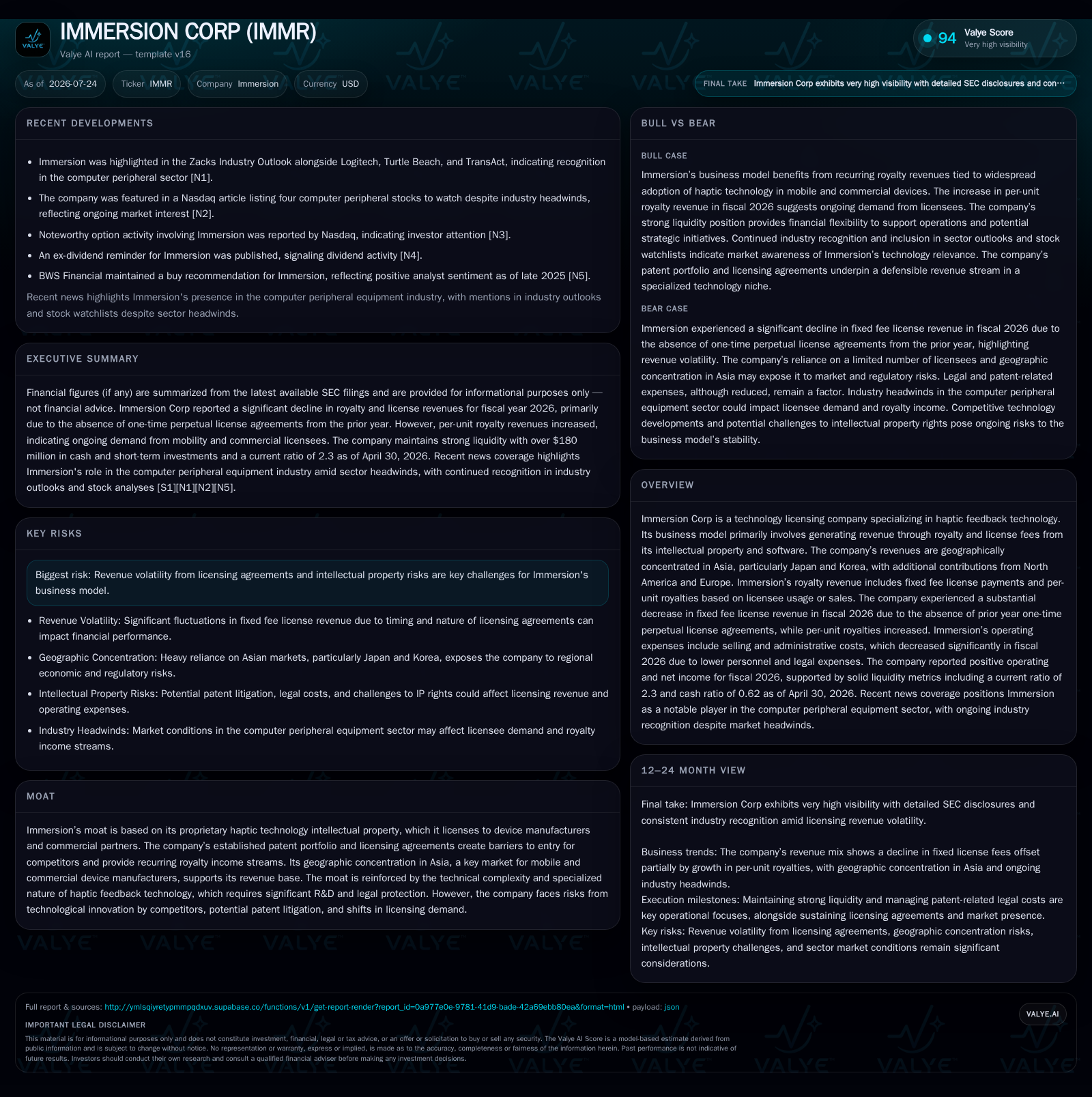
Immersion Corporation’s latest quarterly filing reveals a critical shift in its royalty revenue profile, marked by a notable decline in one-time fixed fee license income offset partially by increasing per-unit royalties, driven primarily by demand in Asian markets such as Japan and Korea. The company’s business model remains rooted in licensing proprietary haptic feedback technology intellectual property to device manufacturers, relying on recurring royalty streams rather than product sales. While the concentration of revenue in Asia aligns with mature device manufacturing hubs and growth opportunities in mobile and commercial segments, it also introduces geographic risk factors. Operationally, Immersion has effectively reduced selling and administrative expenses, particularly legal costs, enhancing profitability amidst volatile licensing demand. The company’s substantial patent portfolio remains a core moat but ongoing risks include patent litigation, technological obsolescence, and licensing volatility. Immersion’s strong liquidity position supports strategic flexibility despite revenue headwinds.
Recent Operating Update Highlights Revenue Mix Shift
Immersion Corporation’s latest quarterly filing for the period ended January 31, 2026, reveals a significant transition in its revenue composition within its technology licensing business [S2][S1]. The company experienced a steep decline in fixed fee license revenue, primarily due to the expiration of prior one-time perpetual license agreements, which had contributed disproportionately in previous periods. This decline was partially offset by an increase in per-unit royalty revenue, reflecting steady adoption of Immersion’s proprietary haptic feedback technology in licensed devices, particularly in mature Asian markets such as Japan and Korea
This evolving revenue mix signals a maturing licensing model where recurring income depends more heavily on unit sales volumes of licensed products incorporating Immersion’s patented haptic feedback technology. While this shift enhances long-term revenue sustainability if device adoption grows consistently, it introduces short-term variability linked to end-market device cycles, per-unit royalty rate pressures, and licensing renewal timing.
Business Model Anchored in Licensing Proprietary Haptic Technology
Immersion operates as a technology licensor specializing in haptic feedback intellectual property (IP), which it monetizes through technology licensing agreements with device manufacturers (licensees) [S1]. These licensees integrate Immersion’s tactile feedback solutions into a broad range of consumer and commercial electronics, including smartphones, gaming peripherals, automotive infotainment systems, and other interactive devices.
Revenue generation primarily derives from two streams: recurring royalties based on licensee product sales or usage metrics, and fixed license fees associated with upfront licensing agreements. This business model avoids direct manufacturing or product sales exposure, instead leveraging the company’s extensive patent portfolio as a competitive moat. The predictability of royalty revenue depends on stable licensing demand, per-unit royalty rates, and the renewal or expansion of licensing agreements.
Key operating metrics for Immersion include royalty revenue growth, number of active licensing agreements, per-unit royalty rates, and licensing renewal rates, all of which influence recurring revenue stability and operating leverage [S1]
Geographic Concentration: Asia as Both Opportunity and Risk
Immersion’s royalty revenue remains highly concentrated in Asian markets, notably Japan and Korea, which are global leaders in electronics manufacturing and technology adoption [S1][N1]. These regions host major device manufacturers who incorporate haptic feedback technology extensively, making them critical hubs for Immersion’s licensing income.
While this geographic focus captures growth from mature device production ecosystems and expanding commercial applications, it also concentrates exposure to regional economic cycles, regulatory environments affecting intellectual property enforcement, and geopolitical trade dynamics. Such concentration contrasts with licensors that diversify across multiple global markets, potentially increasing revenue volatility linked to localized disruptions or policy changes.
readers may want to monitor this dual-edged aspect: Asia provides access to fast-evolving end markets with high technology adoption rates but also heightens vulnerability to regional downturns or regulatory shifts impacting IP enforcement effectiveness [S1][N1].
Operating Expense Management Enhances Profitability Amid Revenue Pressures
Despite the top-line pressure from declining fixed fee license revenue, Immersion demonstrated effective cost control during fiscal 2026 [S1]. Selling and administrative expenses decreased significantly from $25.8 million in fiscal 2025 to $12.2 million in fiscal 2026, driven by reductions in personnel costs and lower legal and patent enforcement expenses
This disciplined expense management improves operating leverage amid shifting revenue patterns and reflects management’s focus on maintaining a scalable cost structure [S1]. Given that legal expenses related to patent litigation and licensing enforcement can fluctuate substantially in the technology licensing sector, maintaining lean legal operations without compromising IP protection is critical for sustaining margin resilience
Intellectual Property Portfolio: Core Competitive Advantage with Litigation Risks
Immersion’s extensive patent portfolio is central to its competitive positioning, protecting proprietary haptic feedback technologies that are difficult for competitors to replicate without infringement [S1]. This IP estate supports multi-year licensing contracts that generate recurring royalty income, a key driver of revenue stability.
However, patent litigation risk remains material, as competitors or licensees may challenge patent validity or seek design-arounds to circumvent licensing fees. Additionally, technological innovation by competitors employing alternative tactile feedback methods could erode Immersion’s market share if not countered by ongoing R&D investment and new patent filings [S1].
Monitoring the size, strength, and renewal of the patent portfolio, as well as legal expense trends, is essential to assessing the durability of Immersion’s royalty revenue streams.
Growth Drivers: Expanding Adoption Across Diverse Device Segments
Immersion’s growth prospects are anchored in expanding adoption of its haptic feedback technology across multiple device segments. Key areas include next-generation smartphones emphasizing advanced user interactivity, automotive infotainment systems where tactile controls enhance driver safety and user experience, gaming peripherals seeking immersive feedback, and emerging commercial applications in Asia beyond core manufacturing hubs [S1][N1].
These growth drivers depend on OEM willingness to adopt licensed technologies amid competitive alternatives and cost pressures. Relevant KPIs include unit shipment growth among licensees, per-unit royalty rate trends, and renewal or upsell rates on existing licensing agreements.
Industry trends favoring enhanced user experience technologies and increased integration of haptics in consumer electronics underpin the potential for royalty revenue expansion if Immersion can maintain its IP leadership and licensing relationships.
Key Risks: Licensing Volatility and Concentrated Exposure
Immersion’s business model entails several risks that could impact revenue and profitability. The company’s reliance on a limited number of licensing agreements creates potential revenue volatility if contracts expire or are not renewed on favorable terms [S1][S2]. The recent expiration of one-time perpetual license agreements contributed to the sharp decline in fixed fee license revenue.
Patent expiration or invalidation risks could abruptly reduce royalty income streams. Geographic concentration in Asia exposes Immersion to regional economic downturns, regulatory changes affecting IP enforcement, and geopolitical uncertainties.
Moreover, rapid technological advances may introduce competing tactile technologies, potentially diminishing demand for Immersion’s current IP licenses. Monitoring licensing renewal rates, patent litigation outcomes, and competitor innovation is critical to assessing downside scenarios.
Upcoming Milestones To Monitor
Key upcoming catalysts include announcements regarding renewals or renegotiations of significant multi-year fixed-fee licenses that recently expired, new patent grants or filings that extend the company’s technological reach, and R&D progress supporting competitive differentiation [S3].
Broader industry adoption trends signaling increased uptake of haptics-enabled devices, particularly in mobile, automotive, and gaming sectors, will also be important indicators of growth momentum [N1].
Tracking these milestones will clarify whether the shift toward recurring per-unit royalties can sustainably offset legacy contract attrition and support revenue growth.
Financial Profile Discussion: Strong Liquidity Supports Strategic Flexibility
As of April 30, 2026, Immersion reported cash and cash equivalents of approximately $138 million against total debt of $71 million, resulting in a net cash position of roughly $67 million [F1]. This strong liquidity position supports operational continuity and strategic flexibility despite headwinds from declining fixed license fees.
The company’s current ratio stood at approximately 2.3x, reflecting solid short-term financial health [F1]. This liquidity enables ongoing R&D investments critical for maintaining IP leadership, while also supporting capital return initiatives such as dividends, which totaled $8.1 million paid during fiscal 2026, and modest share repurchases aligned with prudent capital allocation policies [S4].
In summary, Immersion faces the challenge of balancing near-term top-line declines from expiring upfront licenses with longer-term potential from growing per-unit royalties concentrated in Asia-based device markets. Effective cost control combined with sustained R&D investment underpin its competitive positioning anchored by proprietary haptics IP amid ongoing technological innovation pressures. This dynamic presents both opportunities for recurring revenue capture and cyclicality reflecting a concentrated customer base.
Disclaimer: This is research-only, informational analysis and not investment advice. It may include AI-generated interpretation and general industry context. Always verify important details using primary sources.

Comments